

New findings from the James Webb Space Telescope contradict traditional theories about early galaxy formation, revealing large and bright galaxies instead of the expected small, dim structures.
This observation supports the Modified Newtonian Dynamics (MOND) theory, which disputes the role of dark matter and suggests a rapid formation of galaxies in the early universe, presenting a challenge to the widely accepted dark matter hypothesis.
Challenging Conventional Galaxy Formation Theories
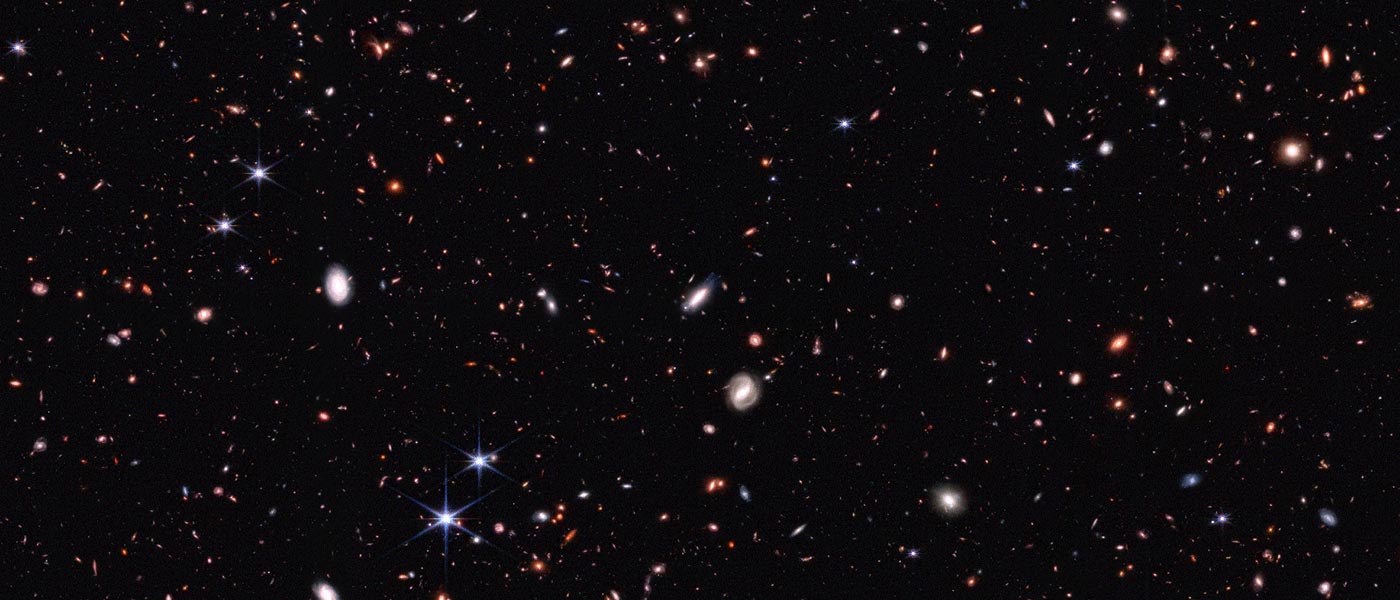
The prevailing theory of galaxy formation in the early universe suggested that the James Webb Space Telescope (JWST) would detect faint signals from small, primitive galaxies. However, new data challenge this idea, casting doubt on the widely accepted hypothesis that invisible dark matter helped the earliest stars and galaxies clump together.
Instead, observations show that the oldest galaxies are unexpectedly large and bright. This finding aligns with an alternative theory of gravity, according to research from Case Western Reserve University published recently in The Astrophysical Journal. The results call into question astronomers’ long-held understanding of how the universe’s first structures formed.
Evidence Supporting Modified Gravity
“What the theory of dark matter predicted is not what we see,” said Case Western Reserve astrophysicist Stacy McGaugh, whose paper describes structure formation in the early universe.
Rather than dark matter driving galaxy formation, McGaugh suggests that modified gravity could be the key. A theory called Modified Newtonian Dynamics (MOND), proposed in 1998, predicted that galaxy formation in the early universe occurred much faster than the Cold Dark Matter model, known as lambda-CDM, had anticipated.
The Role of JWST in Galactic Observations
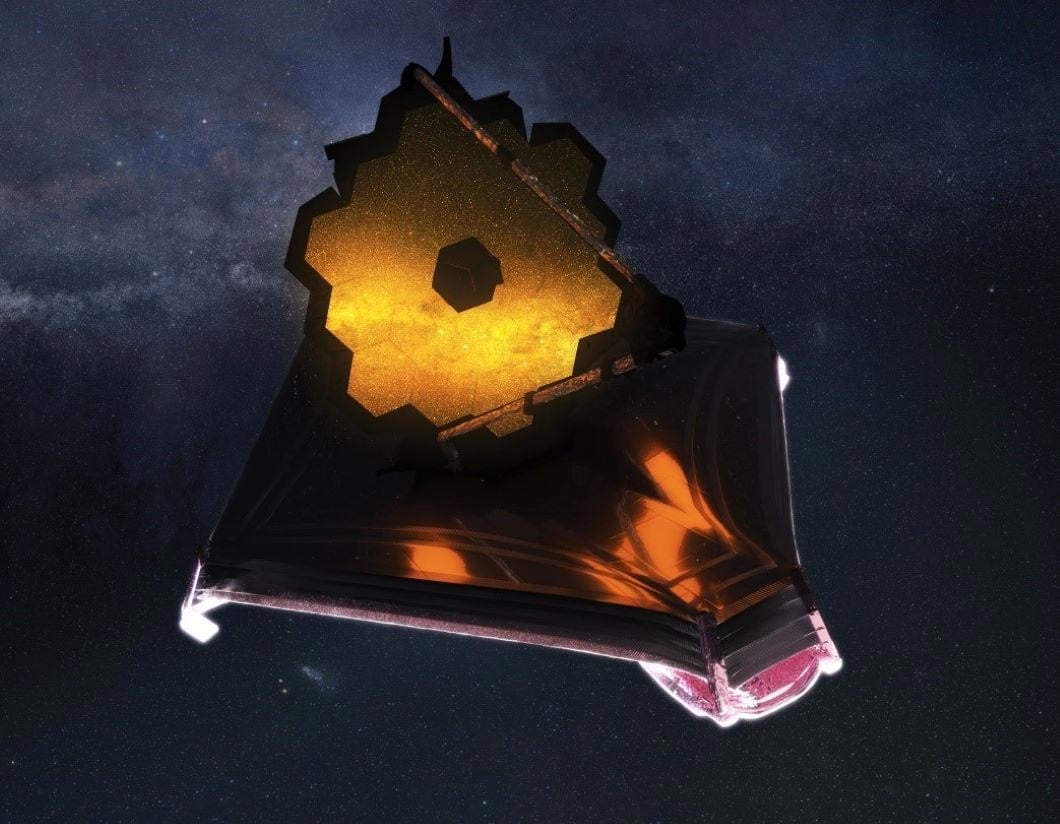
JWST was designed to answer some of the biggest questions in the universe, such as how and when did stars and galaxies form? Until it was launched in 2021, no telescope was able to see that deeply into the universe and far back in time.
Lambda-CDM predicts that galaxies were formed by gradual accretion of matter from small to larger structures, due to the extra gravity provided by the mass of dark matter.
“Astronomers invented dark matter to explain how you get from a very smooth early universe to big galaxies with lots of empty space between them that we see today,” McGaugh said.
The small pieces assembled in larger and larger structures until galaxies formed. JWST should be able to see these small galaxy precursors as dim light.
MOND’s Predictive Success
“The expectation was that every big galaxy we see in the nearby universe would have started from these itty-bitty pieces,” he said.
But even at higher and higher redshift—looking earlier and earlier into the evolution of the universe—the signals are larger and brighter than expected.
MOND predicted that the mass that becomes a galaxy assembled rapidly and initially expands outward with the rest of the universe. The stronger force of gravity slows, then reverses, the expansion, and the material collapses on itself to form a galaxy. In this theory, there is no dark matter at all.
The large and bright structures seen by JWST very early in the universe were predicted by MOND over a quarter century ago, McGaugh said. He co-authored the paper with former Case Western Reserve postdoctoral researcher Federico Lelli, now at INAF—Arcetri Astrophysical Observatory in Italy, and former graduate student Jay Franck. The fourth coauthor is James Schombert from the University of Oregon.
“The bottom line is, ‘I told you so,’” McGaugh said. “I was raised to think that saying that was rude, but that’s the whole point of the scientific method: Make predictions and then check which come true.” He added that finding a theory compatible with both MOND and General Relativity is still a great challenge.
Reference: “Accelerated Structure Formation: The Early Emergence of Massive Galaxies and Clusters of Galaxies” by Stacy S. McGaugh, James M. Schombert, Federico Lelli and Jay Franck, 12 November 2024, The Astrophysical Journal.
DOI: 10.3847/1538-4357/ad834d
Never miss a breakthrough: Join the SciTechDaily newsletter.
Follow us on Google and Google News.
15 Comments
There are now two camps of astronomers, the ones that adhere to the “big bang”, and the ones who adhere to “eternal universe”. Both have data to back them up and the battle rages on.
And I’m just standing aside, with popcorn, waiting to see which camp will win the right to forever call the opposing side “flatearthers”.
The losing camp in your description will have held the wrong view because of lack of evidence. Flatearthers hold their wrong view despite all the contradictory evidence.
That is a bold and notably unsupported claim since “big bang” theory – which currently implies an eternal universe, see e.g. “Scale factor (cosmology”, Wikipedia – is the consensus observation – see e.g. the cosmic background radiation from the hot big bang – and theory – see e.g. “Lambda-CDM model”, Wikipedia. Like man made global warming it is easy to see that 99+ % of publications is on it, however other claims we can see.
The Lambda-CDM reference describes significant alternative models which chose other constraints to work with. An “eternal universe” model is not on that list.
For myself, I reach for the popcorn when people start to mention fringe notions as if they were significant players on the field: the own goal rate goes high.
If the universe runs on a repetitive Big Bang/Big Crunch cycle, a view of String Theory suggests how large galaxies could exist at the beginning of a new Big Bang. In this case, stars on the periphery would have disappeared and the core will have more mass (gravity) than the cores of more recent galaxies.
But there isn’t such a cycle, since our universe started out with low entropy during inflation.
The explanation all (but some fringes) look for is within concordance cosmology.
By the way, a conventional explanation of early bright galaxies has been put forward before the latest MOND attempt:
“This indicates that most of these highly star-forming galaxies are intrinsically spherical rather than disk-shaped. Supported by numerical simulations, this discovery has shown us that the main mechanism behind the formation of these tri-dimensional galaxies (spheroids) is the simultaneous action of cold gas accretion and galaxy interactions. This process is thought to have been quite common in the early Universe, during the period when most spheroids were forming. ”
[“Astronomers witness the in situ spheroid formation in distant submillimetre-bright galaxies”, Kavli Institute]
I’ve stated before and will continue hereafter; observations that challenge theory should not be addressed by inventing magic and pixie dust. Lambda-CDM aught to be taken off the top shelf.
Here MOND is the magic and pixie dust.
LCDM is so far the simplest model – and for comparison, with 5 parameters the LCDM era is simpler than the 6 parameter inflation era preceding it – and we have both detected dark matter and vacuum “dark” energy by many different means which has enabled description.
Cold Dark Matter is the century old observation, now with many methods, and self evident description, see Wikipedia.
For more recent vacuum energy the list of detections goes from spontaneous emission over Lamb shift to late era cosmological expansion. [“Vacuum energy”, Wikipedia] Its description comes from effective quantum field theory (existence) in combination with inflation theory (magnitude, from Weinberg’s prediction of its value in anthropic inflationary multiverses).
Well, at least I didn’t go on about Topological Vortex Theory.
My skepticism for LCDM is based in the scientists, not the science. In 1980, my astronomy class were studying planetary development in hypothetical solar systems. I commented, “Wouldn’t it be cool to find a planet the mass of Jupiter orbiting it’s host star about the radius of Mercury?” My instructor said that couldn’t happen. “How do you know? We haven’t yet found any planets outside of our solar system.” At which point he grabbed the chalk, went to the blackboard, and wrote down all the reasons WHY that couldn’t happen, including some cool equations. As we scribbled all this info into our notes, I could see from the corners of my eyes all my friends giving me some nasty looks, and I knew what they were thinking; “…hey, you just gave us something else to study for on the big final! Thanks, buddy…!” I’d give anything to go back in time to be there when he first heard about 51 Pegasus.
Point being, we’re always just one new discovery away from blowing up long-held theory about our universe. Even the Earth-centric model was once established theory backed up by the math.
What If ? could the farthest galaxies actually be newly formed and not old like is believed . Red shift would dim if they were older , in other words the center of the universe is more like a dynamo and the motion to create the EMF / CDM is a heat sink vortex churning to a low negative then a field would build to initiate a quantum effect that chains over time to practical manifestations . Better to get out of the box rather than be a cat in a box .
And there was me thinking that the science on this matter – as with man-made CO2 emissions being responsible for climate change – was “settled
Clearly (IPCC please note) it never is.
Funny: I made my response to Boba before I read down here:
“Like man made global warming it is easy to see that 99+ % of publications is on [LCDM], however other claims we can see.”
As for science being based on observation and testing and hence has uncertainty both in data and possibility of revision, that is a feature and not the problem. E.g. man made global warming (with our CO2 emissions the largest factor) is now a robust observation beyond reasonable doubt: you can make a assumption-less spreadsheet data fit and see the correlation at 3 sigma.
Add in the viable (99+ % of papers) theory, and the possibility of mistakes plummet to something unreasonable to the global population: “More than half of people globally said they were more worried about climate change now than last year, and four out of five want their countries to strengthen commitments to address climate change.” [UNDP] If you can’t win, join: help us help you.
That was a 2024 global poll.
s/a assumption-less/an assumption-less
“He added that finding a theory compatible with both MOND and General Relativity is still a great challenge.” MOND was killed in 2017, it isn’t compatible with (special) relativity. The first multimessenger observation of a binary neutron star merger convinced everyone but some astronomers – that should know better – that it isn’t viable physics.
“Troubled Times for Alternatives to Einstein’s Theory of Gravity
New observations of extreme astrophysical systems have “brutally and pitilessly murdered” attempts to replace Einstein’s general theory of relativity.”
[Quanta Magazine, 2018]
How many times must we go down this dark back alley!?