

A new mathematical breakthrough sheds light on how tiny black holes could emerge from critical states of spacetime.
Black holes are often portrayed as cosmic giants, swallowing stars and shaping entire galaxies. But some of the most intriguing black holes predicted by physics could be far smaller than an atom. For decades, scientists have known that Einstein’s theory of relativity allows these microscopic black holes to form under extraordinary conditions. The problem was proving exactly how it happens.
Now, researchers from Goethe University Frankfurt and TU Wien have achieved a major breakthrough. Using an unusual mathematical approach, they have derived the first exact formula describing a process known as critical collapse, a phenomenon that sits at the boundary between ordinary spacetime and black hole formation.
The result provides a long-sought analytical explanation for behavior that had previously been seen only in computer simulations.
A Tipping Point Hidden in Spacetime
In everyday life, systems can sometimes reach a critical point where an almost imperceptible change triggers a dramatic transformation. Water freezing into ice is a familiar example.
“Sometimes a tiny, seemingly insignificant cause is enough to trigger a huge and dramatic change,” says Prof. Daniel Grumiller from TU Wien. “Take liquid water at zero degrees Celsius (32 degrees Fahrenheit), for example. A very small change is enough to make the water freeze. The water molecules then spontaneously arrange themselves into a regular pattern and form an ice crystal.”
Physicists believe spacetime can undergo a comparable transition.
According to Einstein’s theory of relativity, matter and energy shape the geometry of spacetime. Massive objects such as stars create strong distortions, while smaller objects produce weaker effects. Under very specific conditions, however, these distortions can organize themselves into an unexpectedly ordered structure.
Instead of remaining chaotic, spacetime develops a repeating pattern that researchers describe as a “spacetime crystal.”
“We say that spacetime is curved by mass,” explains Christian Ecker from the Institute for Theoretical Physics at Goethe University Frankfurt. “Large objects such as stars curve spacetime strongly — for example, we can observe this when light rays are deflected by massive stars. But smaller masses also produce spacetime curvature, just to a lesser extent.”
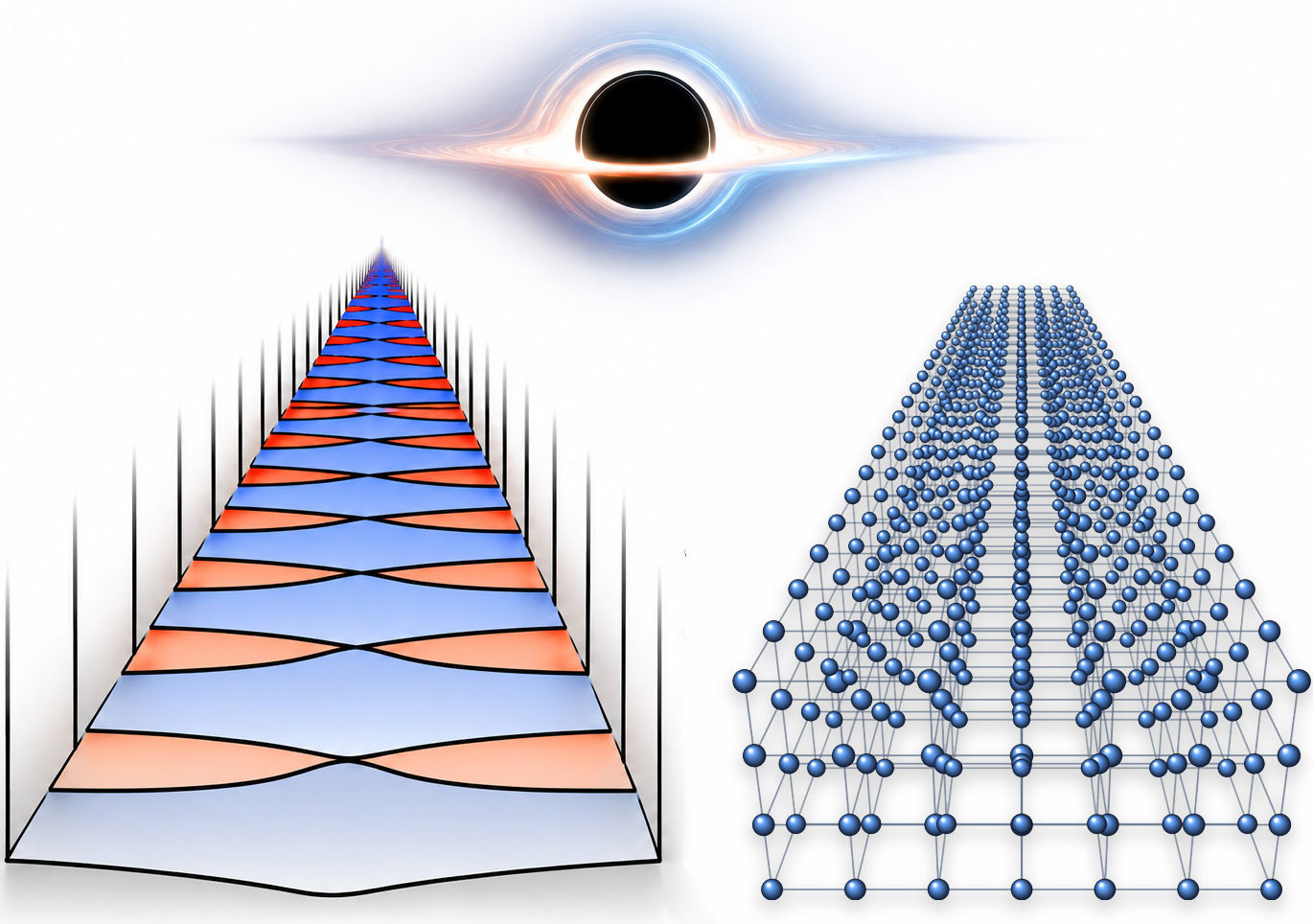
The Strange State Between Nothing and a Black Hole
A spacetime crystal occupies an unusual position in physics. It represents a delicate balancing point between two completely different outcomes.
“This spacetime crystal is a very peculiar and fascinating object,” says Grumiller. “It is a kind of intermediate state, an unstable point that can evolve in two different directions. It may simply dissolve again, leaving behind ordinary spacetime filled with freely moving particles. But if a tiny amount of energy is added, the evolution takes a completely different path: the inconspicuous spacetime crystal turns into a black hole.”
Physicists call this threshold behavior critical collapse. It marks the exact boundary between a system that disperses harmlessly and one that collapses into a black hole.
A Prediction That Waited Three Decades for an Explanation
The existence of critical collapse first gained attention in 1993, when computer simulations revealed a surprising pattern. No matter how the system was set up, black hole formation seemed to follow precise mathematical rules near the critical threshold.
The discovery hinted that a deeper theory was hiding beneath the simulations. Yet despite decades of effort, researchers could not derive an exact mathematical description.
That challenge has now been overcome.
The breakthrough came from looking at the problem in a way that initially seems counterintuitive: increasing the number of dimensions.
Why Infinite Dimensions Can Make Physics Simpler
“Our universe has four dimensions — three dimensions of space and one dimension of time,” explains Christian Ecker. “But in principle, nothing prevents us from writing down physical equations for a larger number of dimensions — five dimensions, forty-two dimensions, or even infinitely many.”
While adding dimensions sounds like it would make the mathematics impossibly complicated, the opposite can happen. Certain features of gravity become much simpler when physicists examine them in the limit of infinitely many dimensions.
By solving the problem in this hypothetical setting, the researchers were able to uncover mathematical relationships that remained hidden in ordinary four-dimensional spacetime.
The next challenge is translating those insights back into realistic models of our universe. If successful, the approach could become a powerful new tool for studying some of the most difficult problems in gravitational physics.
“Our technique turns out to be remarkably stable. Depending on the desired precision, we can systematically improve our formulas using additional approximation methods,” says Florian Ecker from TU Wien. “This gives us a new method for studying black-hole-related phenomena that could previously not be analyzed analytically.”
Reference: “Analytic Discrete Self-Similar Solutions of Einstein-Klein-Gordon at Large D” by Christian Ecker, Florian Ecker and Daniel Grumiller, 12 May 2026, Physical Review Letters.
DOI: 10.1103/qgl5-5l3t
Never miss a breakthrough: Join the SciTechDaily newsletter.
Follow us on Google and Google News.
3 Comments
thanks for this
Physicists have long known that black holes do not necessarily have to form from collapsing stars. Under the right conditions, spacetime itself can organize into a delicate, highly ordered state that sits on the threshold between ordinary space and something far more extreme.
VERY GOOD, Despite decades of effort, researchers could not derive an exact mathematical description.
Asking the physicist:
What is the scientific basis for what you know and don’t know?
Human society has entered the age of intelligence, and knowledge has long been openly accessible. The public are no fools—so-called peer-reviewed publications that spread pseudoscience, including Nature, Science, Nature Physics, Physical Review Letters, and others, had better mend their ways and rein themselves in as soon as possible.
Very Good, gravitation insights will shift our understanding of the universe immensely, keep going.