
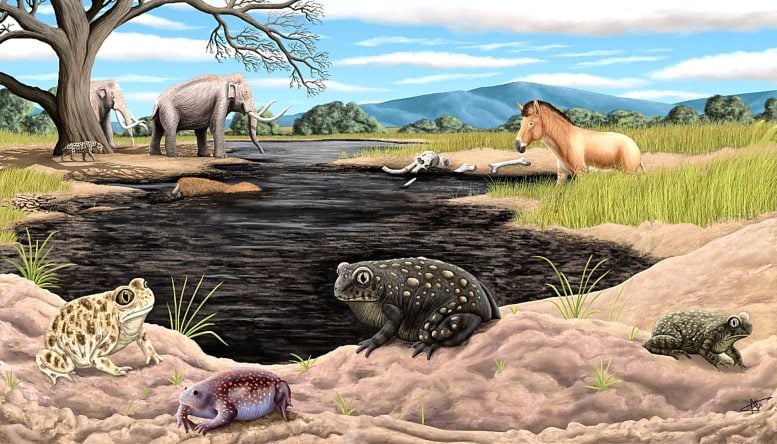
A tiny fossil overlooked for decades at La Brea Tar Pits has turned out to belong to a species previously unknown to science.
Researchers have identified Spea labreae, a previously unknown extinct spadefoot toad from La Brea Tar Pits and the first new species of extinct amphibian discovered from Ice Age Los Angeles. Only one other extinct Pleistocene amphibian has been reported from North America (a tree frog from Florida), making the find exceptionally rare and offering scientists a new window into the climate and environment of prehistoric Southern California.
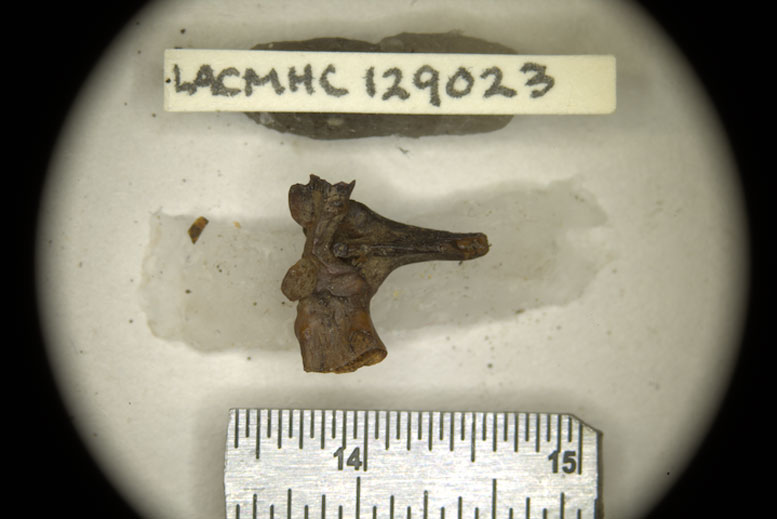
The fossil that led researchers to S. labreae is not a complete skeleton or even a skull. It is an incomplete sacro-urostyle, a bone at the base of a frog’s or toad’s spine where it connects with the hips. The specimen had originally been collected in the 1950s.
Dr. Alberto Cruz encountered it while reviewing La Brea Tar Pits’ relatively understudied collection of reptiles and amphibians. He was working there as a postdoctoral fellow and was not searching for new species.
“I’m really more of a paleoecologist, paleogeographer, not a taxonomist,” says Dr. Cruz.
But the bone did not look quite right for any known spadefoot toad.
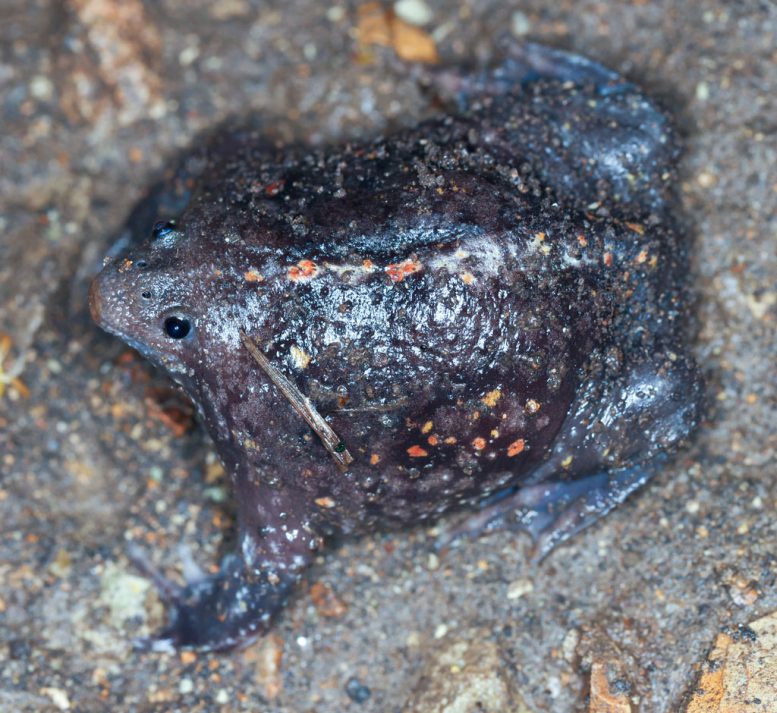
How Scientists Identified Spea labreae
His first suspicion was not that he had discovered a new species. Cruz wondered whether the unusual anatomy could have resulted from disease or an injury during the animal’s lifetime, an example of paleopathology. Comparisons with living spadefoot toads eventually convinced him that the differences were genuine.
“I reviewed and reviewed a lot of specimens until I was convinced. I thought, ‘Oh my gosh, this is a new species.’ This material is originally from the 1950s, but when you study it again, you can find gold in these specimens. It’s very cool.”
The discovery, described in the Journal of Vertebrate Paleontology, illustrates why old museum collections can remain scientifically valuable long after excavation. New questions, better comparative collections, and fresh expertise can turn specimens that seemed ordinary decades ago into evidence for species no one knew existed.
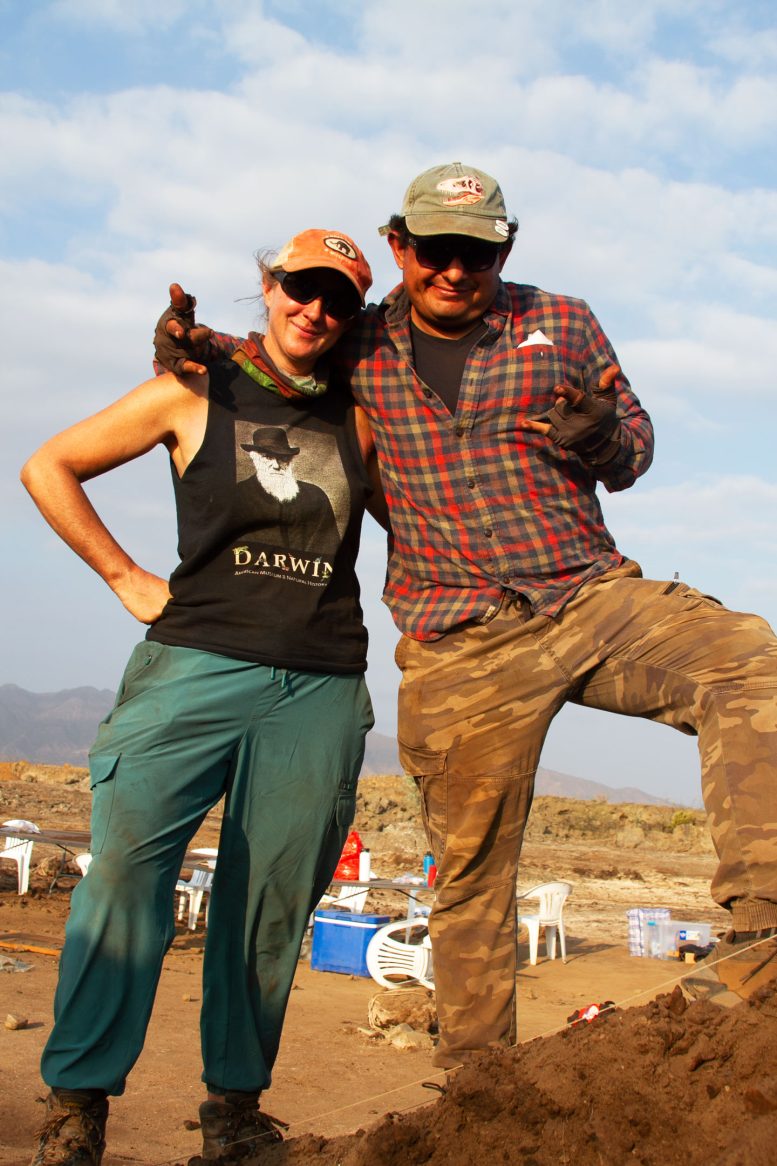
“It’s a great example of how we’re still finding new things at La Brea Tar Pits, even after a century of ongoing excavation and research,” says Dr. Emily Lindsey, Curator and Excavation Site Director at the Samuel Oschin Global Center for Ice Age Research at La Brea Tar Pits. “There’s definitely more to come.”
Tiny Amphibians Reveal Ancient Climate
La Brea is famous for animals built to command attention: mammoths, mastodons, dire wolves, and saber-toothed cats. Yet for reconstructing local environments, much smaller animals can sometimes provide more precise clues.
Amphibians are especially useful because they are closely tied to environmental conditions and generally do not travel enormous distances during their lives. Finding one in a fossil deposit can therefore offer unusually local information about the habitat and climate surrounding that site.
“If you change the environment, you change the vegetation, the climate is warmer or colder, it affects these animals directly,” says Cruz.
That sensitivity means changes in amphibian communities can help scientists track ecological shifts that might be harder to detect from wide-ranging large mammals alone.
Why La Brea Preserves Rare Fossils
Unfortunately, the same animals that can be so informative are also difficult to find as fossils. Frogs, toads, and salamanders have delicate skeletons that often break apart or disappear before fossilization can occur.
La Brea is different. Natural asphalt seeps have preserved an enormous range of organisms, from famous large mammals to much smaller vertebrates, plants, insects, and other remains. The site has produced millions of fossils and preserves a record extending across roughly the last 50,000 years. This unusual preservation is one reason scientists can study parts of the Ice Age ecosystem that would be missing at many conventional fossil sites.

The scarcity of fossil amphibians also raises an intriguing possibility. Species such as S. labreae may represent only a fraction of the amphibian and reptile diversity that disappeared during the Pleistocene. Others could have vanished without leaving sufficiently durable remains for paleontologists to recognize them.
Cruz examined the shape and dimensions of amphibian bones from the Tar Pits, a collection that had not received a detailed assessment in nearly 30 years. He then compared the fossils with 80 specimens held in the Herpetology Collections at the Natural History Museum of Los Angeles County and the Museum of Vertebrate Zoology at the University of California, Berkeley.
A Mexican Toad Once Lived in Los Angeles
Researchers also identified the first known southwestern U.S. fossil record of the Mexican burrowing toad, Rhinophrynus. That animal does not live anywhere near Los Angeles today. Its nearest modern populations are almost 2,500 km (about 1,550 miles) away in southern Mexico.
That enormous difference in range suggests that Ice Age Southern California supported environmental conditions very different from those found there now.
The disappearance of S. labreae and the retreat of the Mexican burrowing toad tell a broader story. As the last Ice Age ended and environments changed, amphibian communities changed with them. One species disappeared altogether, while the other survived only by shifting far to the south.
Reference: “A new extinct Pleistocene species of spadefoot toad and comments on the paleoecology and paleobiogeography of anurans from Rancho La Brea, California” by J. Alberto Cruz and Emily L. Lindsey, 4 August 2026, Journal of Vertebrate Paleontology.
DOI: 10.1080/02724634.2026.2689465
Never miss a breakthrough: Join the SciTechDaily newsletter.
Follow us on Google and Google News.