
The study traces dark matter using hydrogen in the Lyman-Alpha forest, revealing tensions between observed cosmic data and theoretical expectations, hinting at new particles or effects from black holes.
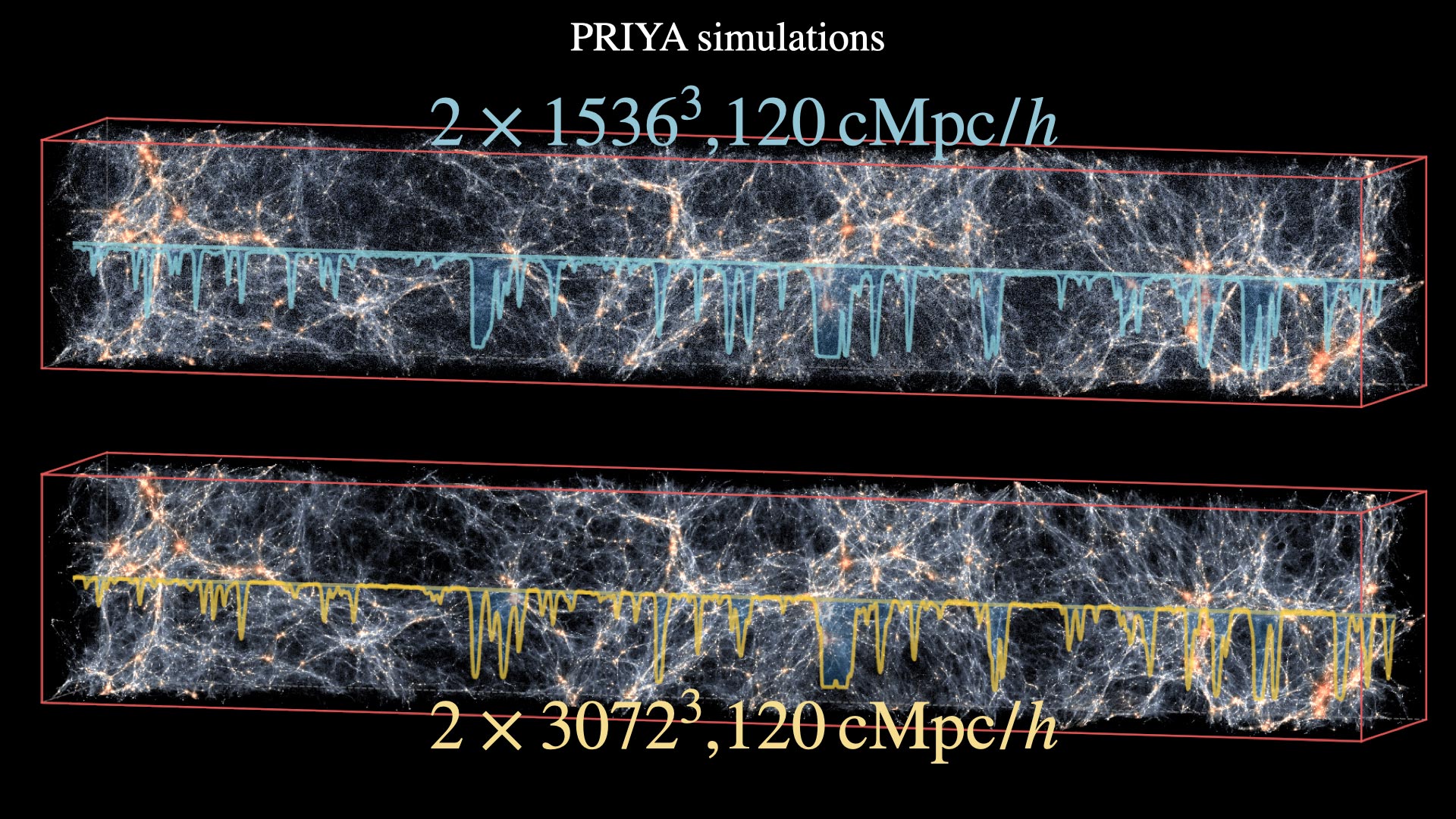
The sharp peaks observed in the wavelength distribution graph of a Lyman-Alpha forest indeed resemble a series of miniature trees. Each of those peaks represents a sudden drop in “light” at a specific and narrow wavelength, effectively mapping the matter that light has encountered on its journey to us.
Understanding Spectrograms and Cosmic Shadows
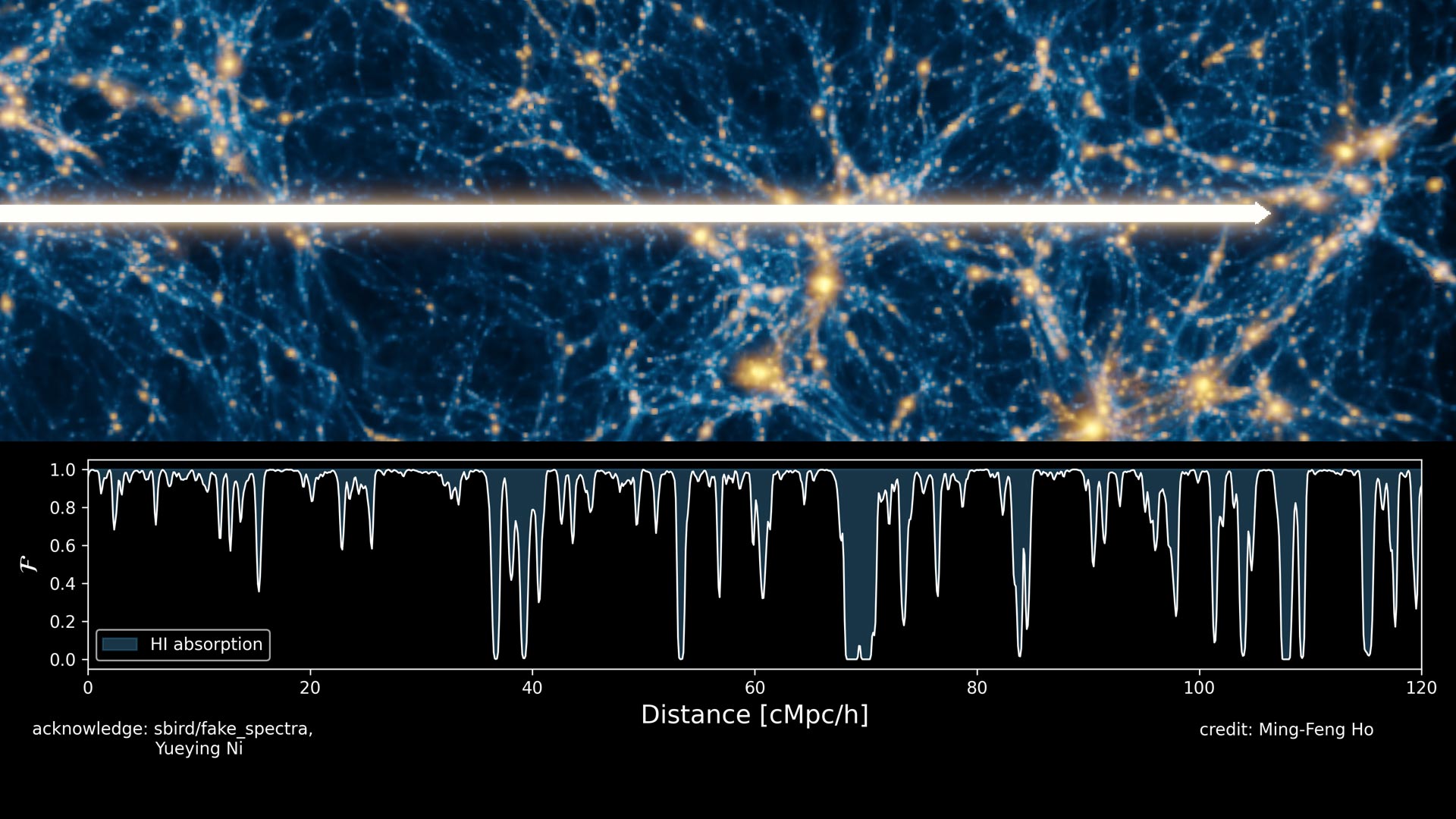
It’s somewhat like shadow puppetry, where we guess the character placed between the light and the screen based on its silhouette. The “shadow” of hydrogen molecules, suspended at vast distances between us and the light projected by intense luminous sources even further away, is well recognized by astrophysicists. The images used are called spectrograms. They are decompositions of radiation, which for simplicity we will call light, but which also includes frequencies our eyes cannot see, into the wavelength bands that compose it.
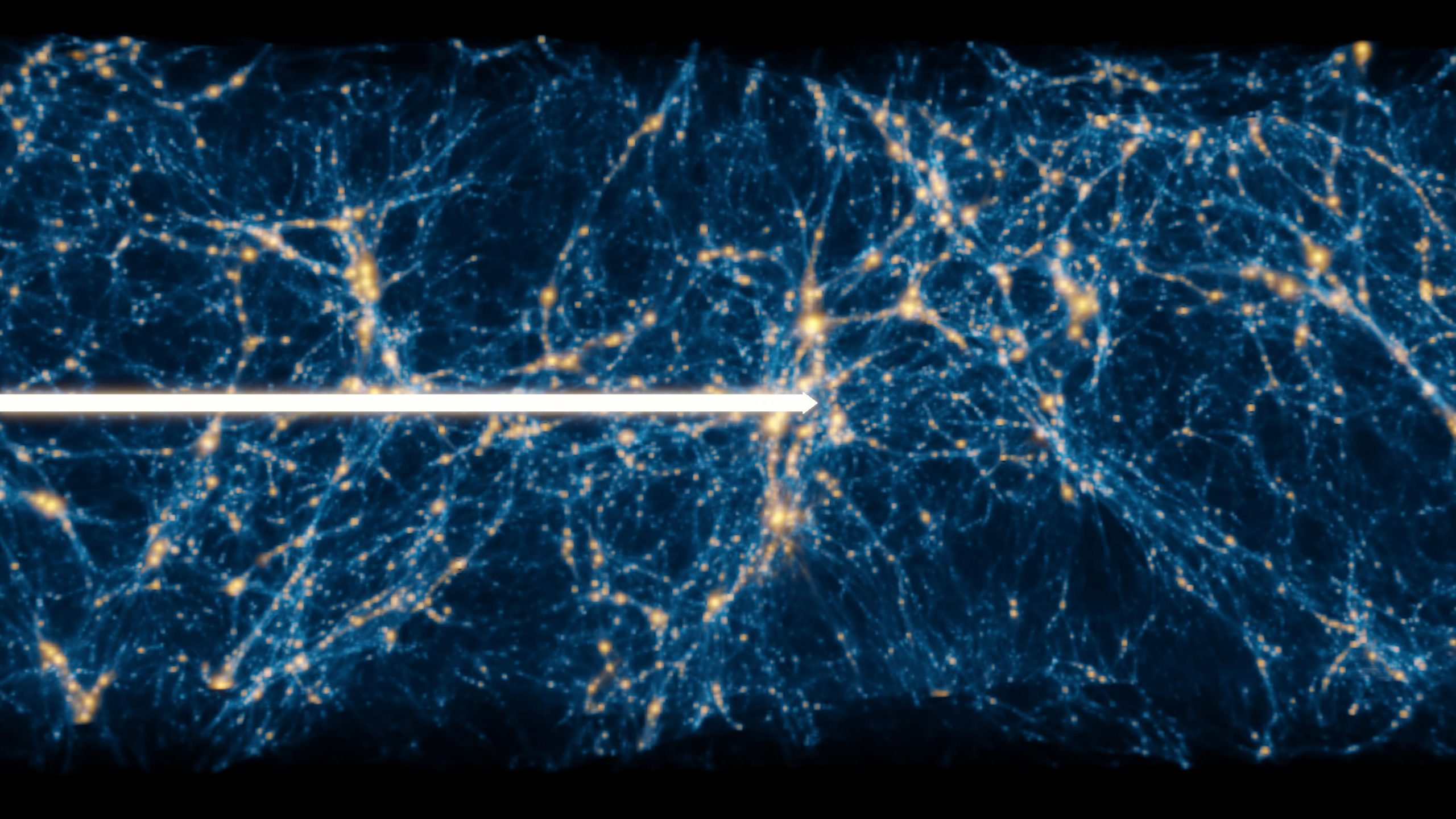
Artistic reconstruction of a photon’s path through intergalactic gas. Credit: UC Riverside
“It’s like a kind of very fine-grained rainbow,” explains Simeon Bird, a physicist at UC Riverside and one of the study’s authors. We see a rainbow when sunlight passes through a prism (or a water droplet) and is split into its “ingredients,” the wavelengths that mixed together appear as white light.
In spectrograms of light coming from cosmic sources like quasars, the same thing happens, only almost always some frequencies are missing, visible as black bands where the light is absent as if something had cast a shadow. These are the atoms and molecules that the light has encountered along the way. Since each type of atom has a specific way of absorbing light, leaving a sort of signature in the spectrogram, it is possible to trace their presence, especially that of hydrogen, the most abundant element in the universe.
Reconstruction of a photon’s path through intergalactic gas with the corresponding spectrogram. Credit: UC Riverside
Dark Matter Tracing with Hydrogen
“The hydrogen is useful because it’s like a tracer of dark matter,” Bird explains. Dark matter is one of the great challenges of current studies of the universe: we still don’t know what it is and we’ve never seen it, but we are certain it exists in great abundance—greater than that of normal matter. Bird and his colleagues used hydrogen to track it indirectly.
“It’s like sticking dye into a stream of water: the dye will follow where the water goes. Dark matter gravitates so it has a gravitational potential. The hydrogen gas falls into it, and you use it as a tracer of the dark matter. Where it is more dense there’s more dark matter. You can think of the hydrogen as the dye, and the dark matter as the water.”
Addressing Cosmic Tensions
Bird and his colleagues’ work does more than just monitor dark matter. In current studies of the cosmos, there are some so-called “tensions,” or discrepancies between observations and theoretical predictions.
It’s like opening a can of peeled tomatoes and finding glass marbles inside: based on your assumptions about how the world works, you would expect one thing, but surprisingly, the facts contradict you. Your common sense is equivalent to the theoretical models of physics: they lead you to predictions about the content, but then you look in the can and are stunned.
Two things could have happened: you have vision problems and those are indeed tomatoes, or your knowledge base is wrong (maybe you are in a foreign country and misread the label on the can). Something similar happens in the studies of the physics of the universe. “One of the current tensions is the amount of galaxies on small scales and at low redshifts,” Bird explains. The low redshift universe is the one relatively close to us.
“The current hypotheses to explain the discrepancy between observations and expectations are two: that there exists a never-before-seen particle of which we know nothing, or that something strange is happening with supermassive black holes inside galaxies. The black holes are stunting the growth of galaxies in some way, and so are messing up our structure calculations.”
Bird and his colleagues’ work has confirmed the validity of the tension (so indeed they are marbles and not tomatoes). It has also done something more. “The significance of this detection is still quite small, so it’s not completely convincing yet. But if this holds up in later data sets, then it is much more likely to be a new particle or some new type of physics, rather than the black holes messing up our calculations,” Bird concludes.
Reference: “Cosmological constraints from the eBOSS Lyman-α forest using the PRIYA simulations” by M.A. Fernandez, Simeon Bird and Ming-Feng Ho, 17 July 2024, Journal of Cosmology and Astroparticle Physics.
DOI: 10.1088/1475-7516/2024/07/029
Never miss a breakthrough: Join the SciTechDaily newsletter.
Follow us on Google and Google News.
4 Comments
“The significance of this detection is still quite small, so it’s not completely convincing yet. But if this holds up in later data sets, then it is much more likely to be a new particle or some new type of physics, rather than the black holes messing up our calculations,” Bird concludes.
VERY GOOD!
Please ask researchers to think deeply:
1. Why is there dark matter?
2. Is dark matter based on mathematical reasoning or imagination?
3. Can the physical reality observed in scientific experiments be called dark matter?
4. What are the differences and similarities between the speed of light described by relativity and the speed of light measured in scientific experiments?
and so on.
Scientific research guided by correct theories can help humanity avoid detours, failures, and pomposity. Please witness the exemplary collaboration between theoretical physicists and experimentalists (https://scitechdaily.com/microscope-spacecrafts-most-precise-test-of-key-component-of-the-theory-of-general-relativity/#comment-854286). Some people in contemporary physics has always lived in a self righteous children’s story world. Whose values have been overturned by such a comical and ridiculous reality?
We don’t know how much ‘normal’ matter there is in the universe. How many objects are in our solar system? How many stars in our galaxy? How many stars in distant galaxies, How many galaxies in the universe? To evoke exotic matter before we know all the known ‘normal’ matter is to create a problem that might not even exist. But is it even possible to calculate all the ‘normal’ matter in the first place in a universe that’s expanding beyond our observational limits? Assuming that it’s really expanding in the first place. Our perceptions have been wrong before.
If matter and antimatter are absolutely symmetrical, theoretically they are both ‘normal’ matter. Because if we examine matter and antimatter separately, you will not be able to define which is matter and which is antimatter. For example, topological vortex and its antivortex. The synchronous effect of countless topological vortices and their antivortices will make spacetime motion more complex and difficult to isolate.
Best of luck to you!
Would’ve been nice if the article stated exactly what the unexpected finding was.