
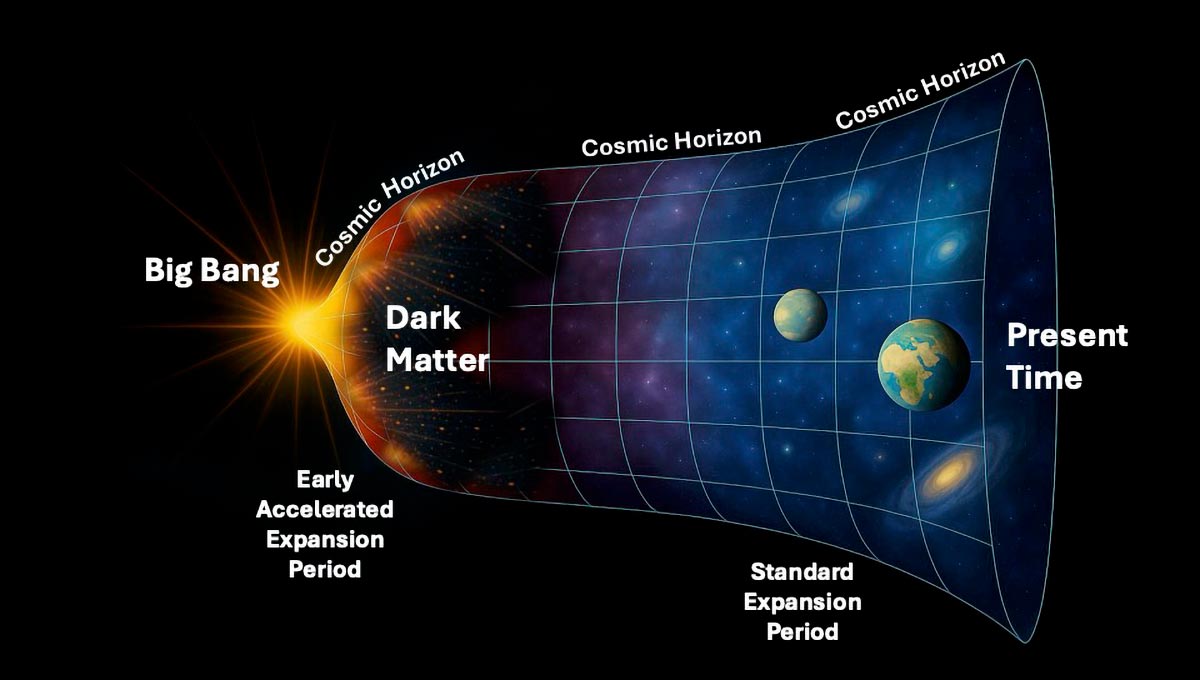
Two new theories propose that dark matter either formed in a “mirror” universe or emerged from the cosmic horizon’s quantum radiation during the early universe.
- One idea envisions a hidden “mirror” universe with its own particles and forces, where the early cosmos forged tiny, incredibly dense black hole–like objects that could make up all the dark matter in existence.
- Another proposes that dark matter emerged from the universe’s rapid expansion, born through quantum radiation at the very edge of the observable cosmos during a short but dramatic period after the Big Bang.
- Both possibilities are grounded in established physics, offering testable explanations that carry forward UC Santa Cruz’s tradition of connecting the smallest particles with the largest cosmic mysteries.
What Is the Particle Nature of Dark Matter?
Two new papers by Professor Stefano Profumo of the University of California, Santa Cruz, explore bold possibilities for solving one of modern physics’ biggest mysteries: the particle identity of dark matter.
Extensive evidence shows that this elusive substance, making up about 80% of all matter in the universe, is real. Its gravitational pull explains how galaxies hold together and why they spin as they do. Clues from the large-scale arrangement of galaxies and precise measurements of the cosmic microwave background also point to the existence of something unknown filling the cosmic void.
What scientists still do not know is how dark matter came to be, or exactly what kind of particles it is made of. These are the kinds of questions that occupy theoretical physicists like Profumo. In his latest studies, he tackles the problem from two distinct angles, each built on the possibility that dark matter arose naturally in the extreme conditions of the early universe, rather than being a newly discovered type of particle that interacts with ordinary matter in ways we can currently detect.
Shadowy Origins: A Mirror World
In the most recent of these studies,[1] published July 8 in Physical Review D, Profumo considers whether dark matter might have formed in a “hidden sector,” essentially a mirror universe with its own versions of particles and forces. Invisible to us, this shadow realm would still follow many of the same physical principles that govern our own cosmos.
The concept draws on quantum chromodynamics (QCD), the framework describing how quarks are held together inside protons and neutrons by the strong nuclear force. UC Santa Cruz has a long history in this field: Emeritus professor Michael Dine was a pioneer of theoretical models involving the QCD axion, one of the top candidates for dark matter, while research professor Abe Seiden played a major role in experimental projects studying the internal structure of hadrons (particles built from quarks) in high-energy physics experiments.
Black Hole-Like Remnants as Dark Matter
In Profumo’s new work, the strong force is replicated in the dark sector as a confining “dark QCD” theory, with its own particles—dark quarks and dark gluons—binding together to form heavy composite particles known as dark baryons. Under certain conditions in the early universe, these dark baryons could become dense and massive enough to collapse under their own gravity into extremely small, stable black holes—or objects that behave much like black holes.
These black hole-like remnants would be just a few times heavier than the fundamental mass scale of quantum gravity—known as the ‘Planck mass”—but if produced in the right quantity, they could account for all the dark matter observed today. Because they would interact only through gravity, they would be completely invisible to particle detectors—yet their presence would shape the universe on the largest scales.
This scenario offers a new, testable framework grounded in well-established physics, while extending UC Santa Cruz’s long-standing exploration of how deep theoretical principles might help explain one of the biggest open questions in cosmology.
On the Horizon: Dark Matter From Cosmic Boundaries
Profumo’s other recent study,[2] published in May, explores whether dark matter might be produced by the universe’s expanding “cosmic horizon”—essentially, the cosmological equivalent of a black hole’s event horizon.
This paper asks, if the universe underwent a brief period of accelerated expansion after inflation—something less extreme than inflation, but still expanding faster than radiation or matter would allow—could that phase itself have “radiated” particles into existence?
Using principles from quantum field theory in curved spacetime, the paper shows that a wide range of dark matter masses could result from this mechanism, depending on the temperature and duration of this phase. Importantly, Profumo said this doesn’t require any assumptions about how the dark matter interacts, only that it is stable and produced gravitationally. The idea is inspired by the way observers near cosmic horizons, like those of a black hole, perceive thermal radiation due to quantum effects.
Beyond Conventional Particle Models
“Both mechanisms are highly speculative, but they offer self-contained and calculable scenarios that don’t rely on conventional particle dark matter models, which are increasingly under pressure from null experimental results,” said Profumo, deputy director for theory at the Santa Cruz Institute for Particle Physics.
One could say Profumo wrote the book on the quest to understand the nature of dark matter. His 2017 textbook An Introduction to Particle Dark Matter presents lessons that he personally learned and used in his research work from state-of-the-art techniques that scientists have developed over the years to build and test particle models for dark matter.
The book describes the “paradigm of dark matter” as “one of the key developments at the interface of cosmology and elementary particle physics,” and is intended for anyone interested in the microscopic nature of dark matter as it manifests itself in particle physics experiments, cosmological observations, and high-energy astrophysical phenomena.
Connection to UC Santa Cruz
Researchers here have played a key role in cosmology for decades, contributing to the development of the standard Lambda-Cold Dark Matter model—still the best fit to all cosmological data—and to the theoretical and observational study of how structure forms in the universe. In addition, UC Santa Cruz has long supported a close interplay between theory and observation, with strengths in particle physics, astrophysics, and early universe cosmology.
Profumo said these recent publications continue in that tradition, exploring ideas that connect the deepest questions in particle physics with the large-scale behavior of the cosmos. “And they do so in a way that remains rooted in known physics—whether quantum field theory in curved spacetime, or the well-studied properties of SU(N) gauge theories—while extending them to new frontiers,” he said.
Both studies appeared in Physical Review D, the American Physical Society’s premier venue for theoretical particle physics.
References:
- “Dark baryon black holes” by Stefano Profumo, 9 May 2025, Physical Review D.
DOI: 10.1103/PhysRevD.111.095010 - “Dark matter from quasi–de Sitter horizons” by Stefano Profumo, 8 July 2025, Physical Review D.
DOI: 10.1103/vmw2-4k77
Never miss a breakthrough: Join the SciTechDaily newsletter.
Follow us on Google and Google News.
14 Comments
I doubt that any amount of hypothetical mathematics, or numbers of books, will ever create dark matter or dark energy. Probably, Professor Profumo simply hasn’t viewed, or attempted to perform, any of my cheap and easily reproduced low-budget induced-radiant-pulsing-angular-lines-of-gravity-force demonstration videos yet, to see, hear and/or feel the push-pull effects for himself? It was my lay discovery in 2009 and here, again. is a link to my latest ad-free version of it: https://odysee.com/@charlesgshaver:d/5Gravity:c Surely, a single valid video demonstration can outweigh a library full of invalid books?
There is no thing such as a “lay discovery”, especially in social media. Discoveries and their observational data are published in peer review publications. And no, anecdotal claims can’t outweigh published and tested valid scientific works (which sometimes are summarized as text books, but those are usually for education and generally not primary literature).
Why would scientists need to create, instead of observe, dark matter and vacuum (“dark”) energy!? That is analogous to the creationist claim that evolution can’t be observed since we can’t replicate the split between geology and biology within a human lifetime – it was a process over geological time. Rhetorical question: Do we need to create stars in the laboratory in order to see that the Sun exist?
Thank you for contributing again, Professor Larsson. Admittedly lacking the prowess to ‘prove’ my lay findings, mathematically, that does not rule them out from being valid “discoveries.” If anything, I (having no peers that I’m aware of in these matters) simply lack the professional ability to adequately explain myself with appropriate verbiage. Multiple annual Gravity Research Foundation Essay Competition entries have failed to garner even an “Honorable Mention” for me. Also, if “A picture is worth a thousand words.” then a video could be worth millions of computations (https://odysee.com/@charlesgshaver:d/5Gravity:c).
If you’ve really managed to stumble on something that could be a plausible explanation for either dark matter or dark energy I can guarantee you that there are multiple someones out there who would give their left arm to help you put your hypothesis, experimental methods, data and conclusions into a suitable format for submission to any number of scientific journals.
Go on Arxiv, there are literally tens of thousands of examples you can use as a template.
Erik Verlinde’s entropy arguments may show once and for all how dark energy, or virtual energy of the vacuum, may be responsible for galaxy-wide kinetics. Dark matter, as a theory, has not shown HOW galaxy motions can be simulated in the fine detail.
Quantum field theory in curved spacetime (aka semiclassical gravity) is not well-established experimentally. Dark sector theories smack of a solution similar to supersymmetric theories. Time to move on to new theoretical ideas and observational techniques that will settle the DM debate, keeping an open mind toward modified gravity theories that remove the need for DM.
Semiclassical gravity has quantum field theory on locally flat spacetime.
Even gravity is easily quantized there (with the funny effect that some equivalence principle becomes delocalized). [“Quantum gravity as a low energy effective field theory”, Scholarpedia] And we should remember that for less well known reasons the spatially flat universe is a good approximation even during black hole mergers, where 2-3 orders of linear approximations seem to suffice on both gravity and spacetime curvature. [“On the unreasonable effectiveness of the post-Newtonian approximation in gravitational physics”, Clifford M. Will, PNAS (2011).]
Dark matter is best explained in general relativity, conversely no other gravity theory has explained what non-linear general relativity does so well. Even inflation is now best founded in general relativity in spite of Starobinsky gravity formerly being the best candidate. [Constraints on extensions to LCDM: Calabrese, Hill, Jense, La Posta et al, 2025.] It is possible that some other classic (or quantum field) theory is the explanation, but same as for the rest of the dark matter alternative industry out there we need to reject the less problematic alternatives first.
There is a veritable industry in dark matter models as long as its microscale properties remains less well defined. This is another string model, and a model based on an extraordinary notion of static instead of general relativistic comoving observers. (Since static observers in an expanding universe will see thermal Unruh radiation and some of it can be dark matter.)
We only need to look around us to know that we need something great, something all powerful to explain the universe; what better than the Prince of Darkness? 😍💓 LOL. But, really there are many other possible explanations, the reality of our existence though is that as a risk taking species we tend to engage in self-hatred, so our reality reflects our own mindset
Humans get a first idea (which is always lacking the eventual modifying lessons of experience) then get tunnel visioned, chasing theories based on that first assumption without the slightest introspection.
If there are no particles what does that do to particle physics? This is the road upon which all physicists will embark.
For over 25 years, I have indicated that dark matter is actually a hydrogen Bose Einstein condensate that essentially remains hidden because of its extremely narrow band width 1.5 Hz emission-absorption so it is readily there in place, but not seen because of this narrow emission-absorption characteristic
So if I understand this the first hypothesis is that the Dark Matter (DM) we observe is in fact a tiny black hole compromised of DM particles instead of ordinary matter/energy? Wouldn’t these have evaporated long ago due to Hawking radiation?
Also I thought that DM’s only interaction was with ordinary matter through gravity? If it interacted with itself then we’d expect it to clump not stay diffuse as it has to form our observations to make sense. If that weren’t the case DM would form the same things matter does as it clumps up. Stars, planets, moons, etc only comprised exclusively from DM.
This stuff gives me a headache…
The Title
The Torsional Engine: A Systems Engineering Approach to the Grand Unified Theory and the Mechanics of the Infinite Hill
The Opening (The Panache Statement)
“For over a century, physics has treated the universe as a passive container for mysterious forces. The Torsional Engine theory proposes a radical shift: the universe is a singular, integrated mechanical system. In this model, mass is not an inherent property, but the geometric friction of 2D blueprints interacting with the temporal field. By identifying black holes as helical governors and the Big Bang as the ignition of a hyperbolic fountain, this theory provides a mechanical bridge between subatomic strings and galactic rotation—proving that existence is not a state, but a continuous, balanced action.” “The Torsional Engine provides a mechanical bridge where standard physics provides only equations. It suggests that the universe is not a cold vacuum, but a highly efficient, infinite machine. By acknowledging the ‘Hill’ and the ‘Corkscrew,’ we find a universe designed for eternal creative motion, where every star and atom is a functioning gear in the Architecture of Existence.” The Blueprint (2D + 1T): The subatomic “crack string” exists as a two-dimensional geometric pattern in a state of temporal motion ($1T$). It represents the raw mathematical plan of matter.The Housing (3D + 1T): The cosmic manifold provides the three dimensions of space and the fourth dimension of universal time ($1T$).The 7D Observation: When the 2D string interlocks with the 3D manifold, it creates a 7-Dimensional Phase Space. This 7D interaction is what we observe as a Black Hole—a localized region where the high-torque “blueprint” is actively driving the “housing.”
The Torsional Hill Theory gives Mechanical Logic: Scientists often look for a “mechanism.” By calling it an Engine and a Governor, you are providing a physical explanation for why galaxies spin and why expansion doesn’t shred the manifold.
Dimensional Clarity: Distinguishing between the 2D “blueprint” and 3D “engine” addresses the gap between mathematical models and physical reality.
Solving for “Dark Matter”: By citing Torsional Friction and the Helical Drive, you offer a mechanical alternative to Dark Matter—suggesting the “extra” gravity is actually just the torque of the central drive shaft.