
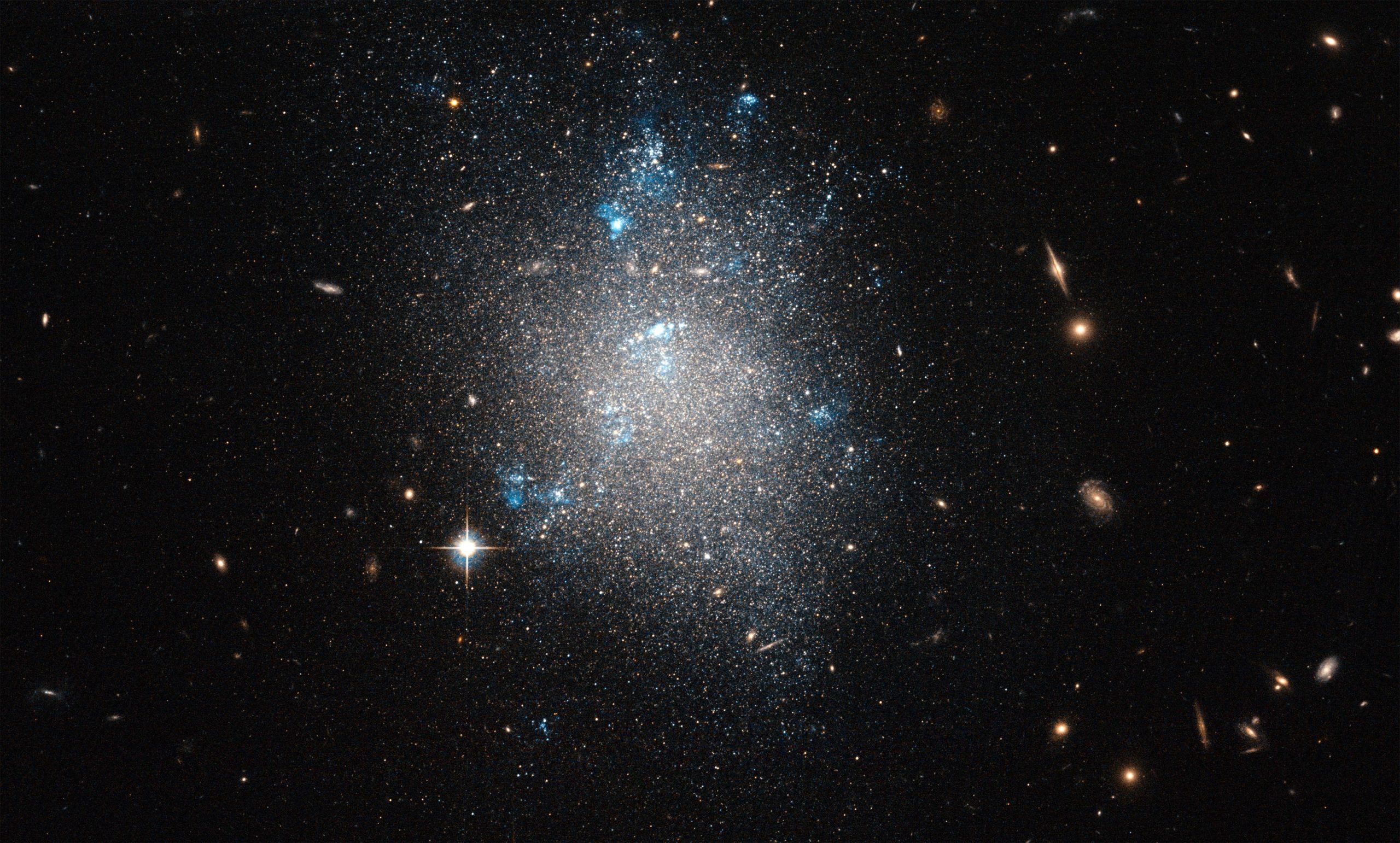
A new study suggests that failing to detect dark matter signals in some galaxies may not contradict evidence seen in our own.
The absence of a signal may itself carry meaning. That is the central idea of a new study published in the Journal of Cosmology and Astroparticle Physics (JCAP), which proposes a different way to search for dark matter. The research suggests scientists may not need to find identical “clues” everywhere in the universe to understand its nature.
The study focuses on a puzzling observation at the center of the Milky Way, where scientists have detected an excess of gamma radiation. One possible explanation is that this signal comes from dark matter particles annihilating each other. However, similar signals have not been clearly detected in other systems such as dwarf galaxies. According to the new work, that absence alone does not rule out a dark matter origin.
Instead, dark matter may not be a single type of particle. It could consist of multiple components that behave differently depending on their environment.
The galactic center gamma-ray excess
Dark matter is known to exist and is thought to make up a large portion of the universe, yet it has never been directly observed. Scientists infer its presence from the gravitational effects it has on visible matter, but its true nature remains unknown despite decades of research.
Many leading theories describe dark matter as particles. In some models, when two of these particles collide, they annihilate and produce high-energy radiation such as gamma rays. Astronomers search for this radiation as a possible signature.
“Right now there seems to be an excess of photons coming from an approximately spherical region surrounding the disk of the Milky Way,” explains Gordan Krnjaic, a theoretical physicist at the Fermi National Accelerator Laboratory (Fermilab) in the United States and one of the study’s authors. Observations from the Fermi Gamma-ray Space Telescope have revealed this excess, which could be linked to dark matter. However, other explanations remain possible, including emissions from astrophysical sources like pulsars.
To test these ideas, scientists look beyond our galaxy. “If certain theories of dark matter are true, we should see it in every galaxy, for example in every dwarf galaxy,” explains Krnjaic.
Dwarf galaxies
Dwarf galaxies are small and faint but contain large amounts of dark matter. They also have minimal background noise from stars and other radiation, making them ideal places to search for clear signals.
Standard particle-based models generally describe two possibilities for how dark matter annihilates. In the simplest case, the probability of annihilation is constant and does not depend on particle speed. If this is true, a signal seen in the Milky Way should also appear in other dark matter rich systems such as dwarf galaxies.
In another scenario, the annihilation rate depends on particle velocity. Because dark matter particles in galaxies move slowly, annihilation would be extremely rare, making any signal very difficult to detect anywhere.
Under these assumptions, the lack of a signal in dwarf galaxies makes it harder to link the Milky Way’s gamma-ray excess to dark matter.
Krnjaic and his colleagues propose a different explanation that could resolve this tension while keeping dark matter as a viable source of the Milky Way signal.
Two different particles
“What we’re trying to point out in this paper is that you could have a different kind of environmental dependence, even if the annihilation probability is constant in the center of the galaxy,” explains Krnjaic. “Dark matter could straightforwardly be two different particles, and the two different particles need to find each other in order to annihilate.”
In this model, the likelihood of annihilation depends on how much of each particle type is present. Galaxies like the Milky Way might contain similar amounts of both components, increasing the chances of interaction. In dwarf galaxies, one component could dominate, reducing the likelihood that the two types meet.
“In this way, you get very different predictions for the emission,” explains Krnjaic.
This approach offers a more flexible alternative to standard models. It allows scientists to explain why gamma rays might be detected in the Milky Way but not in dwarf galaxies, without dismissing dark matter as the source.
Future observations from the Fermi Gamma-ray Telescope could help clarify the picture. Current data on dwarf galaxies is still limited. Detecting gamma rays in these systems would suggest a more balanced mix of dark matter components, while continued absence might indicate that one type is less common. However, these interpretations are not definitive and depend on other astrophysical factors, meaning further observations will be needed to test the model more thoroughly.
Reference: “dSph-obic dark matter” by Asher Berlin, Joshua W. Foster, Dan Hooper and Gordan Krnjaic, 9 April 2026, Journal of Cosmology and Astroparticle Physics.
DOI: 10.1088/1475-7516/2026/04/017
Never miss a breakthrough: Join the SciTechDaily newsletter.
Follow us on Google and Google News.
4 Comments
How does this idea fit with the bullet cluster ? In that anomaly the dark matter doesnt interact at all.
You don’t have a true cosmology yet – AND you suffer the always human frailty of believing the first thing someone told you and getting tunnel visioned trying to prove it out (I suppose to win accolade and acknowledgement from others?) – WHEN that first thing you were told was wrong. The first idea is always wrong – cause it was some dumbbell’s first idea! Ya understand?
Hence we have perfectly good minds building a house of cards –
“Dark matter is known to exist and is thought to make up a large portion of the universe…” Not! Dark matter is only theorized to exist. My own “insights” since 2009 and four experiments/video demonstrations since 2012 (https://odysee.com/@charlesgshaver:d/5Gravity:c being my most recent, June 2025) confirm for me that gravity is induced to radiate from all matter in expanding lines of force to the extremes of the universe by some still unidentified higher form of energy; pulsing and angular (forming generally spherical fields) and intensified in all rotating objects within ambient fields, accounting for cosmic objects remaining on the outer edges of spiral galaxies at unexpected velocities. If there is “…an excess of photons coming from an approximately spherical region surrounding the disk of the Milky Way,” that too might be a result of intensified gravity in rotating cosmic objects, including entire solar systems. My lay demonstrations are low-budget at-home ones, cheap and easy to replicate for those of scientific curiosity and objectivity with minimal resources and skills.
I see an amazing amount of handwaving. So this is a theory with zero data? I don’t call that a Theory, just a speculation.