
Close Menu
    Facebook X (Twitter) Instagram
    SciTechDaily
    • Biology
    • Chemistry
    • Earth
    • Health
    • Physics
    • Science
    • Space
    • Technology
    Facebook X (Twitter) Pinterest YouTube RSS
    SciTechDaily
    Home»Space»Gravitational Waves Expose Hidden Dark Matter Around Black Holes
    Space

    Gravitational Waves Expose Hidden Dark Matter Around Black Holes

    By University of AmsterdamDecember 9, 2025No Comments3 Mins Read
    Facebook Twitter Pinterest Telegram LinkedIn WhatsApp Email Reddit
    Share
    Facebook Twitter LinkedIn Pinterest Telegram Email Reddit
    Gravitational Waves Art Illustration
    New theoretical work suggests that the faint ripples produced as small black holes spiral into larger ones could quietly expose the invisible structures surrounding galactic centers. Credit: Stock

    Researchers have created a fully relativistic model showing that gravitational waves might carry hidden clues about dark matter near massive black holes.

    New research from scientists at the University of Amsterdam outlines how gravitational waves produced by black holes could offer a way to detect dark matter and learn more about its behavior. Central to the study is a model based on Einstein’s general relativity that describes, with high precision, how a black hole interacts with nearby material.

    Rodrigo Vicente, Theophanes K. Karydas, and Gianfranco Bertone of the UvA Institute of Physics (IoP) and the GRAPPA centre for Gravitation and Astroparticle Physics Amsterdam reported their findings in Physical Review Letters. Their research presents a refined method for predicting how dark matter near black holes can influence the gravitational waves that these systems generate.

    Extreme mass-ratio inspirals

    The study examines extreme mass-ratio inspirals, or EMRIs: systems in which a compact object that is relatively small (for example, a black hole created from the collapse of a single star) orbits and gradually moves inward toward a far more massive black hole often located at a galaxy’s center. During this inward journey, the smaller body produces a continuous gravitational-wave signal.
    Two Black Holes Gravitational Waves
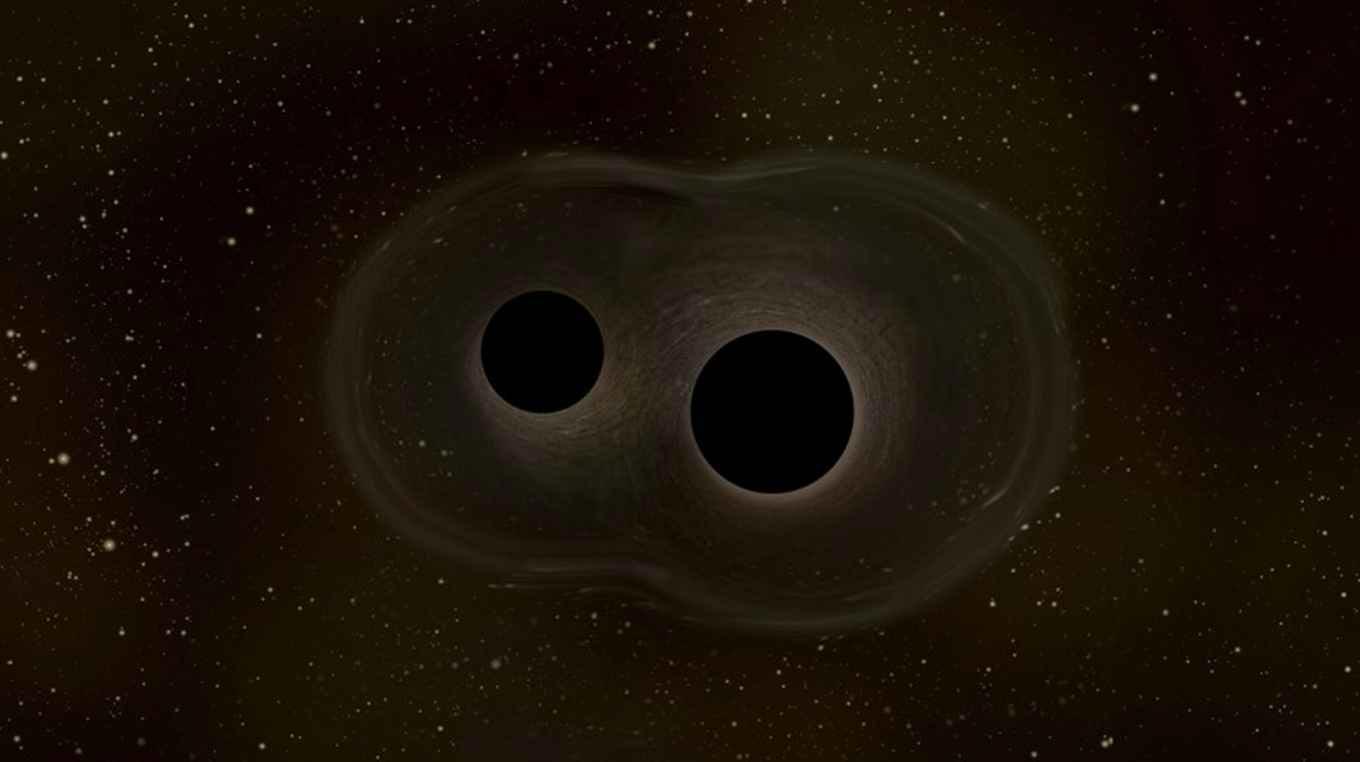
    As two black holes orbit each other and merge, they emit gravitational waves that can be detected with instruments on Earth. By studying the detailed shape of these waves, scientists can probe the environment surrounding black holes and, in the future, learn more about the distribution and fundamental nature of dark matter. Credit: ESA

    Future space missions such as the European Space Agency’s LISA space antenna, planned for launch in 2035, are expected to record these signals for months or even years, tracking hundreds of thousands to millions of orbital cycles. If modelled accurately, these “cosmic fingerprints” can reveal how matter – especially the mysterious dark matter that is thought to make up most of the matter in the Universe – is distributed in the immediate surroundings of massive black holes.

    A relativistic point of view

    Before missions like LISA begin taking data, it is crucial to predict in detail what kinds of signals we should expect and how to extract as much information as possible from them. Until now, most studies have relied on simplified descriptions of how the environment affects EMRIs. The new paper by the IoP/GRAPPA physicists closes this gap for a broad class of environments. It provides the first fully relativistic framework – meaning that it uses Einstein’s theory of gravity in full, instead of simpler approximations based on Newtonian gravity – to describe how the surroundings of a massive black hole modify an EMRI’s orbit and the resulting gravitational waves.

    The study focuses in particular on dense concentrations of dark matter – often called “spikes” or “mounds” – that may form around massive black holes. By embedding their new relativistic description into state-of-the-art waveform models, the authors show how such structures would leave a measurable imprint on the signals recorded by future detectors. This work represents a fundamental step in a long-term program that aims to use gravitational waves to map the distribution of dark matter in the Universe and shed light on its fundamental nature.

    Reference: “Fully Relativistic Treatment of Extreme Mass-Ratio Inspirals in Collisionless Environments” by Rodrigo Vicente, Theophanes K. Karydas and Gianfranco Bertone, 17 November 2025, Physical Review Letters.
    DOI: 10.1103/s4wh-x6c4

    Never miss a breakthrough: Join the SciTechDaily newsletter.
    Follow us on Google and Google News.

    Astronomy Astrophysics Black Hole Cosmology Dark Matter Gravitational Waves Popular University of Amsterdam
    Share. Facebook Twitter Pinterest LinkedIn Email Reddit

    Related Articles

    New Study Suggests Gravitational Waves May Have Created Dark Matter

    Chaotic Triple Drama: Black Hole Billiards in the Centers of Galaxies

    Ripples in the Fabric of Space and Time Offer New Clues to the Shape of Black Holes

    Lopsided “David and Goliath” Black Hole Merger With an Oddball Origin Story

    Massive “Bang” in LIGO and Virgo Gravitational-Wave Detectors: Fabric of Space-Time Shaken by Binary Black Hole Merger

    Quick ‘Bang’ Signals the Most Massive Gravitational-Wave Source Ever Detected

    LIGO Detects Merging Ripples in Space and Time

    New Discovery Challenges Dark Matter, Stellar Acceleration Models

    New Research Shows LIGO’s Twin Black Holes Might Have Been Born Inside a Single Star

    Leave A Reply Cancel Reply

    • Facebook
    • Twitter
    • Pinterest
    • YouTube

    Don't Miss a Discovery

    Subscribe for the Latest in Science & Tech!

    Trending News

    Monster Storms on Jupiter Unleash Lightning Beyond Anything on Earth

    Scientists Create “Liquid Gears” That Spin Without Touching

    The Simple Habit That Could Help Prevent Cancer

    Millions Take These IBS Drugs, But a New Study Finds Serious Risks

    Scientists Unlock Hidden Secrets of 2,300-Year-Old Mummies Using Cutting-Edge CT Scanner

    Bread Might Be Making You Gain Weight Even Without Eating More Calories

    Scientists Discover Massive Magma Reservoir Beneath Tuscany

    Europe’s Most Active Volcano Just Got Stranger – Here’s Why Scientists Are Rethinking It

    Follow SciTechDaily
    • Facebook
    • Twitter
    • YouTube
    • Pinterest
    • Newsletter
    • RSS
    SciTech News
    • Biology News
    • Chemistry News
    • Earth News
    • Health News
    • Physics News
    • Science News
    • Space News
    • Technology News
    Recent Posts
    • 289-Million-Year-Old Reptile Mummy Reveals Origin of Human Breathing System
    • New Brain Discovery Challenges Long-Held Theory of Teenage Brain Development
    • Sharks Are Overheating as Warming Oceans Push Them to the Edge
    • Scientists Discover Plants “Scream” – We Just Couldn’t Hear Them Until Now
    • 25-Year Study Uncovers Hidden Paths and Early Warning Signs of Blood Cancer
    Copyright © 1998 - 2026 SciTechDaily. All Rights Reserved.
    • Science News
    • About
    • Contact
    • Editorial Board
    • Privacy Policy
    • Terms of Use

    Type above and press Enter to search. Press Esc to cancel.