
Ocean giants are overheating—and climate change is leaving them with nowhere to go.
A new study shows that some of the ocean’s most powerful predators are running hotter than scientists expected, and it could come at a growing cost. These animals already require large amounts of energy to survive, and now they face a difficult combination of warming seas and shrinking food supplies. Researchers describe this situation as “double jeopardy,” where both environmental changes and biological demands are working against them.
Warm-Bodied Fish Use Far More Energy
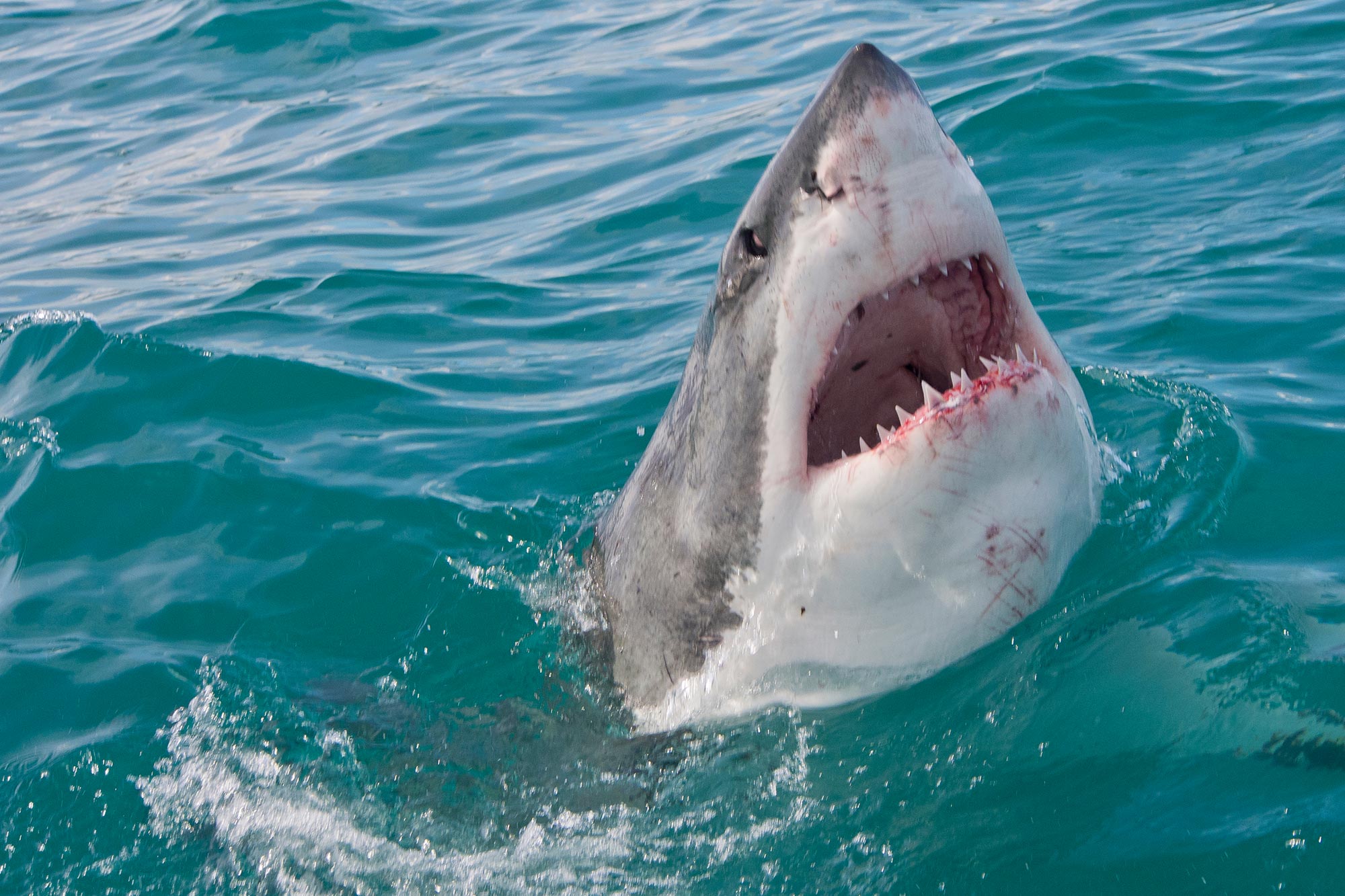
The research, led by Trinity College Dublin in partnership with the University of Pretoria’s (UP) Faculty of Veterinary Science, found that warm-bodied fish such as tunas and certain sharks, including the Great White and the basking shark, burn nearly four times more energy than cold-blooded fish of similar size. As ocean temperatures rise, this high energy use increases the risk of overheating, which could limit where these animals can live and push them toward cooler waters near the poles.
What Makes Mesothermic Fish Different
The study, published in the journal Science, focuses on “mesothermic” fishes. These are a rare group, making up less than 0.1% of all fish species, that can retain body heat and keep parts of their bodies warmer than the surrounding water. This trait has evolved multiple times in sharks and tunas, helping them swim faster, travel long distances, and hunt more effectively.
Tracking Heat and Metabolism in the Wild
To measure the cost of this high-performance lifestyle, the researchers created a new method to estimate metabolic rates in fish swimming freely in the ocean. They analyzed biologging data from small sensors that record body and water temperatures, allowing them to calculate how much heat fish produce and lose in real time. These findings included data from large basking sharks weighing up to 3.5 tonnes, combined with hundreds of laboratory measurements from smaller species.
Dr. Nicholas Payne from Trinity’s School of Natural Sciences, the study’s lead author, said: “The results were really quite striking – after accounting for body size and temperature, we found that mesothermic fishes use about 3.8 times more energy than similarly sized ‘ectothermic’, or ‘cold-blooded’ fishes. In addition, a 10°C increase in body temperature more than doubles a fish’s routine metabolic rate which, in practical terms, means warm-bodied predators must consume far more food to fuel their lifestyle.”
Why Larger Fish Struggle to Stay Cool
Dr. Payne explained that rising energy needs are only part of the challenge. “But that heighted energy demand is only part of the story because as fish grow larger their bodies generate heat faster than they can lose it,” he said. “This creates a mismatch driven by basic geometry and physics because bigger bodies retain heat more effectively, and in mesotherms, high metabolic rates amplify this effect.”
Because of this imbalance, larger fish become increasingly “warm-bodied” as they grow. This scaling effect makes it harder for them to release heat, creating a greater risk of overheating that could affect their survival.
Heat Limits and Habitat Constraints
Professor Andrew Jackson, senior author of the study, said the team used their data to identify “heat-balance thresholds.” These thresholds mark the water temperatures at which large fish can no longer shed heat fast enough to maintain stable body temperatures.
“Based on the data, we were able to create theoretical ‘heat-balance thresholds’, which are the water temperatures above which large fish cannot shed heat quickly enough to maintain stable body temperatures without changing their behavior or physiology. For example, a 1-tonne warm-bodied shark may struggle to remain in heat balance in waters above about 17°C.”
“Above such thresholds, fish must slow down, alter blood flow, or dive into cooler depths to avoid dangerous warming, but that comes at a cost too; it might be harder to find food, or catch it, for example, especially if your main weapon is speed and power.”
Changing Ocean Patterns and Migration
These results help explain long-standing patterns in the ocean. Large fish are often found in cooler waters, at higher latitudes, or at greater depths. Many species also migrate seasonally to stay within favorable temperature ranges.
Looking ahead, scientists expect that warming oceans will reduce suitable habitats for large mesothermic fish, especially during summer. Some species, such as Atlantic bluefin tuna, can temporarily cope by diving deeper or increasing heat loss, but even these strategies may not be enough if surface waters continue to warm.
Climate Change Tightens the Pressure
Dr. Snelling, UP, said: “This research shows that being a high-performance predator in the ocean comes at a greater cost than we previously appreciated. As the oceans warm, these species are being pushed closer to their physiological limits, which could have consequences for where they can live and how they survive.”
He added: “What’s particularly concerning is that these animals are already operating on a tight energy budget, and climate change is narrowing their options even further. Understanding these constraints is essential if we want to predict how marine ecosystems will shift in the coming decades.”
A Double Threat for Marine Giants
“The implications are really sobering as this new finding essentially places these animals in ‘double jeopardy,” said Dr. Payne. “Many mesothermic fishes are already heavily impacted by overfishing of themselves and also their prey species, so their elevated energy needs make them especially vulnerable when their food becomes scarce.”
He also pointed to past evidence. “Fossil evidence suggests that warm-bodied marine giants, like the infamous extinct Megalodon shark, suffered disproportionately during past climate shifts when seas changed, and today’s oceans are changing at unprecedented speeds, so the alarm bells are ringing loudly at this point.”
Why This Research Matters
This study offers a new way to identify which species are most at risk as the planet warms. It shows that many of the ocean’s fastest and most powerful predators may also be among the most physically constrained. As climate change continues, understanding how these animals manage heat could play a key role in protecting them and maintaining healthy marine ecosystems.
Reference: “Mesothermic fishes face high fuel demands and overheating risk in warming oceans” by Nicholas L. Payne, Edward P. Snelling, Ignacio Peralta-Maraver, David E. Cade, Taylor K. Chapple, Alexandra G. McInturf, Yuuki Y. Watanabe, David W. Sims, Nuno Queiroz, Ivo da Costa, Lara L. Sousa, Jeremy A. Goldbogen, Haley R. Dolton and Andrew L. Jackson, 16 April 2026, Science.
DOI: 10.1126/science.adt2981
Never miss a breakthrough: Join the SciTechDaily newsletter.
Follow us on Google and Google News.
10 Comments
Get a breathalyzer test next time prior to publishing more nonsense
Give it up! You can’t really be that stupid. Wake up, the climate change hoax is dead!
Supposedly sharks evolved 450 million years ago. You are trying to tell me that the earth was never hotter than it is now? The sharks survived much worse than todays temperatures!
Not sure how to react to the negative comments.
The earth and all the planets are moving differently than they did years ago.
Climate change is real.
And we are a major cause of damage to the earth.
I don’t believe we should be using tax money to fly around the moon. Let the billionaire pay, if that is what they….want!
This plant is still undiscovered. Beautiful and amazing.
It is fighting back. Stop breading animals. Care for and love the ones who need a home. Millions!
Sincerely
Sharks have been around for tens of millions of years and in that time the worlds oceans have been warmer and cooler. This is just another puff piece by climate terrorists trying to get us to buy into expensive so called “remedies” to line their pockets.
Wouldn’t it make sense that if these mesothermic fish eat more to raise their body temperatures that now they’d eat less because of the mildly warmer water? I don’t mean to sound like a jerk or anything. But 95% of what scientists and biologists thought they knew about great white sharks has now been proven wrong, they only hunt in shallow water, murky water is when they bite humans, they hunt more after dusk! All these assumptions were not only wrong but it was the complete opposite! Just the fact that they would say any of this, it’s garbage.If these sharks have lived over four hundred and fifty million years, they’ve gone through five ice ages, they’ve gone through whether temperatures that were much hotter and much colder.The fact is, sharks live in the ocean.They can adapt to cold or hot water!
Written by a moron. Sharks hav3 migratory pattern, tak8ng them to cooler waters for feeding, breeding, and shark needs. Sharks developed these migrations in response to survival needs, through extremely warm and extremely cool periods. Whomever wrote this article needs to leave article writing to the more intelligent, less alarmist people.
This is hilarious. “Science” has taken core samples of ice and found our planet was at it’s coldest in thousands of years at the time we started recording. We are still 2 degrees cooler than medieval times. At some point we just need to stop the nonsense. Sharks have evolved over hundreds of millions of years and are not overheating when the water has been significantly hotter (and cooler) thousands of times over that period. We are 18 to 27 degrees Fahrenheit COLDER than during the tertiary period when these same sharks didn’t die off. Enough!
In addition to the above reasonable complaints about the article’s claim, the global mean atmospheric temperature has only increased about 1 deg C in the last century. Largely because of the difference in the specific heat capacity of water (it takes more energy to increase water temperature than air temperature the same amount) the oceans are only warming at about half the rate of the air.
This is almost as laughable as the claim about the teeth of sharks being in danger because of so-called ‘ocean acidification.’
I agree with the others. This is a climate-nutter scare piece. Along with disinformation like this is that they describe the ocean surface temp, not the temp at depth. I was diving this last weekend and the surface temp was 78 but the temp down on the reef was 72. It’s always like that, cooler at depth. Oh, and we saw a large lemon shark that looked like it was doing just fine. One thing I will concur with, however, is the general over-harvesting of the ocean. The reefs are much more fished out than they were in the 80’s and 90’s.