
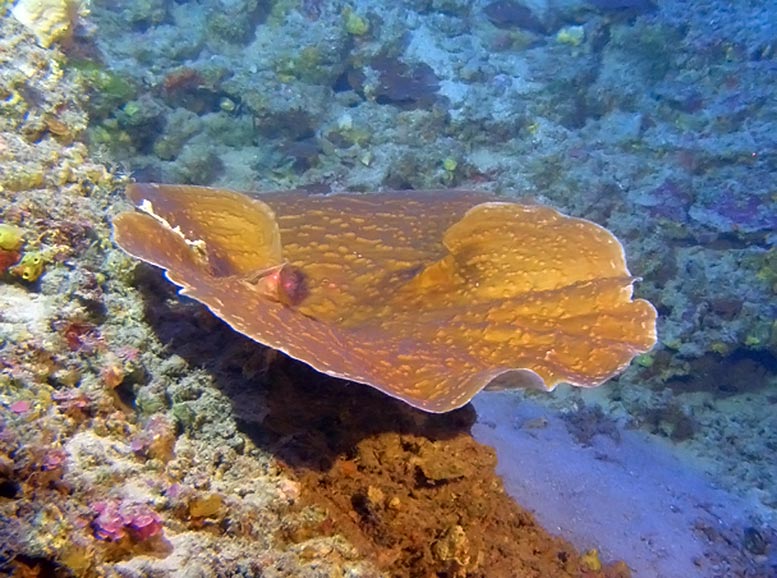
New research published in the journal Coral Reefs revealed unexpectedly high growth rates for deep-water photosynthetic corals. The study, led by Samuel Kahng, affiliate graduate faculty in the University of Hawai’i at Mānoa School of Ocean and Earth Science and Technology (SOEST), alters the assumption that deep corals living on the brink of darkness grow extremely slowly.
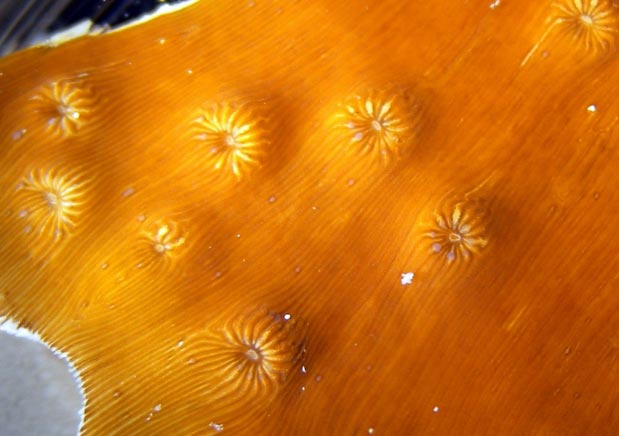
Leptoseris is a group of zooxanthellate coral species which dominate the coral community near the deepest reaches of the sun’s light throughout the Indo-Pacific. Symbiotic microalgae (called zooxanthellae) live within the transparent tissues of some coral — giving corals their primary color and providing the machinery for photosynthesis, and in turn, energy.
Deeper in the ocean, less light is available. At the lower end of their depth range, the sunlight available to the Leptoseris species examined in the recent study is less than 0.2% of surface light levels. Less light dictates a general trend of slower growth among species that rely on light for photosynthesis.
Previous studies suggested that photosynthetic corals at the bottom of the ocean’s sunlit layer grow extremely slowly — about 0.04 inches (0.1 centimeters) per year for one species of Leptoseris. Until recently, there were very few data on growth rates of corals at depths greater than about 225 feet given the logistical challenges of performing traditional time series growth measurements at these depths.
Kahng, who is also an associate professor at Hawai’i Pacific University, collaborated with SOEST’s Hawai’i Undersea Research Laboratory (HURL), the Waikiki Aquarium, National Taiwan University and Hokkaido University to collected colonies of Leptoseris at depths between 225 (76 meters) and 360 feet (110 meters) in the Au’au Channel, Hawai’i using HURL’s Pisces IV/V submersibles. The research team used uranium-thorium radiometric dating to accurately determine the age of the coral skeletons at multiple points along its radial growth axis — much like one might determine the age of tree rings within a tree trunk.
“Considering the low light environment, the previous assumption was that large corals at these extreme depths should be very old due to extremely slow growth rates,” said Kahng. “Surprisingly, the corals were found to be relatively young with growth rates comparable to that of many non-branching shallow water corals. Growth rates were measured to be between nearly 1 inch (2.5 centimeters) per year at 225 feet (76 meters) depth and 0.3 inches (0.8 centimeters) per year at 360 feet (110 meters) depth.”
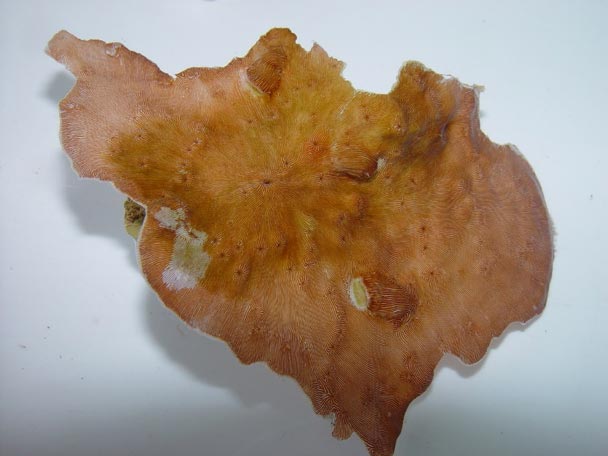
The research team found that these low-light, deep-water specialists employ an interesting strategy to dominate their preferred habitat. Their thin skeletons and plate-like shape allow for an efficient use of calcium carbonate to maximize surface area for light absorption while using minimal resources to form their skeleton. These thin corals only grow radially outward, not upward, and do not thicken over time like encrusting or massive corals.
“Additionally, the optical geometry of their thin, flat, white skeletons form fine parallel ridges that grow outward from a central origin,” said Kahng. “In some cases, these ridges form convex spaces between them which effectively trap light in reflective chambers and cause light to pass repeatedly through the coral tissue until it is absorbed by the photosynthetic machinery.”
The strategic efficiency of Leptoseris enabling its robust growth rates in such low light has important implications for its ability to compete for space and over-shade slower-growing organisms.
“It also illustrates the flexibility of reef-building corals and suggests that these communities may be able to develop and recover from mortality events much faster than previously thought,” said Kahng.
Reference: “Moderate zooxanthellate coral growth rates in the lower photic zone” by Samuel E. Kahng, Takaaki K. Watanabe, Hsun-Ming Hu, Tsuyoshi Watanabe and Chuan-Chou Shen, 15 June 2020, Coral Reefs.
DOI: 10.1007/s00338-020-01960-4
Never miss a breakthrough: Join the SciTechDaily newsletter.
Follow us on Google and Google News.
1 Comment
well, ocean cooling is a must for terraforming the planet for future underwater sea cities and farming and for space colonies as well.