
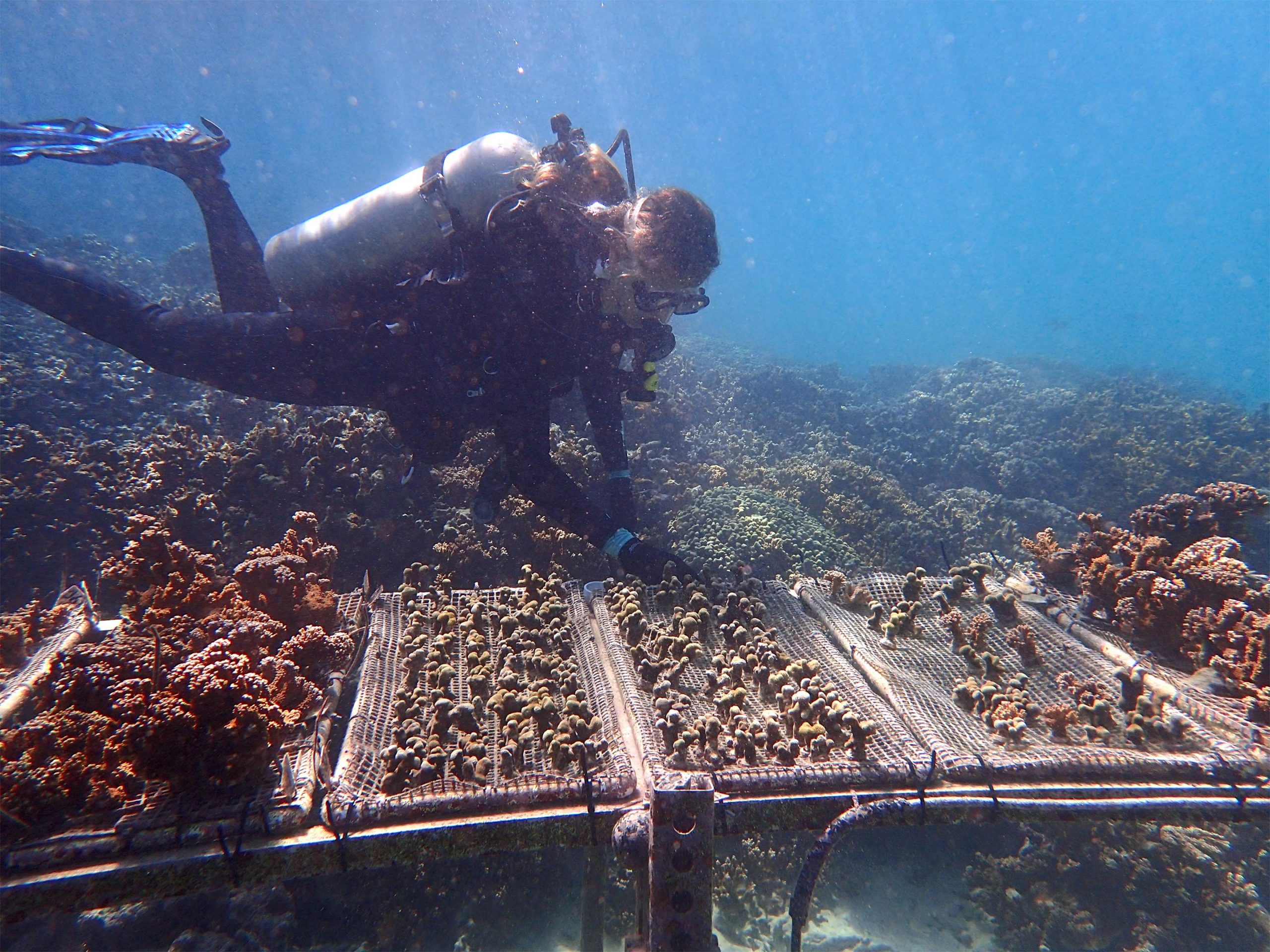
Corals that withstood a severe bleaching event and were transplanted to a different reef maintained their resilient qualities, according to a new study led by Katie Barott of the University of Pennsylvania School of Arts & Sciences.
In 2015, nearly half of Hawaiʻi’s coral reefs were affected by the most severe bleaching event to date. Coral bleaching occurs when warmer-than-normal ocean temperatures prompt corals to expel the algae that normally live inside them and on which the corals rely for food.
Bleaching events are dismaying, but corals can sometimes recover, while others resist bleaching altogether. In a new study published in the journal Proceedings of the National Academy of Sciences, researchers led by Katie Barott of the University of Pennsylvania found that these battle-tested, resilient corals could thrive, even when transplanted to a different environment and subjected to additional heat stress. The findings offer hope that hardy corals could serve as a founding population to restore reefs in the future.
“The big thing that we were really interested in here was trying to experimentally test whether you can take a coral that seems to be resistant to climate change and use that as the seed stock to propagate and put out on a different reef that might be degraded,” Barott says. “The cool thing was we didn’t see any differences in their bleaching response after this transplant.”
Mass coral bleaching events are getting increasingly frequent, raising worries that corals will become victims of climate change in the near future. Yet Barott and colleagues have been studying the corals that resist bleaching, with an eye toward buying corals more time to hang on in the face of warming and acidifying ocean waters.
Coral Transplants as a Reef Recovery Tool
One strategy they and others have envisioned, and which has been trialed in areas such as the Great Barrier Reef, is coral transplantation. Researchers could replenish reefs damaged by climate change—or other anthropogenic insults, such as sedimentation or a ship grounding—with corals that had proved sturdy and able to survive in the face of tough conditions.
For this to work, however, would require the coral “survivors” to continue to display their resilient characteristics after being moved to a new environment.
“If you take a coral that is resistant to bleaching in its native habitat, it could be that the stress of moving to a new place might make them lose that ability,” Barott says.
Just as a fern that grew well in the shade might wilt if moved to a sunny plot, the conditions of a new environment, including water flow rate, food access, light, and nutrient availability, could affect the resilience of transplanted corals.
Barott and colleagues went after this question with an experiment in two reefs in Hawaiʻi’s Kāneʻohe Bay on the island of Oʻahu: one closer to shore with more stagnant waters and another farther from shore with higher flow. In each area, the researchers identified coral colonies that had resisted bleaching during the 2015 bleaching event and collected samples from them the following year. Corals are clonal organisms, and so a chunk taken from a colony can regrow and will have the same genetics as the “mother” coral. For each colony, they kept some samples on their native reef and transplanted others to the second reef.
After the corals had spent six months at their new location, the biologists also put coral samples from each site in tanks in the lab and simulated another bleaching event by raising the water temperature over a period of several days.
Resilience Persists Across Locations
Carefully tracking the corals’ health and the conditions of the surrounding environment, the team measured photosynthesis rates, metabolism, and calcification rates, as well as the health of the symbiotic algae. They found that bleaching-resistant corals stayed that way, even in a new environment.
“What was really novel is that we had this highly replicated experiment,” Barott says, “and we saw no change in the coral’s bleaching response.”
The researchers also looked at how well the corals reproduced the summer that followed their collection. A coral’s native site conditions had an impact on their future reproductive fitness, they discovered.
“The corals from the ‘happy’ site—the outer lagoon that had higher growth rates prior to the bleaching event—generally seemed a little happier and their fitness was higher,” Barott says. “That tells us that, if you’re going to have a coral nursery, you should pick a site with good conditions because there seems to be some carryover benefit of spending time at a nicer site even after the corals are outplanted to a less ‘happy’ site.”
The “happy” site, the lagoon farther from shore, had higher flow rates than the other reef, which is closer to shore, less salty, and more stagnant. “Higher flow rates are really important for helping corals get rid of waste and get food,” Barott says.
Barott, who started the work as a postdoc at the Hawaiʻi Institute of Marine Biology, is continuing to pursue research on coral resiliency in her lab at Penn, including an investigation of the effects of heat stress and bleaching on reproductive success and the function of coral sperm.
Restoration Helps, But Global Climate Action Is Crucial
While the results of the transplantation study are promising, she says that it would only be a temporary solution to the threat of climate change.
“I think techniques like this can buy us a little bit of time, but there isn’t a substitute for capping carbon emissions,” she says. “We need global action on climate change because even bleaching-resistant corals aren’t going to survive forever if ocean warming keeps increasing as fast as it is today.”
Reference: “Coral bleaching response is unaltered following acclimatization to reefs with distinct environmental conditions” by Katie L. Barott, Ariana S. Huffmyer, Jennifer M. Davidson, Elizabeth A. Lenz, Shayle B. Matsuda, Joshua R. Hancock, Teegan Innis, Crawford Drury, Hollie M. Putnam and Ruth D. Gates, 28 May 2021, Proceedings of the National Academy of Sciences.
DOI: 10.1073/pnas.2025435118
Katie L. Barott is an assistant professor in the Department of Biology in the University of Pennsylvania School of Arts & Sciences.
Barott’s coauthors on the work were Penn’s Teegan Innis and the University of Hawaiʻi’s Ariana S. Huffmyer, Jennifer M. Davidson, Elizabeth Lenz, Shayle B. Matsuda, Joshua R. Hancock, Crawford Drury, Hollie M. Putnam, and Ruth D. Gates.
The study was supported by the Paul G. Allen Family Foundation, the University of Pennsylvania, and the National Science Foundation (grants 1923743 and 1323822).
Never miss a breakthrough: Join the SciTechDaily newsletter.
Follow us on Google and Google News.