
Researchers found a vast magma reservoir in Tuscany using seismic noise analysis, showing hidden volcanic systems can exist without surface clues and aiding resource exploration.
How can scientists detect magma buried 5, 10, or even 15 km (~3, 6, and 9 miles, respectively) below the surface when there are no visible clues above ground? The answer is ambient noise tomography, a method that measures subtle natural vibrations in the Earth with remarkable accuracy.
Using this approach, researchers from the University of Geneva (UNIGE), the Institute of Geosciences and Earth Resources (CNR-IGG), and the National Institute of Geophysics and Volcanology (INGV) uncovered a massive magma reservoir beneath Tuscany, estimated at 6,000 km3 (about 1,440 cubic miles).
This discovery is not only important for understanding Earth’s interior but also has practical value. It could lead to faster, more affordable ways to identify geothermal energy sources and locate critical materials like lithium and rare earth elements, which often form in association with deep magmatic activity. The findings were published in Communications Earth & Environment.
Famous volcanic regions such as Yellowstone National Park in the United States, Lake Toba in Indonesia, and Lake Taupo in New Zealand are known to contain enormous underground magma bodies that span thousands of kilometers. Scientists identified these systems through clear surface signs, including volcanic deposits, craters, ground movement, and gas emissions. Without these indicators, however, large magma accumulations can remain hidden deep within the crust.
Discovery of a Massive Hidden Reservoir
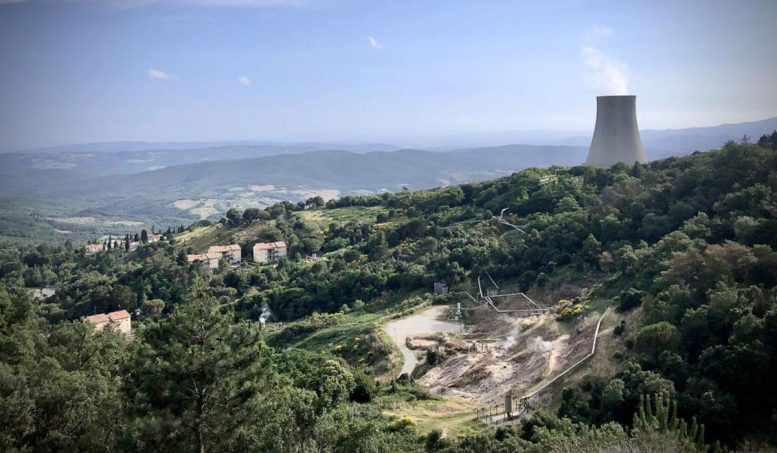
That is precisely what researchers found in Tuscany. The team identified reservoirs of volcanic fluids totaling about 6,000 km³ (about 1,440 cubic miles), located at depths of 8–15 km (5 to 9 miles) within the continental crust. The study involved scientists from UNIGE, along with collaborators from IGG-CNR and INGV.

Although this magma body could theoretically play a role in forming a supervolcano over long geological periods, it does not currently pose a danger. “We knew that this region, which extends from north to south across Tuscany, is geothermally active, but we did not realize it contained such a large volume of magma, comparable to that of supervolcanic systems such as Yellowstone,” explains Matteo Lupi, associate professor in the Department of Earth Sciences at UNIGE’s Faculty of Science, who led the study.
Researchers detected the molten rock using ambient noise tomography, a technique widely applied in seismology. It effectively allows scientists to “X-ray” the Earth’s crust by analyzing natural vibrations produced by ocean waves, wind, and human activity.
Seismic Imaging and 3D Mapping Techniques
As these vibrations move through the ground, they are captured by high-resolution seismic sensors placed at the surface. In this study, about 60 instruments were used. When seismic waves travel more slowly than expected, it can signal the presence of molten material such as magma.
By combining all of the collected data, the team created a detailed three-dimensional image of the region’s internal structure.
“These results are important both for fundamental research and for practical applications, such as locating geothermal reservoirs or deposits rich in lithium and rare earth elements, which are used, for example, in electric vehicle batteries. In addition to their great scientific interest, these studies show that tomography, by exploring the subsoil quickly and at low cost, can be a useful tool for the energy transition,” concludes Matteo Lupi.
Reference: “High-enthalpy Larderello geothermal system, Italy, powered by thousands of cubic kilometres of mid-crustal magma” by Matteo Lupi, Douglas Stumpp, Iván Cabrera-Pérez, Konstantinos Michailos, Gilberto Saccorotti, Marco Bonini, Federico Farina, Elliot Amir Jiwani-Brown, Riccardo Lanari, Samuele Papeschi, Geneviève Savard, Juan Porras, Julien Sfalcin, Francisco Muñoz-Burbano, Riccardo Minetto, Chiara Del Ventisette, Davide Piccinini and Domenico Montanari, 14 April 2026, Communications Earth & Environment.
DOI: 10.1038/s43247-026-03334-0
Never miss a breakthrough: Join the SciTechDaily newsletter.
Follow us on Google and Google News.