
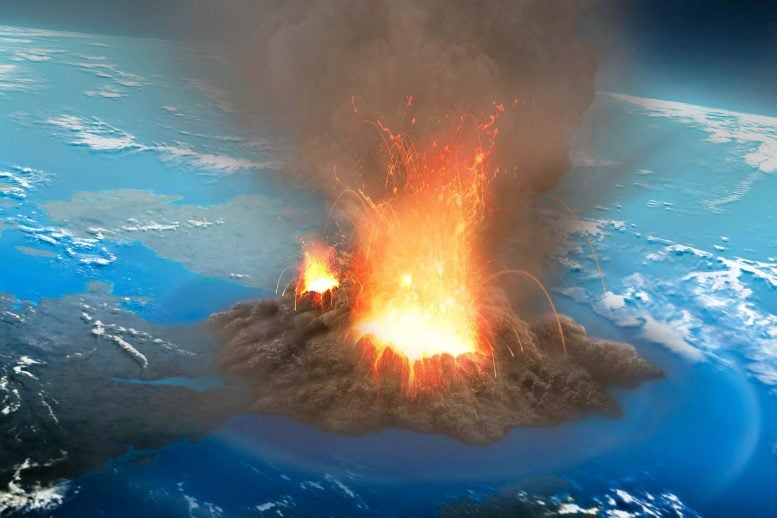
The Composition of Gases Could Forewarn of Increased Volcanic Activity
Volcanic eruptions are dangerous, but unfortunately, they are also difficult to predict. Now, a team of scientists at the University of Tokyo has discovered that the ratio of atoms in specific gases released from volcanic fumaroles (gaps in the Earth’s surface) can provide an indicator of what is happening to the magma deep below. It works quite similarly to taking a blood test to check your health. This can indicate when things might be “heating up” volcanically.
Specifically, changes in the ratio of argon-40 and helium-3 can indicate how frothy the magma is, which signals the risk of different types of eruptions. Understanding which ratios of which gases indicate a certain type of magma activity is a big step. Next, the researchers hope to construct a 24/7 volcanic activity monitoring and early warning system by developing portable equipment which can provide on-site, real-time measurements.

Does the thought of standing on a volcano make you quiver with excitement, or fear? For many people, living in the shadow of a volcano is part of daily life. Japan has 111 active volcanoes and an average of 15 volcanic “events,” including eruptions, every year. However, these events — which can be deadly — are notoriously difficult to predict.
The Mount Ontake Tragedy Highlights Prediction Limitations
Mount Ontake, Japan’s second-highest volcano and a famous tourist spot, unexpectedly erupted in 2014, sadly killing 58 people and leaving five missing. Although earthquake activity is typically an early warning sign, some eruptions (including the one at Ontake) can occur without clear earthquake signals. Therefore, disaster mitigators, such as the Japan Meteorological Agency, would benefit from other reliable ways to forewarn residents of the next potential disaster.
Fumaroles are holes and cracks in the Earth’s surface (the crust), which release gas and steam and often occur around volcanoes. The ejected gas is made up of a mix of chemicals. Its composition can provide us with insight into what is happening below the Earth’s crust in the mantle, where magma (molten rock) forms and pushes upwards, eventually erupting as lava. Researchers already know that the ratio of isotopes (atoms from an element with the same chemical properties but different mass) of certain gases can indicate hidden magma activity.
“We knew that the helium isotope ratio occasionally changes from a low value, similar to the helium found in the Earth’s crust, to a high value, like that in the Earth’s mantle, when the activity of magma increases. This was based on an observation of the helium isotope ratio of cold spring gas in El Hierro Island, in the Canary Islands (in the Atlantic Ocean off the northwestern coast of Africa), where an eruption occurred in 2011,” explained Professor Hirochika Sumino from the Research Center for Advanced Science and Technology. “But we didn’t know why we had more mantle-derived helium during magmatic unrest.”
Hirochika Sumino (dark green jacket), Tomoya Obase (blue jacket) and Hiroshi Shinohara (orange jacket) collect gas samples from fumaroles in Tateyama Jigokudani (“Hell Valley”) geothermal area, in Toyama Prefecture, Japan. Collecting gas samples from fumaroles is dangerous due to the toxic gas and hot steam, so a gas mask, goggles, helmet, and gloves are required. But Sumino says the results of this study show that the insight obtained from the samples is well worth the challenge. Credit: Yuki Hibiya
To gain further insight, Sumino and the research team decided to monitor gases from six fumaroles around the active Kusatsu-Shirane volcano, which lies about 150 kilometers (90 miles) northwest of Tokyo in Gunma Prefecture. The team collected samples every few months for seven years between 2014 and 2021. After collection, they took the samples back to the lab and analyzed them using state-of-the-art equipment called a noble gas mass spectrometer. This enabled them to precisely measure isotopic compositions, including that of ultratrace (tiny but important) isotopes, such as helium-3, which is typically more abundant in the mantle compared to the crust or air.
Magma Activity: A Deeper Understanding Through Gases
“We succeeded in detecting changes in the magma-derived argon-40/helium-3 ratio, related to magmatic unrest. Using computer models, we revealed that the ratio reflects how much the magma underground is foaming, making bubbles of volcanic gases which separate from the liquid magma,” explained Sumino. “How much magma foams controls how much magmatic gas is provided to the hydrothermal system beneath a volcano and how buoyant the magma is. The former is related to a risk of phreatic eruption, in which an increase in water pressure in the hydrothermal system causes the eruption. The latter would increase the rate of magma ascent, resulting in a magmatic eruption.

“When you compare a volcano with a human body, the conventional geophysical methods represented by observations of earthquakes and crustal deformation are similar to listening to the chest and taking body size measurements. In these cases, it is difficult to know what health problem causes some noise in your chest or a sudden increase in your weight, without a detailed medical check. On the other hand, analyzing the chemical and isotope composition of elements in fumarolic gases is like a breath or blood test. This means we are looking at actual material directly derived from magma to know precisely what is going on with the magma.”
For now, gas samples have to be collected out in the field and brought back to the lab for analysis, which is a challenging and time-consuming process. However, Sumino has experience in improving noble gas mass spectrometers and hopes to develop a new tool that would enable them to perform the same analysis, but in real-time and out in the field.
“We want to be able to detect changes in magma activity as soon as possible,” said Sumino. “Now we are developing a portable mass spectrometer for on-site, real-time monitoring of noble gas isotope ratios from fumarolic gases. Our next step is to establish a noble gas analysis protocol with this new instrument, to make it a reality that all active volcanoes — at least those which have the potential to cause disaster to local residents — are monitored 24 hours a day, seven days a week.”
Reference: “Monitoring of magmatic-hydrothermal system by noble gas and carbon isotopic compositions of fumarolic gases” by Tomoya Obase, Hirochika Sumino, Kotaro Toyama, Kaori Kawana, Kohei Yamane, Muga Yaguchi, Akihiko Terada and Takeshi Ohba, 21 November 2022, Scientific Reports.
DOI: 10.1038/s41598-022-22280-3
Funding: This work was supported by the Ministry of Education, Culture, Sports, Science and Technology (MEXT) of Japan, under its Integrated Program for Next Generation Volcano Research and Human Resource Development (Program Grant Number JPJ005391) and The Second Earthquake and Volcano Hazards Observation and Research Program (Earthquake and Volcano Hazard Reduction Research).
Never miss a breakthrough: Join the SciTechDaily newsletter.
Follow us on Google and Google News.
1 Comment
Eclific Adventures about to take place we need to see Guam Japan night have 50% casualties Alaska 75% casualties 1/3 of Earth foundations will be moved shaken the fifth hour the seventh day 200 million will die then my best they didn’t want the healing I’ve done my best to settle down they won’t let me have it their way