
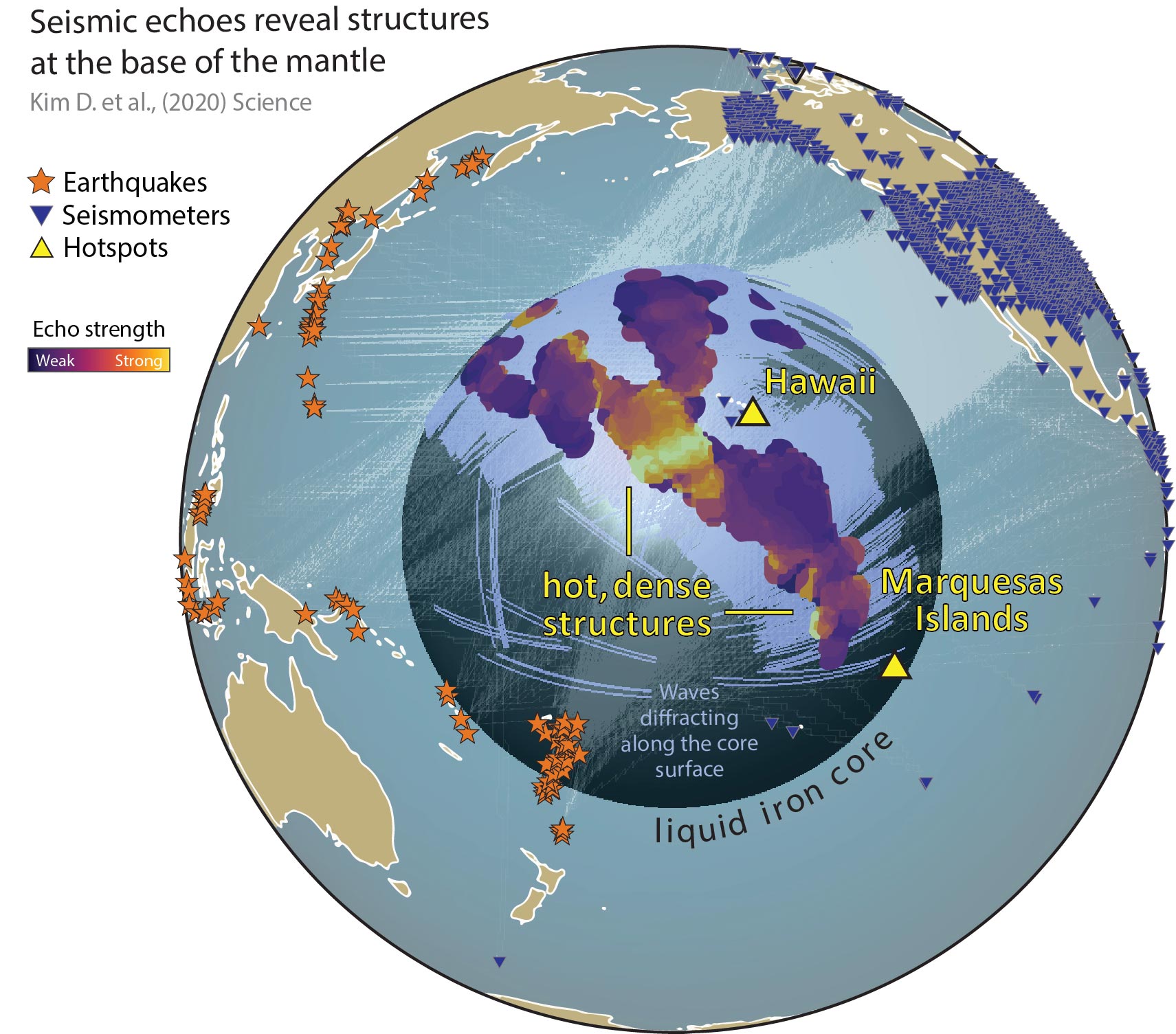
University of Maryland researchers conduct first simultaneous analysis of hundreds of earthquakes to identify echoes from features deep inside Earth.
University of Maryland geophysicists analyzed thousands of recordings of seismic waves, sound waves traveling through the Earth, to identify echoes from the boundary between Earth’s molten core and the solid mantle layer above it. The echoes revealed more widespread, heterogenous structures—areas of unusually dense, hot rock—at the core-mantle boundary than previously known.
Scientists are unsure of the composition of these structures, and previous studies have provided only a limited view of them. Better understanding their shape and extent can help reveal the geologic processes happening deep inside Earth. This knowledge may provide clues to the workings of plate tectonics and the evolution of our planet.
The new research provides the first comprehensive view of the core-mantle boundary over a wide area with such detailed resolution. The study was published in the June 12, 2020, issue of the journal Science.
The researchers focused on echoes of seismic waves traveling beneath the Pacific Ocean basin. Their analysis revealed a previously unknown structure beneath the volcanic Marquesas Islands in the South Pacific and showed that the structure beneath the Hawaiian Islands is much larger than previously known.
“By looking at thousands of core-mantle boundary echoes at once, instead of focusing on a few at a time, as is usually done, we have gotten a totally new perspective,” said Doyeon Kim, a postdoctoral fellow in the UMD Department of Geology and the lead author of the paper. “This is showing us that the core-mantle boundary region has lots of structures that can produce these echoes, and that was something we didn’t realize before because we only had a narrow view.
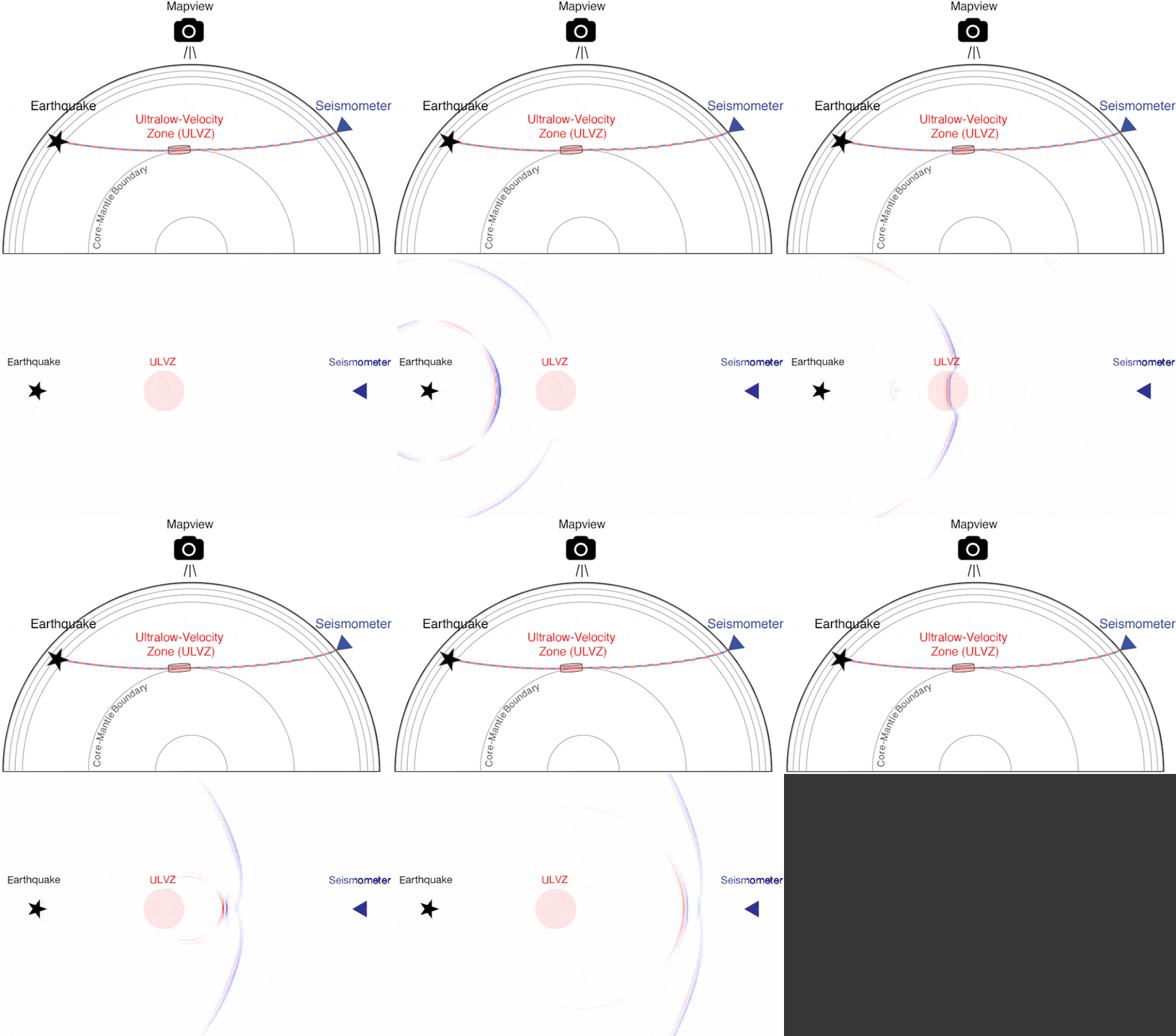
Earthquakes generate seismic waves below Earth’s surface that travel thousands of miles. When the waves encounter changes in rock density, temperature or composition, they change speed, bend or scatter, producing echoes that can be detected. Echoes from nearby structures arrive more quickly, while those from larger structures are louder. By measuring the travel time and amplitude of these echoes as they arrive at seismometers in different locations, scientists can develop models of the physical properties of rock hidden below the surface. This process is similar to the way bats echolocate to map their environment.
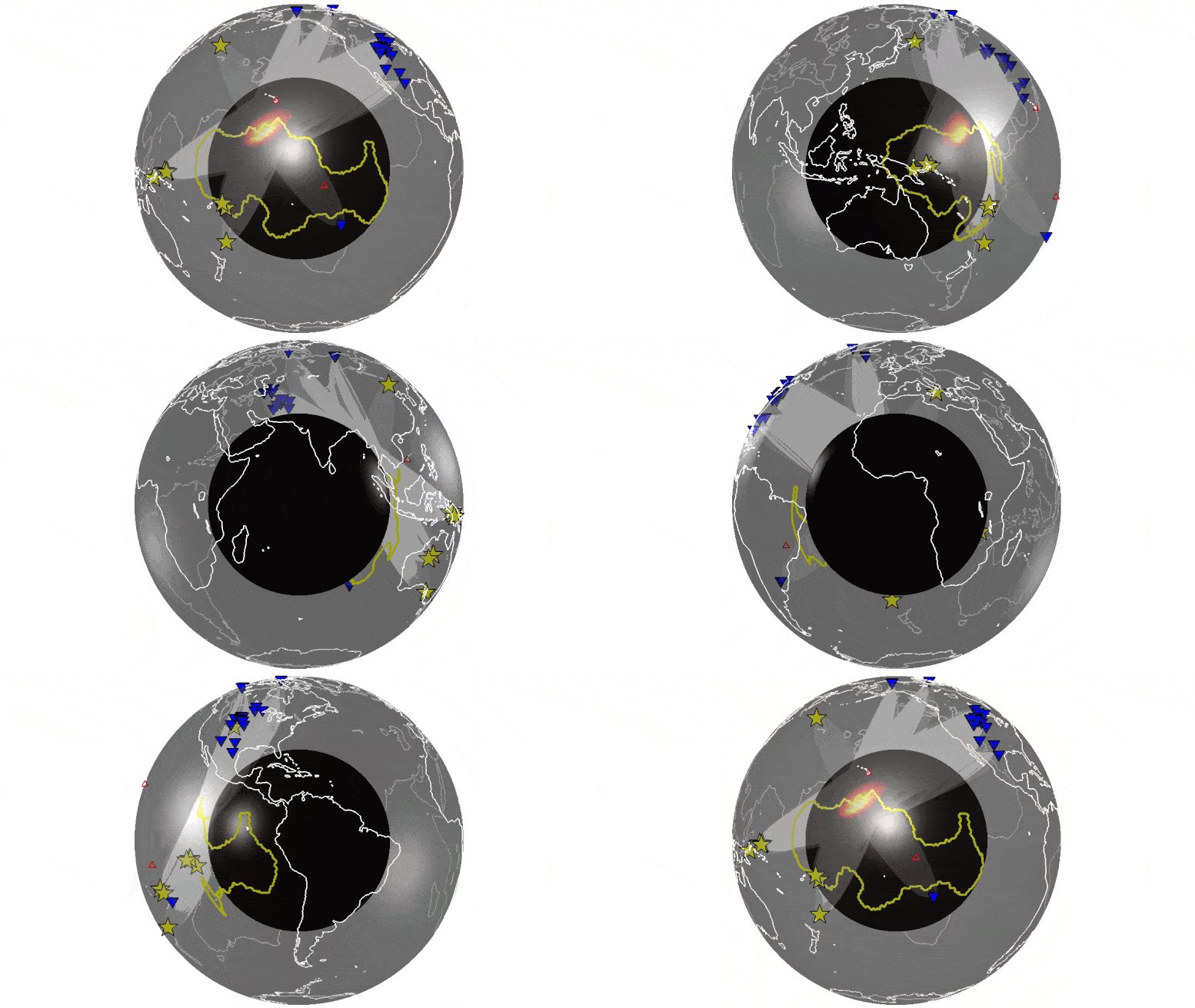
For this study, Kim and his colleagues looked for echoes generated by a specific type of wave, called a shear wave, as it travels along the core-mantle boundary. In a recording from a single earthquake, known as a seismogram, echoes from diffracted shear waves can be hard to distinguish from random noise. But looking at many seismograms from many earthquakes at once can reveal similarities and patterns that identify the echoes hidden in the data.
Using a machine learning algorithm called Sequencer, the researchers analyzed 7,000 seismograms from hundreds of earthquakes of 6.5 magnitude and greater occurring around the Pacific Ocean basin from 1990 to 2018. Sequencer was developed by the new study’s co-authors from Johns Hopkins University and Tel Aviv University to find patterns in radiation from distant stars and galaxies. When applied to seismograms from earthquakes, the algorithm discovered a large number of shear wave echoes.
“Machine learning in earth science is growing rapidly and a method like Sequencer allows us to be able to systematically detect seismic echoes and get new insights into the structures at the base of the mantle, which have remained largely enigmatic,” Kim said.
The study revealed a few surprises in the structure of the core-mantle boundary.
“We found echoes on about 40% of all seismic wave paths,” said Vedran Lekić, an associate professor of geology at UMD and a co-author of the study. “That was surprising because we were expecting them to be more rare, and what that means is the anomalous structures at the core-mantle boundary are much more widespread than previously thought.”
The scientists found that the large patch of very dense, hot material at the core-mantle boundary beneath Hawaii produced uniquely loud echoes, indicating that it is even larger than previous estimates. Known as ultralow-velocity zones (ULVZs), such patches are found at the roots of volcanic plumes, where hot rock rises from the core-mantle boundary region to produce volcanic islands. The ULVZ beneath Hawaii is the largest known.
This study also found a previously unknown ULVZ beneath the Marquesas Islands.
“We were surprised to find such a big feature beneath the Marquesas Islands that we didn’t even know existed before,” Lekić said. “This is really exciting, because it shows how the Sequencer algorithm can help us to contextualize seismogram data across the globe in a way we couldn’t before.”
Reference: “Sequencing Seismograms: A Panoptic View of Scattering in the Core-Mantle Boundary Region” by D. Kim, V. Lekić, B. Ménard, D. Baron and M. Taghizadeh-Popp, 12 June 2020, Science.
DOI: 10.1126/science.aba8972
This work is supported by Packard Foundation Fellowships and the National Science Foundation (Award No. EAR1352214). The content of this article does not necessarily reflect the views of these organizations.
Never miss a breakthrough: Join the SciTechDaily newsletter.
Follow us on Google and Google News.
19 Comments
Probably clumps of heavy metals. The vast majority of heavy metals are located way beneath the surface of the Earth, because when the Earth was molten the heavy metals weighed more than the surrounding mass and sank toward the center.
That’s how the North and South Pole’s stay where they are. The less densor the more off the earth is
The north and south poles don’t stay where they are. The magnetic poles are constantly moving and infact the rate of movement has increase dramaticaly of late. I believe these dense (extra heavy ? ) will also move cousing the poles to follow .This movement may be responsible for tectonic shift and cause the dynamic balance of earth to change causing ever greater earthquacks. They remain at the top of the core because of centrifugal forces and will not sink.
Could be old Cheap Trick 8 tracks, discarded
So when are we able to visit middle earth, I hear it’s nice this time of year
Gonna Raise Hell!!!
Earth is flat
Your intellect is flat
Conceptual postulate: Matter has the function of accreting and “containing” and nullifying the effect of antimatter.
Conceptual postulate: Matter can not be created nor destroyed, but neither can antimatter.
Conceptual postulate: The dense lagoons ballooning and amoeba-ising in the earth’s mantle are bulges of dense matter where there is depleted or neutralised antimatter. This is the first stages of atomic stratification which will eventually lead to the formation of elements.
Crab people civilization
Very exciting. Perhaps the start of ability of humanity to predict earthquakes.
Yes but where’s the liquid gold deposits.
What a great example of how our worldwide networks, technological standart, and the power of computation worked together to push further the frontiers of knowledge. it was only possible in our days, not before. wonderful.
I still do not know if the inner core is solid or liquid. I’ve heard it both ways. It makes sense to me that it could be solid from the pressure alone. Temperature and pressure relationships are very interesting and we usually don’t think of that in our normal everyday lives.
Earth has a 2-part core. The inner part is solid, composed of iron and nickle. The outer layer, also composed of iron and nickle, is liquid.
Under Hawaii eh?- That’ll probably be one of the Earth elementals then (commonly known as dragons). And that’s my slightly none scientific explanation.
Here’s a thought for you: We have never proven that the Earth’s core is actually iron. We have taught it as truth, and not questioned it. These scientists are basing their studies on assumptions without asking questions that might allow them to discover new truths… true scientist will question the very basics that have not been proven, and get slammed on by the rest of the world (Galileo). Less effective scientists teach theories as fact, and thus disregard anomalies that don’t line up with what they believe, and thus never discover.
This is very interesting research, as we really know very little about the Earth’s core.
It’s far hotter on the surface at the moment!!
Theia’s core?