
Adolescence is widely thought to be a time when the brain trims away excess neural connections, refining circuits through synaptic pruning. New research now suggests this view may be incomplete.
Adolescence is when the brain’s “control center” keeps coming online. As teens move toward adulthood, skills like planning ahead, weighing consequences, and solving unfamiliar problems become more reliable. Scientists have long known this behavioral shift tracks with changes inside the brain, but the step-by-step wiring changes that support it are still not fully mapped.
At the heart of that wiring are synapses, the functional connections between neurons that allow information to flow through the brain. For years, a popular model has suggested a simple arc: synapse numbers rise during childhood, then drop during adolescence as the brain prunes away weaker links.
That refinement process, called synaptic pruning, is often described as a kind of biological quality control that strengthens efficient circuits by removing unused or fragile connections. Some researchers have argued that if pruning goes too far, it could raise the risk of neuropsychiatric disorders. Schizophrenia is frequently discussed in this context because it can involve hallucinations, delusions, and disorganized thinking.
A Challenge to the Synaptic Pruning Model
A research team at Kyushu University is now pushing back on this long-held idea that adolescence is mainly about cutting connections. In a study published in Science Advances, the group reports that the adolescent brain is also building something new: dense, tightly packed clusters of synapses that appear on specific stretches of dendrites, the branching extensions of neurons.
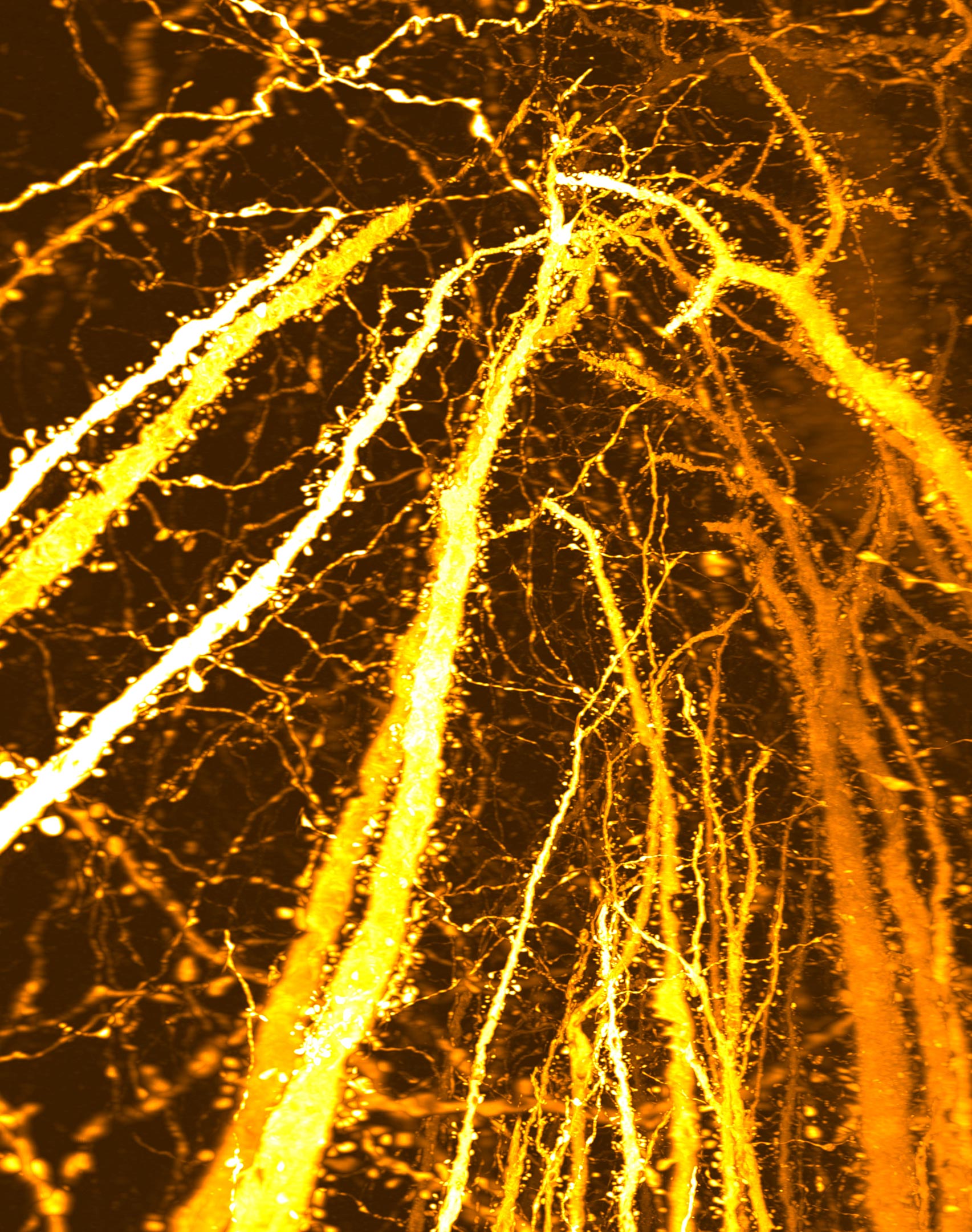
“We did not set out to study brain disorders,” says Professor Takeshi Imai at Kyushu University’s Faculty of Medical Sciences. “After developing a high-resolution tool for synaptic analysis in 2016, we looked at the mouse cerebral cortex out of curiosity. Beyond seeing the beauty of the neuronal structure, we were surprised to discover a previously unknown high-density hotspot of dendritic spines, the tiny protrusions in dendrites where excitatory synapses are formed.”
The cerebral cortex, which plays a central role in perception, thought, and behavior, is organized into six distinct layers. Imai’s team concentrated on neurons in Layer 5, which collect information from multiple sources and send signals out of the cortex. Because of this role, these neurons are essential for controlling how cortical information is processed.
Mapping Synaptic Hotspots in the Adolescent Brain
To examine synaptic structures throughout entire neurons, the researchers combined super-resolution microscopy with SeeDB2—the tissue clearing agent Imai’s team developed. This approach made brain tissue transparent, allowing the scientists to observe fine neural details deep within intact samples.
Using this method, the team created a complete map of dendritic spines across individual Layer 5 neurons. Their analysis uncovered an unexpected region of extremely high spine density located along the apical dendrite. Further comparisons across developmental stages showed that this dense cluster does not appear early in life but instead emerges specifically during adolescence.
When Synapse Formation Goes Wrong
To determine how and when this dense region forms, the researchers followed changes in dendritic spine distribution over time. In mice that were two weeks old and had not yet been weaned, spines were spread fairly evenly along the dendrites. However, between three and eight weeks of age, a period that spans early development through adolescence, spine numbers increased sharply in one specific section of the apical dendrite. Over time, this selective growth led to the formation of a concentrated synaptic hotspot.
“These findings suggest that the well-established ‘adolescent synaptic pruning’ hypothesis needs to be reconsidered,” says Imai.
“While synaptic pruning occurs broadly across dendrites, synapse formation also takes place in specific dendritic compartments during adolescent cortical development. Disruption of this process may be the key factor in at least some types of schizophrenia,” says Ryo Egashira, the study’s first author and a graduate student at Kyushu University’s Graduate School of Medical Sciences, when the research was conducted.
To explore this possibility, the team examined mice carrying mutations in genes linked to schizophrenia, such as Setd1a, Hivep2, and Grin1. While dendritic spine density remained normal until two to three weeks after birth, spine formation during adolescence was markedly impaired by the mutations of these genes, resulting in the failure of proper hotspot formation.
For many years, the disorder has been linked primarily to excessive pruning of dendritic spines. The new findings offer a new perspective on schizophrenia’s origins or pathology, suggesting that impaired synapse formation during adolescence may be a key. However, it should be noted that the study examined the developmental process only in mice, and it remains unclear if similar mechanisms are at work in primates and humans.
Looking Ahead
“Moving forward, we hope to identify which brain regions are forming these new synaptic connections during adolescence,” says Imai. “That will tell us what circuits are actually being built during this developmental window. Understanding how and when these connections form can advance our knowledge of both brain development and the mechanisms underlying neuropsychiatric disorders.”
Reference: “Dendritic compartment-specific spine formation in layer 5 neurons underlies cortical circuit maturation during adolescence” by Ryo Egashira, Meng-Tsen Ke, Nao Nakagawa-Tamagawa, Satoshi Fujimoto, Shigenori Inagaki, Tsuyoshi Takagi, Tsuyoshi Miyakawa, Yoshiaki Tagawa and Takeshi Imai, 14 January 2026, Science Advances.
DOI: 10.1126/sciadv.adw8458
Funding: Japan Agency for Medical Research and Development, Grant-in-Aid for Transformative Research Areas (A), Japan Science and Technology Agency, Japan Society for the Promotion of Science, Uehara Memorial Foundation, Sumitomo Foundation, Ichiro Kanehara Foundation for the Promotion of Medical Sciences and Medical Care, Brain Science Foundation, Daiichi Sankyo Foundation of Life Science, Intramural grant from RIKEN Center for Developmental Biology, Kagoshima University Megumikai Medical Research Promotion Fund
Never miss a breakthrough: Join the SciTechDaily newsletter.
Follow us on Google and Google News.