

How the body efficiently shifts metabolism after fasting may be key to improving health, UTSW-led research suggests.
Cutting calorie intake has long been linked to longer life, and intermittent fasting often appears to work better than maintaining a constant diet. Even so, scientists have struggled to explain exactly why this happens.
New research from UT Southwestern Medical Center, published in Nature Communications, suggests that the key factor is not the fasting period itself, but how the body adjusts its metabolism when food is reintroduced. The experiments were carried out in Caenorhabditis elegans, a type of roundworm commonly used in laboratory studies, and the findings could eventually inform approaches to improving human health.
“Our discoveries shift the focus toward a neglected side of the metabolic coin – the refeeding phase. Our data suggest that the health-promoting effects of intermittent fasting are not merely a product of the fast itself, but are dependent on how the metabolic machinery recalibrates during the subsequent transition back to a fed state,” said study leader Peter Douglas, Ph.D., Associate Professor of Molecular Biology and a member of the Hamon Center for Regenerative Science and Medicine at UT Southwestern. Dr. Douglas co-led the study with Lexus Tatge, Ph.D., a former member of the Douglas Lab.

Metabolic switch drives fasting benefits
During fasting, cells quickly use up limited glucose supplies and then switch to breaking down stored lipids for energy. This shift, known as catabolism, is controlled by a protein called NHR-49. When glucose levels drop, NHR-49 activates and triggers lipid breakdown. Once food is available again, NHR-49 turns off, allowing cells to stop breaking down fats and begin restoring their energy reserves. Earlier work published in 2022 by Dr. Douglas and colleagues showed that NHR-49 also monitors lipid levels inside cells and helps prevent starvation when those reserves run low.
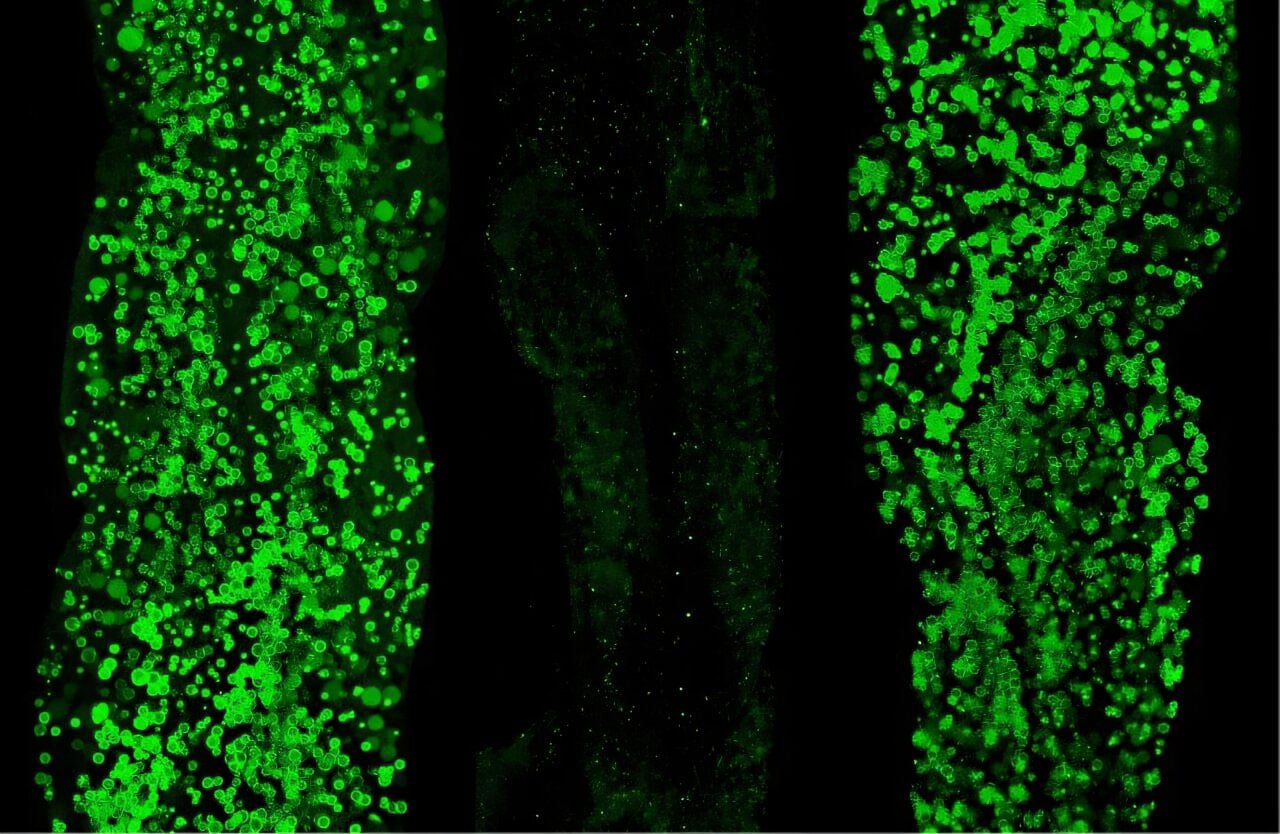
To explore whether NHR-49 is responsible for the lifespan benefits of fasting, Dr. Douglas and colleagues removed the gene for this protein in C. elegans and then subjected the worms to a 24-hour fast. The outcome was unexpected. The absence of NHR-49 did not reduce the lifespan benefit. The fasted worms still lived about 41 percent longer on average and showed more youthful behavior, including increased movement, similar to worms with normal NHR-49 function.
Refeeding response determines longevity
The researchers then turned their attention to what happens after fasting ends, when NHR-49 is normally switched off.
To understand this process, they examined how NHR-49 is naturally inactivated. Experiments led by Vincent Tagliabracci, Ph.D., Associate Professor of Molecular Biology at UTSW and a Howard Hughes Medical Institute Investigator, along with Victor Lopez, Ph.D., a postdoctoral researcher in the Tagliabracci Lab, showed that an enzyme called protein kinase CK1 alpha 1 (KIN-19) modifies NHR-49 through phosphorylation. When Dr. Douglas and colleagues altered this system so that NHR-49 remained active even after feeding resumed, lipid breakdown continued, and the lifespan-extending effects of fasting disappeared.
Targeting metabolism could extend life
Taken together, the findings indicate that the ability to properly shut down NHR-49 after fasting is critical for extending lifespan through calorie restriction. Adjusting this process may offer a way to gain the benefits of fasting without needing to follow strict dietary regimens.
“Our findings bridge a gap between lipid metabolism and aging research,” Dr. Douglas said. “By targeting aging, the single greatest risk factor for human disease, we move beyond treating isolated conditions toward a preventive model of medicine that enhances quality of life for all individuals.”
Reference: “Silencing lipid catabolism determines longevity in response to fasting” by Lexus Tatge, Juhee Kim, Rene Solano Fonseca, Kyle Feola, Jordan M. Wall, Gupse Otuzoglu, Ann C. Johnson, Kielen R. Zuurbier, Jaeyoung Oh, Shaghayegh T. Beheshti, Victor A. Lopez, Anthony J. Daley, Emma G. Werner, Patrick Metang, Sonja L. B. Arneaud, Abigail Watterson, Jeffrey G. McDonald, Vincent S. Tagliabracci, Michael E. French and Peter M. Douglas, 22 January 2026, Nature Communications.
DOI: 10.1038/s41467-026-68764-y
This study was funded by the Clayton Foundation for Research, The Welch Foundation (I-2061-20210327), the American Federation of Aging Research (AFAR 2023), and the National Institutes of Health (R01AG076529, R01GM15385).
Never miss a breakthrough: Join the SciTechDaily newsletter.
Follow us on Google and Google News.
10 Comments
Great findings, if one is a worm. Now age 82, I had to learn three serious lessons in life to make it this far: 1) I have multiple sub-acute (nearly subclinical) non-IgE-mediated food and food additive allergies (Dr. Arthur F. Coca, by 1935; “The Pulse Test,” 1956), 2) some FDA approved food additives are toxic to me (e.g., soy [late 1960s], the cooking oil preservative TBHQ [1972] and added MSG [1980], minimally, and 3) medical professional ignorance of the first two factors results in medical errors being the third leading cause of death in the US. I doubt C. elegans can inform them of those. While their research with the worms may have elucidated the exact biological mechanism involved, in humans the story is much more complicated. When first learning of my multiple food allergies in late 1981, at home experimentation with diet and lifestyle informed me that the basic individual single offender allergy reaction and low-grade inflammation lasted only about six to twelve hours and was practically harmless. However, add multiple allergens and/or some MSG to the meal and the allergy reaction and inflammation can become dangerously chronic, long-term (months to decades, highly individual). From my now senior lay perspective, intermittent fasting allows the low-grade inflammation (e.g., high serum uric acid and free radicals) to subside, allowing one’s body to recover from more common allergy reactions than thought in a number of ways.
Thank you. I also have food allergies, one of them soy. I’m almost 65 and symptoms have worsened. Idk if it’s because of age or if it’s because I have recently stopped intermittent fasting. I will take any advantage I can get over the sabotage.
Nina, you are welcome for anything of value I can share. I can think of a few possibilities regarding your symptoms worsening, Very likely, especially if you are a mother who regularly avoids dairy and/or meats, you may be seriously deficient of calcium and/or other essential minerals. Standard blood serum testing for calcium is unreliable. “Ionic” testing for calcium is said to be reliable. And, more variety might help. Avoiding, alternating and/or rotating my worst known allergens allows me to eat more normally and helps me to carry-on. For a brief overview and summary of my lay findings of forty-five years and counting, I invite you to visit the “About” page of my ad-free video channel: https://odysee.com/@charlesgshaver:d?view=about
How many people over 80 do you know that are the epitome of health and enjoy life the way they used to? So what’s the big scramble to milk every extra year out of life that you can. Especially for followers of Jesus, we are promised a new body and eternal life. Submit to, and follow Jesus and let the chips fall where they may.
Hey Glen, bet you’re not even 65 yet. Perspective changes with time (or the remaining lack of such).
Good question. I am a follower of Jesus and I’m like Apostle Paul, though it would be wonderful to be in the kingdom, I’d like to stick around for those I can minister to about the kingdom. One of my greatest blessings is to be able to share with my grandkids and God-willing their children, and whoever else God puts in my path. Blessings.
If it turns out to be true for humans, intermittent fasting is much easier than permanent dietary changes, and would be a boon to individual health.
In fact, it is easy enough, that there really is little reason for most adults, including those with mild blood lipid and sugar disorders to give it a try. Pick a random day each week to fast. If that day isn’t convenient, push it ahead or back a day. See what happens after 6 months. You can do your own labs at Anylabtestnow to conveniently follow results.
Vikingvista thank you for health info that you shared.
hey people we aren’t round worms!!!
You haven’t met my last boss, apparently.