
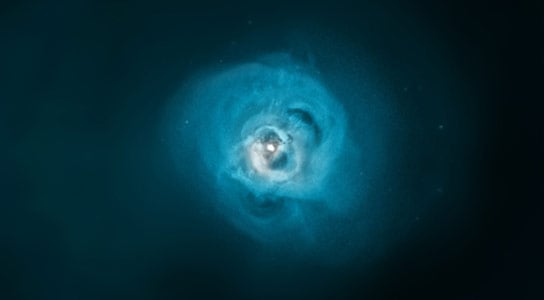
In a new study, theoretical physicists from Case Western Reserve University suggest that dark matter may be massive and that the Standard Model may account for it.
The physics community has spent three decades searching for and finding no evidence that dark matter is made of tiny exotic particles. Case Western Reserve University theoretical physicists suggest researchers consider looking for candidates more in the ordinary realm and, well, more massive.
Dark matter is unseen matter, that, combined with normal matter, could create the gravity that, among other things, prevents spinning galaxies from flying apart. Physicists calculate that dark matter comprises 27 percent of the universe; normal matter 5 percent.
Instead of WIMPS, weakly interacting massive particles, or axions, which are weakly interacting low-mass particles, dark matter may be made of macroscopic objects, anywhere from a few ounces to the size of a good asteroid, and probably as dense as a neutron star, or the nucleus of an atom, the researchers suggest.
Physics professors Glenn Starkman and David Jacobs, who received his PhD in Physics from CWRU in May and is now a fellow at the University of Cape Town, say published observations provide guidance, limiting where to look. They lay out the possibilities in a paper listed below.
The Macros, as Starkman and Jacobs call them, would not only dwarf WIMPS and axions, but differ in an important way. They could potentially be assembled out of particles in the Standard Model of particle physics instead of requiring new physics to explain their existence.
“We’ve been looking for WIMPs for a long time and haven’t seen them,” Starkman said. “We expected to make WIMPS in the Large Hadron Collider, and we haven’t.”
WIMPS and axions remain possible candidates for dark matter, but there’s reason to search elsewhere, the theorists argue.
“The community had kind of turned away from the idea that dark matter could be made of normal-ish stuff in the late ’80s,” Starkman said. “We ask, was that completely correct and how do we know dark matter isn’t more ordinary stuff— stuff that could be made from quarks and electrons?”
After eliminating most ordinary matter, including failed Jupiters, white dwarfs, neutron stars, stellar black holes, the black holes in centers of galaxies, and neutrinos with a lot of mass, as possible candidates, physicists turned their focus on the exotics.
Matter that was somewhere in between ordinary and exotic—relatives of neutron stars or large nuclei—was left on the table, Starkman said. “We say relatives because they probably have a considerable admixture of strange quarks, which are made in accelerators and ordinarily have extremely short lives,” he said.
Although strange quarks are highly unstable, Starkman points out that neutrons are also highly unstable. But in helium, bound with stable protons, neutrons remain stable.
“That opens the possibility that stable strange nuclear matter was made in the early universe and dark matter is nothing more than chunks of strange nuclear matter or other bound states of quarks, or of baryons, which are themselves made of quarks,” he said. Such dark matter would fit the Standard Model.
The Macros would have to be assembled from ordinary and strange quarks or baryons before the strange quarks or baryons decay, and at a temperature above 3.5 trillion degrees Celsius, comparable to the temperature in the center of a massive supernova, Starkman and Jacobs calculated. The quarks would have to be assembled with 90 percent efficiency, leaving just 10 percent to form the protons and neutrons found in the universe today.
The limits of the possible dark matter are as follows:
- A minimum of 55 grams. If dark matter were smaller, it would have been seen in detectors in Skylab or in tracks found in sheets of mica.
- A maximum of 1024 (a million billion billion) grams. Above this, the Macros would be so massive they would bend starlight, which has not been seen.
- The range of 1017 to 1020 grams per centimeter squared should also be eliminated from the search, the theorists say. Dark matter in that range would be massive for gravitational lensing to affect individual photons from gamma-ray bursts in ways that have not been seen.
If dark matter is within this allowed range, there are reasons it hasn’t been seen.
- At the mass of 1018 grams, dark matter Macros would hit the Earth about once every billion years.
- At lower masses, they would strike the Earth more frequently but might not leave a recognizable record or observable mark.
- In the range of 109 to 1018, dark matter would collide with the Earth once annually, providing nothing to the underground dark matter detectors in place.
Reference: “Macro dark matter” by David M. Jacobs, Glenn D. Starkman and Bryan W. Lynn, 14 May 2014, Monthly Notices of the Royal Astronomical Society.
DOI: 10.1093/mnras/stv774
Never miss a breakthrough: Join the SciTechDaily newsletter.
Follow us on Google and Google News.
7 Comments
It’s occurred to me that dark matter could consist of trillions of very tiny black holes that have long since vanished into their own gravitational vortex. Black holes that small wouldn’t bend light all that much and since light can’t escape they’d be completely dark.
Wow, that is incredibly stupid.
what if dark matter is moving so fast that we can’t see it ? Like similar to the speed of light, we can’t see light in motion but we can see light when it hits objects. Also if the big bang originated from a single point, could dark matter be moving outward like a wave and be an explanation for the accelerating expansion of the universe ? Since it is the opposite of matter then i would assume we are not able to see dark matter with naked eye or touch it physically !!!
Dark matter is the influence of other universes on ours…. maybe…
Mircea, i agree with that. Multiple universes being observable on the macrocosm, but not on the microcosm of nature. Gravity is perhaps a multiversal force of nature and is not confined to our level of reality.
Aether has mass. Aether physically occupies three dimensional space. Aether is physically displaced by the particles of matter which exist in it and move through it.
The Milky Way’s halo is not a clump of stuff anchored to the Milky Way. The Milky Way is moving through and displacing the aether.
The Milky Way’s halo is the state of displacement of the aether.
The Milky Way’s halo is the deformation of spacetime.
What is referred to geometrically as the deformation of spacetime physically exists in nature as the state of displacement of the aether.
A moving particle has an associated aether displacement wave. In a double slit experiment the particle travels through a single slit and the associated wave in the aether passes through both.
Q. Why is the particle always detected traveling through a single slit in a double slit experiment?
A. The particle always travels through a single slit. It is the associated wave in the aether which passes through both.
What ripples when galaxy clusters collide is what waves in a double slit experiment; the aether.
Einstein’s gravitational wave is de Broglie’s wave of wave-particle duality; both are waves in the aether.
Aether displaced by matter relates general relativity and quantum mechanics.
There is evidence of dark matter every time a double slit experiment is performed; it’s what waves.