
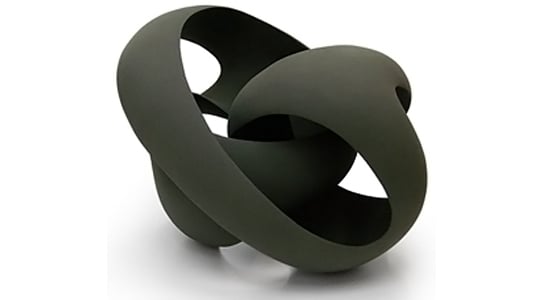
New research showing that black holes have properties that resemble the dynamics of both solids and liquids may help scientists better understand black holes and the physical properties of neutron stars.
Black holes are surrounded by many mysteries, but now researchers from the Niels Bohr Institute, among others, have come up with new groundbreaking theories that can explain several of their properties. The research shows that black holes have properties that resemble the dynamics of both solids and liquids. The results are published in the prestigious scientific journal, Physical Review Letters.
Black holes are extremely compact objects in the universe. They are so compact that they generate an incredibly strong gravitational pull and everything that comes near them is swallowed up. Not even light can escape, so light that hits a black hole will not be reflected, but will be entirely absorbed, as a result, they cannot be seen and we call them black holes.
“But black holes are not completely black, because we know that they emit radiation and there are indications that the radiation is thermal, i.e. it has a temperature,” explains Niels Obers, a professor of theoretical particle physics and cosmology at the Niels Bohr Institute at the University of Copenhagen.
Multiple dimensions
Researchers know that the black holes are very compact, but they do not know what their quantum properties are. Niels Obers works with theoretical modeling to better understand the physics of black holes. He explains that you can look at a black hole like a particle. A particle has in principle no dimensions. It is a point. If you give a particle an extra dimension, it becomes a string. If you give the string an extra dimension, it becomes a plane. Physicists call such a plane a ‘brane’ (the word ‘brane’ is related to ‘membrane’ from the biological world).
“In string theory, you can have different branes, including planes that behave like black holes, which we call black branes. The black branes are thermal, that is to say, they have a temperature and are dynamical objects. When black branes are folded into multiple dimensions, they form a ‘blackfold’,” explains Niels Obers, who worked out this new way of looking at black branes with associate professor in theoretical physics at the Niels Bohr Institute, Troels Harmark, back in 2009.
New breakthrough
Niels Obers and his two doctoral students Jay Armas and Jakob Gath have now made a new breakthrough in the description of the physics of black holes based on the theories of the black branes and blackfolds,
“The black branes are hydro-dynamic objects, that is to say that they have the properties of a liquid. We have now discovered that black branes also have properties, which can be explained in terms of solids. They can behave like elastic material when we bend them,” explains Jay Armas.
He explains that when the black branes are bent and folded into a blackfold, a so-called piezoelectric effect (electricity that occurs due to pressure) is created. This new effect can be understood as a slightly bent and charged black string with a greater concentration of electric charge on the innermost side in relation to the outermost side. This produces two electrically charged poles on the black strings. Black holes are predicted by Einstein’s theory of gravity. This means that there is a very surprising relationship between gravity and fluid mechanics and solid-state physics.
“With these new theories, we expect to be able to explain other black hole phenomena, and we expect to be able to better understand the physical properties of neutron stars. We also expect to gain a greater understanding of the so-called particle theories, which are, for example, relevant for understanding the quark-gluon-plasma in the primordial universe,” explains Niels Obers.
Reference: “Black Branes as Piezoelectrics” by Jay Armas, Jakob Gath and Niels A. Obers, 10 December 2012, Physical Review Letters.
DOI: 10.1103/PhysRevLett.109.241101
Never miss a breakthrough: Join the SciTechDaily newsletter.
Follow us on Google and Google News.
3 Comments
Isn’t the image sort of like an arbitrary 3-dimensional spiral?
ALSO : Using the Torsional Hill theory to find surface gravity gives you a “Weight Answer” that accounts for:
The speed of rotation (the energy of the engine).
The density gradient (the height of the hill).
The solid/fluid makeup (the efficiency of the torque transfer).
This transforms gravity from a mystery of “curved space” into a calculable mechanical pressure within a complex system. It suggests that if we could change the “slip” in the core, we would change the weight at the surface—a prediction that standard physics cannot make.
Current physics struggles to reconcile the 2D “strings” of quantum mechanics with the 4D “space-time” of general relativity. This theory proposes that these are not separate systems, but two halves of a single mechanical assembly.The Blueprint (2D + 1T): The subatomic “crack string” exists as a two-dimensional geometric pattern in a state of temporal motion ($1T$). It represents the raw mathematical plan of matter.The Housing (3D + 1T): The cosmic manifold provides the three dimensions of space and the fourth dimension of universal time ($1T$).The 7D Observation: When the 2D string interlocks with the 3D manifold, it creates a 7-Dimensional Phase Space. This 7D interaction is what we observe as a Black Hole—a localized region where the high-torque “blueprint” is actively driving the “housing.”