
Close Menu
    Facebook X (Twitter) Instagram
    SciTechDaily
    • Biology
    • Chemistry
    • Earth
    • Health
    • Physics
    • Science
    • Space
    • Technology
    Facebook X (Twitter) Pinterest YouTube RSS
    SciTechDaily
    Home»Space»Astronomers Accurately Measure the Mass of Neutrinos for the First Time
    Space

    Astronomers Accurately Measure the Mass of Neutrinos for the First Time

    By University of NottinghamFebruary 10, 20142 Comments3 Mins Read
    Facebook Twitter Pinterest Telegram LinkedIn WhatsApp Email Reddit
    Share
    Facebook Twitter LinkedIn Pinterest Telegram Email Reddit
    Scientists Accurately Measure the Mass of Neutrinos for the First Time
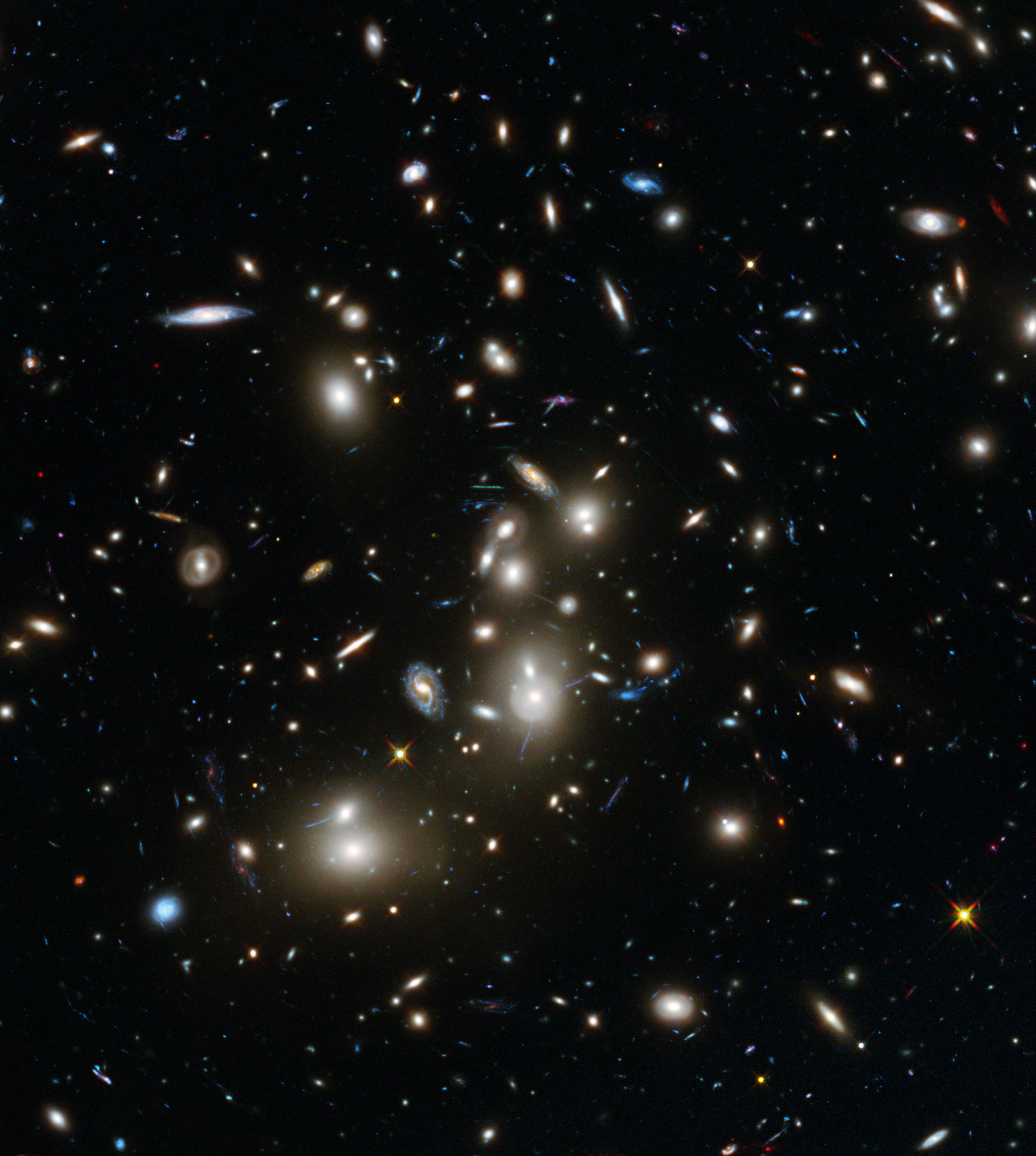
    Image of Abell 2744 from Hubble’s Frontier Fields observing program. Credit: NASA, ESA, and J. Lotz, M. Mountain, A. Koekemoer, and the HFF Team (STScI)

    Astronomers from the universities of Nottingham and Manchester have accurately measured the mass of neutrinos for the first time.

    Scientists have solved a major problem with the current standard model of cosmology by combining results from the Planck spacecraft and measurements of gravitational lensing to deduce the mass of ghostly sub-atomic particles called neutrinos.

    The team, from the universities of Nottingham and Manchester, used observations of the Big Bang and the curvature of space-time to accurately measure the mass of these elementary particles for the first time.

    The recent Planck spacecraft observations of the Cosmic Microwave Background (CMB) – the fading glow of the Big Bang – highlighted a discrepancy between these cosmological results and the predictions from other types of observations.

    The CMB is the oldest light in the Universe, and its study has allowed scientists to accurately measure cosmological parameters, such as the amount of matter in the Universe and its age. But an inconsistency arises when large-scale structures of the Universe, such as the distribution of galaxies, are observed.

    Dr. Adam Moss, from The University of Nottingham’s School of Physics and Astronomy said: “We observe fewer galaxy clusters than we would expect from the Planck results and there is a weaker signal from gravitational lensing of galaxies than the CMB would suggest.

    “A possible way of resolving this discrepancy is for neutrinos to have mass. The effect of these massive neutrinos would be to suppress the growth of dense structures that lead to the formation of clusters of galaxies.”

    Neutrinos interact very weakly with matter and so are extremely hard to study. They were originally thought to be massless but particle physics experiments have shown that neutrinos do indeed have mass and that there are several types, known as flavors by particle physicists. The sum of the masses of these different types has previously been suggested to lie above 0.06 eV (much less than a billionth of the mass of a proton).

    Dr. Moss and Professor Richard Battye from The University of Manchester have combined the data from Planck with gravitational lensing observations in which images of galaxies are warped by the curvature of space-time. They conclude that the current discrepancies can be resolved if massive neutrinos are included in the standard cosmological model. They estimate that the sum of masses of neutrinos is 0.320 +/- 0.081 eV (assuming active neutrinos with three flavors).

    Professor Battye added: “If this result is borne out by further analysis, it not only adds significantly to our understanding of the sub-atomic world studied by particle physicists, but it would also be an important extension to the standard model of cosmology which has been developed over the last decade.”

    Reference: “Evidence for Massive Neutrinos from Cosmic Microwave Background and Lensing Observations” by Richard A. Battye and Adam Moss, 6 February 2014, Physical Review Letters.
    DOI: 10.1103/PhysRevLett.112.051303
    arXiv:1308.5870

    Never miss a breakthrough: Join the SciTechDaily newsletter.
    Follow us on Google and Google News.

    Astrophysics Cosmology Neutrinos Particle Physics Popular University of Manchester University of Nottingham
    Share. Facebook Twitter Pinterest LinkedIn Email Reddit

    Related Articles

    The Most Powerful Neutrino Ever Detected May Have a Surprising Cosmic Source

    What if Dark Matter Has Two Forms? Bold New Hypothesis Could Explain a Cosmic Mystery

    In a First for Humanity, Scientists May Have Finally Seen Dark Matter

    Two Wild New Theories Could Finally Explain Dark Matter

    How Speeding Particles Froze Into Darkness: A Cosmic Plot Twist Explains Dark Matter

    When Stars Collide: Unveiling the Universe’s Hidden Particles

    Invisible Architects: New Link Discovered Between Dark Matter and Clumpiness of the Universe

    Neutrino Factories in Deep Outer Space: Elementary Particles From the Depths of Our Universe

    Nearly Pure Argon Left Undisturbed Since Earth’s Formation May Soon Whisper Secrets About Universe’s Dark Matter

    2 Comments

    1. jose zeledon on February 10, 2014 4:59 pm

      It’s either an accurate measurement of neutrino mass or the current estimates of dark matter concentration and distribution are not entirely accurate. There are a lot of ingredients in this cake mix.

      Reply
      • Geoffrey Wynne-Jones on July 6, 2014 8:43 pm

        If the universe turns out to be infinite, only a matter of time the CMB cannot be used to base calculations.
        Dark matter would then be black holes space would bs Euclidean and not curved and time continuous We would love to know the mass of the photon.
        Geoffrey Wynne-Jones

        Reply
    Leave A Reply Cancel Reply

    • Facebook
    • Twitter
    • Pinterest
    • YouTube

    Don't Miss a Discovery

    Subscribe for the Latest in Science & Tech!

    Trending News

    Popular Sugar-Free Sweetener Linked to Liver Disease, Study Warns

    What Is Hantavirus? The Deadly Disease Raising Alarm Worldwide

    Scientists Just Discovered How the Universe Builds Monster Black Holes

    Scientists Unveil New Treatment Strategy That Could Outsmart Cancer

    A Simple Vitamin May Hold the Key to Treating Rare Genetic Diseases

    Scientists Think the Real Fountain of Youth May Be Hiding in Your Gut

    Ravens Don’t Follow Wolves, They Predict Them

    This Common Knee Surgery May Be Doing More Harm Than Good

    Follow SciTechDaily
    • Facebook
    • Twitter
    • YouTube
    • Pinterest
    • Newsletter
    • RSS
    SciTech News
    • Biology News
    • Chemistry News
    • Earth News
    • Health News
    • Physics News
    • Science News
    • Space News
    • Technology News
    Recent Posts
    • Why Are So Many New Fathers Dying? Scientists Say the U.S. Has a Dangerous Blind Spot
    • Scientists Identify Simple Supplement That Greatly Reduces Alzheimer’s Damage
    • You May Have a Dangerous Type of Cholesterol Even if Your Tests Look Normal
    • Study Reveals Dangerous Flaw in AI Symptom Checkers
    • New MRI Breakthrough Captures Stunningly Clear Images of the Eye and Brain
    Copyright © 1998 - 2026 SciTechDaily. All Rights Reserved.
    • Science News
    • About
    • Contact
    • Editorial Board
    • Privacy Policy
    • Terms of Use

    Type above and press Enter to search. Press Esc to cancel.