
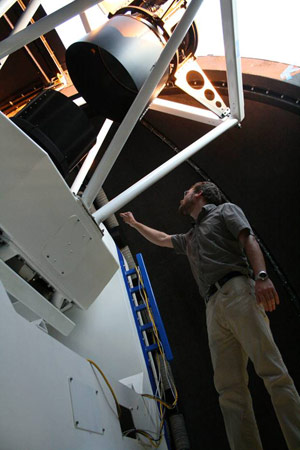
Using the ANU SkyMapper telescope at the Siding Spring Observatory, astronomers have discovered the oldest known star in the Universe.
A team led by astronomers at The Australian National University has discovered the oldest known star in the Universe, which formed shortly after the Big Bang 13.7 billion years ago.
The discovery has allowed astronomers for the first time to study the chemistry of the first stars, giving scientists a clearer idea of what the Universe was like in its infancy.
“This is the first time that we’ve been able to unambiguously say that we’ve found the chemical fingerprint of a first star,” said lead researcher, Dr Stefan Keller of the ANU Research School of Astronomy and Astrophysics.
“This is one of the first steps in understanding what those first stars were like. What this star has enabled us to do is record the fingerprint of those first stars.”
The star was discovered using the ANU SkyMapper telescope at the Siding Spring Observatory, which is searching for ancient stars as it conducts a five-year project to produce the first digital map of the southern sky.
The ancient star is around 6,000 light-years from Earth, which Dr. Keller says is relatively close in astronomical terms. It is one of the 60 million stars photographed by SkyMapper in its first year.
“The stars we are finding number one in a million,” says team member Professor Mike Bessell, who worked with Keller on the research.
“Finding such needles in a haystack is possible thanks to the ANU SkyMapper telescope that is unique in its ability to find stars with low iron from their color.”
Dr. Keller and Professor Bessell confirmed the discovery using the Magellan telescope in Chile.
The composition of the newly discovered star shows it formed in the wake of a primordial star, which had a mass 60 times that of our Sun.
“To make a star like our Sun, you take the basic ingredients of hydrogen and helium from the Big Bang and add an enormous amount of iron – the equivalent of about 1,000 times the Earth’s mass,” Dr. Keller says.
“To make this ancient star, you need no more than an Australia-sized asteroid of iron and lots of carbon. It’s a very different recipe that tells us a lot about the nature of the first stars and how they died.”
Dr Keller says it was previously thought that primordial stars died in extremely violent explosions which polluted huge volumes of space with iron. But the ancient star shows signs of pollution with lighter elements such as carbon and magnesium, and no sign of pollution with iron.
“This indicates the primordial star’s supernova explosion was of surprisingly low energy. Although sufficient to disintegrate the primordial star, almost all of the heavy elements such as iron, were consumed by a black hole that formed at the heart of the explosion,” he says.
The result may resolve a long-standing discrepancy between observations and predictions of the Big Bang.
The discovery was published in the latest edition of the journal Nature.
Reference: “A single low-energy, iron-poor supernova as the source of metals in the star SMSS J031300.36−670839.3” by S. C. Keller, M. S. Bessell, A. Frebel, A. R. Casey, M. Asplund, H. R. Jacobson, K. Lind, J. E. Norris, D. Yong, A. Heger, Z. Magic, G. S. Da Costa, B. P. Schmidt and P. Tisserand, 9 February 2014, Nature.
DOI: 10.1038/nature12990
arXiv:1402.1517
Never miss a breakthrough: Join the SciTechDaily newsletter.
Follow us on Google and Google News.
1 Comment
Along with this ancient cosmic evolution, which is the probability that within a galaxy like the milky way, from the dust of its exploded stars, the living being who uses a computer was formed – computer included? A favourable case among infinite unfavourable possibilities? Fifty-fifty? To be or not to be, is that the question? Or is it a zero followed by a radix point and an infinite amount of zeros behind, but finishing with a one emerging from error or compassion when rounding up? Are calculations simplified or made more complex when the subjective self of each one is the entity that is studied? Anyway , what is the relationship between life and immense numbers? Is life a folding process of infinity? Is it just something infinite that would have enough to allow a self, something isolated but of infinite claims? But, is infinity credible within something with a beginning, out of a Big Bang? And is it credible within something with an ending, with the inevitable death around the corner? Just another mind leisure suggestion, far away from dogmas or axioms.