

‘Magneto-rotational hypernova’ soon after the Big Bang fuelled high levels of uranium, zinc in ancient stellar oddity.
A massive explosion from a previously unknown source — 10 times more energetic than a supernova — could be the answer to a 13-billion-year-old Milky Way mystery.
Astronomers led by David Yong, Gary Da Costa, and Chiaki Kobayashi from Australia’s ARC Centre of Excellence in All Sky Astrophysics in 3 Dimensions (ASTRO 3D) based at the Australian National University (ANU) have potentially discovered the first evidence of the destruction of a collapsed rapidly spinning star — a phenomenon they describe as a “magneto-rotational hypernova”.
The previously unknown type of cataclysm — which occurred barely a billion years after the Big Bang — is the most likely explanation for the presence of unusually high amounts of some elements detected in another extremely ancient and “primitive” Milky Way star.
That star, known as SMSS J200322.54-114203.3, contains larger amounts of metal elements, including zinc, uranium, europium, and possibly gold, than others of the same age.
Neutron star mergers — the accepted sources of the material needed to forge them — are not enough to explain their presence.
The astronomers calculate that only the violent collapse of a very early star — amplified by rapid rotation and the presence of a strong magnetic field — can account for the additional neutrons required.
The research is published today (July 7, 2021) in the journal Nature.
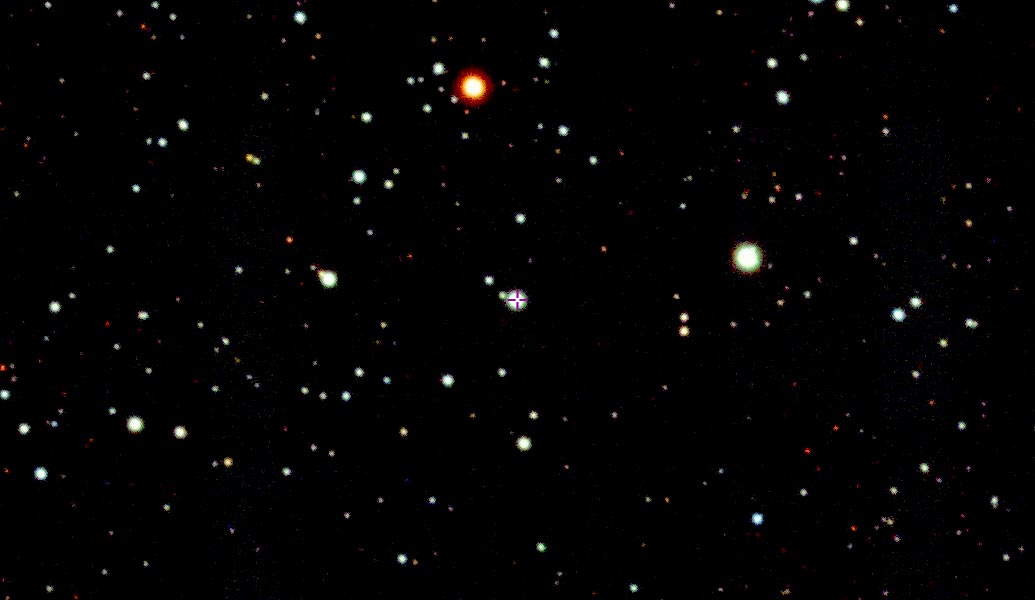
“The star we’re looking at has an iron-to-hydrogen ratio about 3000 times lower than the Sun — which means it is a very rare: what we call an extremely metal-poor star,” said Dr Yong, who is based at the ANU.
“However, the fact that it contains much larger than expected amounts of some heavier elements means that it is even rarer — a real needle in a haystack.”
Forging Heavy Elements in Cosmic Explosions
The first stars in the universe were made almost entirely of hydrogen and helium. At length, they collapsed and exploded, turning into neutron stars or black holes, producing heavier elements which became incorporated in tiny amounts into the next generation of stars — the oldest still in existence.
Rates and energies of these star deaths have become well known in recent years, so the amount of heavy elements they produce is well calculated. And, for SMSS J200322.54-114203.3, the sums just don’t add up.
“The extra amounts of these elements had to come from somewhere,” said Associate Professor Chiaki Kobayashi from the University of Hertfordshire, UK.
“We now find the observational evidence for the first time directly indicating that there was a different kind of hypernova producing all stable elements in the periodic table at once — a core-collapse explosion of a fast-spinning strongly-magnetized massive star. It is the only thing that explains the results.”
Hypernovae have been known since the late 1990s. However, this is the first time one combining both rapid rotation and strong magnetism has been detected.
Formed From Ancient Cosmic Debris
“It’s an explosive death for the star,” said Dr. Yong. “We calculate that 13 billion years ago J200322.54-114203.3 formed out of a chemical soup that contained the remains of this type of hypernova. No one’s ever found this phenomenon before.”
J200322.54-114203.3 lies 7500 light-years from the Sun, and orbits in the halo of the Milky Way.
Another co-author, Nobel Laureate and ANU Vice-Chancellor Professor Brian Schmidt, added, “The high zinc abundance is a definite marker of a hypernova, a very energetic supernova.”
Head of the First Stars team in ASTRO 3D, Professor Gary Da Costa from ANU, explained that the star was first identified by a project called the SkyMapper survey of the southern sky.
“The star was first identified as extremely metal-poor using SkyMapper and the ANU 2.3m telescope at Siding Spring Observatory in western NSW,” he said. “Detailed observations were then obtained with the European Southern Observatory 8m Very Large Telescope in Chile.”
ASTRO 3D director, Professor Lisa Kewley, commented: “This is an extremely important discovery that reveals a new pathway for the formation of heavy elements in the infant universe.”
Reference: “r-Process elements from magnetorotational hypernovae” by D. Yong, C. Kobayashi, G. S. Da Costa, M. S. Bessell, A. Chiti, A. Frebel, K. Lind, A. D. Mackey, T. Nordlander, M. Asplund, A. R. Casey, A. F. Marino, S. J. Murphy and B. P. Schmidt, 7 July 2021, Nature.
DOI: 10.1038/s41586-021-03611-2
Other members of the research team are based at the Massachusetts Institute of Technology in the US, Stockholm University in Sweden, the Max Planck Institute for Astrophysics in Germany, Italy’s Istituto Nazionale di Astrofisica, and Australia’s University of New South Wales.
Never miss a breakthrough: Join the SciTechDaily newsletter.
Follow us on Google and Google News.