
Close Menu
    Facebook X (Twitter) Instagram
    SciTechDaily
    • Biology
    • Chemistry
    • Earth
    • Health
    • Physics
    • Science
    • Space
    • Technology
    Facebook X (Twitter) Pinterest YouTube RSS
    SciTechDaily
    Home»Space»NASA Astrobiology Has Discovered a Ring of Material Around Star HD 191098
    Space

    NASA Astrobiology Has Discovered a Ring of Material Around Star HD 191098

    By NASA AstrobiologyNovember 17, 2019No Comments3 Mins Read
    Facebook Twitter Pinterest Telegram LinkedIn WhatsApp Email Reddit
    Share
    Facebook Twitter LinkedIn Pinterest Telegram Email Reddit
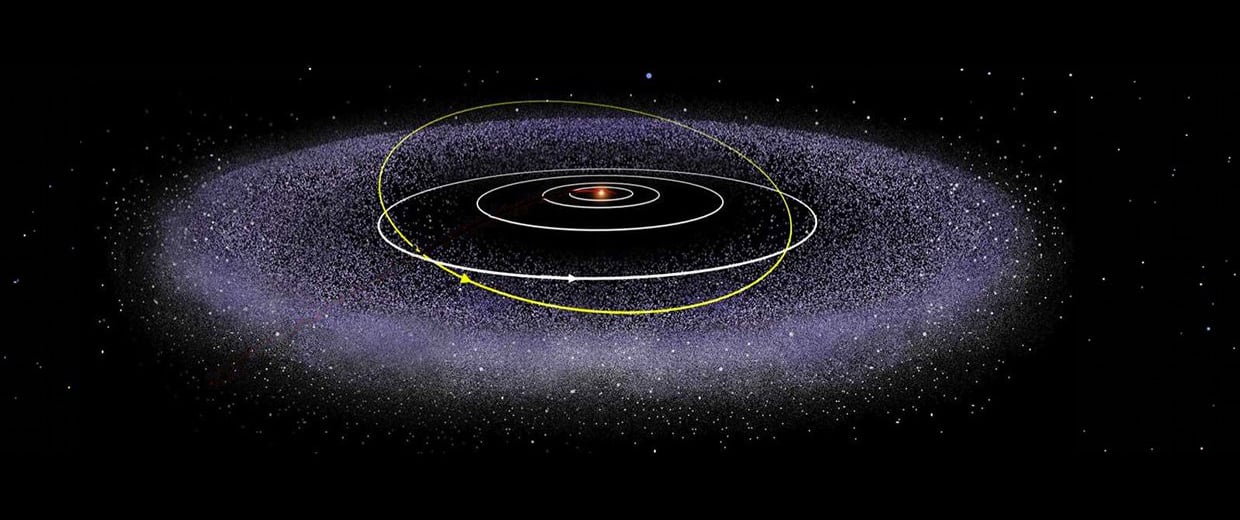
    The Kuiper Belt
    The Kuiper Belt is a region of leftover material from the Solar System’s early history and resembles a thick disk beyond the orbit of Neptune. Beyond the Kuiper Belt is the Oort Cloud. Both the Oort Cloud and the Kuiper Belt could be sources of comets. Credit: NASA

    Researchers supported in part by the NASA Astrobiology Program have discovered a ring of material around the star HD 191098 that resembles our solar system’s Kuiper Belt using scattered-light images from both space- and ground-based telescopes. Additionally, the team spotted a halo around the debris disk of HD 191089. Using radiative transfer modeling, the team was unable to describe a scenario that would consistently produce the observed structure of the system, and propose that more complex models are needed to explain its formation. Data was obtained using the Hubble Space Telescope and the Gemini Planet Imager (GPI), an instrument utilized on the Gemini South Telescope in Chile.

    The Solar System’s Kuiper Belt is a vast region of leftover material from the earliest period of our system’s formation. Studying the Kuiper Belt provides important insight into the history of the Solar System and can yield clues as to how the system ultimately became capable of supporting a habitable planet, the Earth. Identifying similar structures around other stellar systems provides a point of comparison, and could help astrobiologists better understand our own region of space.

    The study, “An Exo–Kuiper Belt with an Extended Halo around HD 191089 in Scattered Light,” was published on September 4, 2019, in The Astrophysical Journal. The work was supported by the Nexus for Exoplanet System Science (NExSS).  NExSS is a NASA  research coordination network supported in part by the  NASA Astrobiology Program. This program element is shared between NASA’s Planetary Science Division (PSD) and the Astrophysics Division. This research is a critical part of NASA’s work to understand the Universe, advance human exploration, and inspire the next generation. As NASA’s Artemis program moves forward with human exploration of the Moon, the search for life on other worlds remains a top priority for the agency.

    Reference: “An Exo–Kuiper Belt with an Extended Halo around HD 191089 in Scattered Light” by Bin Ren, Élodie Choquet, Marshall D. Perrin, Gaspard Duchêne, John H. Debes, Laurent Pueyo, Malena Rice, Christine Chen, Glenn Schneider, Thomas M. Esposito, Charles A. Poteet, Jason J. Wang, S. Mark Ammons, Megan Ansdell, Pauline Arriaga, Vanessa P. Bailey, Travis Barman, Juan Sebastián Bruzzone, Joanna Bulger, Jeffrey Chilcote, Tara Cotten, Robert J. De Rosa, Rene Doyon, Michael P. Fitzgerald, Katherine B. Follette, Stephen J. Goodsell, Benjamin L. Gerard, James R. Graham, Alexandra Z. Greenbaum, J. Brendan Hagan, Pascale Hibon, Dean C. Hines, Li-Wei Hung, Patrick Ingraham, Paul Kalas, Quinn Konopacky, James E. Larkin, Bruce Macintosh, Jérôme Maire, Franck Marchis, Christian Marois, Johan Mazoyer, François Ménard, Stanimir Metchev, Maxwell A. Millar-Blanchaer, Tushar Mittal, Margaret Moerchen, Eric L. Nielsen, Mamadou N’Diaye, Rebecca Oppenheimer, David Palmer, Jennifer Patience, Christophe Pinte, Lisa Poyneer, Abhijith Rajan, Julien Rameau, Fredrik T. Rantakyrö, Jean-Baptiste Ruffio, Dominic Ryan, Dmitry Savransky, Adam C. Schneider, Anand Sivaramakrishnan, Inseok Song, Rémi Soummer, Christopher Stark, Sandrine Thomas, Arthur Vigan, J. Kent Wallace, Kimberly Ward-Duong, Sloane Wiktorowicz, Schuyler Wolff, Marie Ygouf and Colin Norman, 4 September 2019, The Astrophysical Journal.
    DOI: 10.3847/1538-4357/ab3403

    Never miss a breakthrough: Join the SciTechDaily newsletter.
    Follow us on Google and Google News.

    Astrobiology Astronomy Kuiper Belt NASA
    Share. Facebook Twitter Pinterest LinkedIn Email Reddit

    Related Articles

    Scientists Propose a Radical New Method To Find Alien Life

    Titan’s Hidden Ocean May Not Exist and That Changes Everything

    Unveiling Alien Oceans: Webb’s Breakthrough in the Hunt for Life

    3.7 Billion Miles Away: Hubble Uncovers a Hidden Trio That Could Rewrite Kuiper Belt History

    NASA’s Webb Just Found Something Unexpected Beyond Neptune

    New Modeling Reveals that Tilted Orbits Could Make More Worlds Habitable

    Scientists Discover Evidence of Water in Martian Meteorite

    Online Database Tracks Organic Nano-Particles Across the Universe

    “Habitable Zone” Might Help Extreme Life Forms Survive on Exoplanets

    Leave A Reply Cancel Reply

    • Facebook
    • Twitter
    • Pinterest
    • YouTube

    Don't Miss a Discovery

    Subscribe for the Latest in Science & Tech!

    Trending News

    Scientists Warn That This Common Pet Fish Can Wreck Entire Ecosystems

    Scientists Make Breakthrough in Turning Plastic Trash Into Clean Fuel Using Sunlight

    This Popular Supplement May Interfere With Cancer Treatment, Scientists Warn

    Scientists Finally Solved One of Water’s Biggest Mysteries

    Could This New Weight-Loss Pill Disrupt the Entire Market? Here’s What You Should Know About Orforglipron

    Earth’s Crust Is Tearing Open in Africa, and It Could Form a New Ocean

    Breakthrough Bowel Cancer Trial Leaves Patients Cancer-Free for Nearly 3 Years

    Natural Compound Shows Powerful Potential Against Rheumatoid Arthritis

    Follow SciTechDaily
    • Facebook
    • Twitter
    • YouTube
    • Pinterest
    • Newsletter
    • RSS
    SciTech News
    • Biology News
    • Chemistry News
    • Earth News
    • Health News
    • Physics News
    • Science News
    • Space News
    • Technology News
    Recent Posts
    • Kratom Use Explodes in the US, With Life-Changing Consequences
    • Scientists Uncover Fatal Weakness in “Zombie Cells” Linked to Cancer
    • World-First Study Reveals Human Hearts Can Regenerate After a Heart Attack
    • Why Your Dreams Feel So Real Sometimes and So Strange Other Times
    • Scientists Debunk 100-Year-Old Belief About Brain Cells, Rewriting Textbooks
    Copyright © 1998 - 2026 SciTechDaily. All Rights Reserved.
    • Science News
    • About
    • Contact
    • Editorial Board
    • Privacy Policy
    • Terms of Use

    Type above and press Enter to search. Press Esc to cancel.