
Close Menu
    Facebook X (Twitter) Instagram
    SciTechDaily
    • Biology
    • Chemistry
    • Earth
    • Health
    • Physics
    • Science
    • Space
    • Technology
    Facebook X (Twitter) Pinterest YouTube RSS
    SciTechDaily
    Home»Space»Mystery About How Particles Behave Outside a Black Hole Photon Sphere Solved With String Theory
    Space

    Mystery About How Particles Behave Outside a Black Hole Photon Sphere Solved With String Theory

    By Kavli Institute for the Physics and Mathematics of the UniverseApril 8, 20212 Comments3 Mins Read
    Facebook Twitter Pinterest Telegram LinkedIn WhatsApp Email Reddit
    Share
    Facebook Twitter LinkedIn Pinterest Telegram Email Reddit
    String Passing Near Black Hole
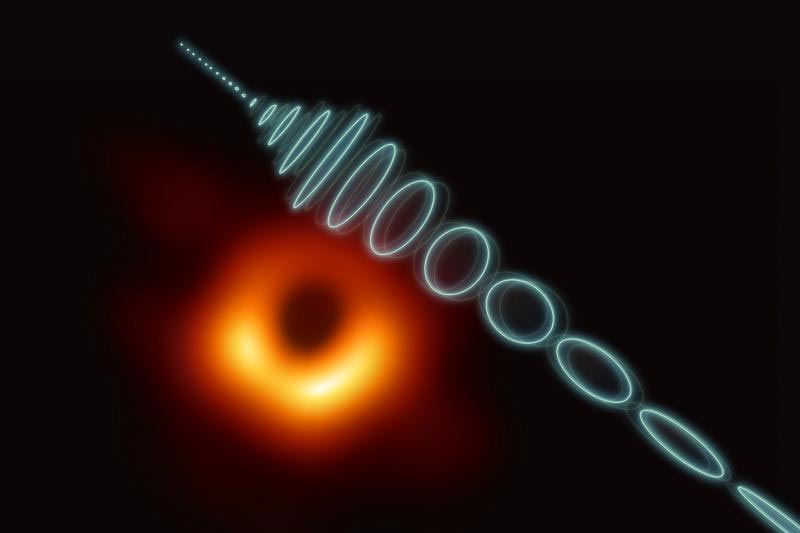
    An artist’s impression of a “string” passing near a black hole. As the string approaches the black hole, it is gradually stretched. Then, as it moves past the black hole, it begins to vibrate. The image to the left, which was captured by the Event Horizon Telescope, represents the shadow of the supermassive black hole at the center of the galaxy M87, including the ring of light around it. Credit: EHT Collaboration; Kavli IPMU (Kavli IPMU modified EHT’s original image))

    New research shows that string theory smooths out quantum singularities near black holes by accounting for tidal stretching of strings, offering insight into the structure of quantum gravity.

    A paper by the Kavli Institute for the Physics and Mathematics of the Universe (Kavli IPMU) Director Ooguri Hirosi and Project Researcher Matthew Dodelson on the string theoretical effects outside the black hole photon sphere has been selected for the “Editors’ Suggestion” of the journal Physical Review D. Their paper was published on March 24, 2021.

    In a quantum theory of point particles, a fundamental quantity is the correlation function, which measures the probability for a particle to propagate from one point to another. The correlation function develops singularities when the two points are connected by light-like trajectories. In a flat spacetime, there is such a unique trajectory, but when spacetime is curved, there can be many light-like trajectories connecting two points. This is a result of gravitational lensing, which describes the effect of curved geometry on the propagation of light.

    In the case of a black hole spacetime, there are light-like trajectories winding around the black hole several times, resulting in a black hole photon sphere, as seen in the recent images by the Event Horizon Telescope (EHT) of the supermassive black hole at the center of the galaxy M87. 

    Released on April 10, 2019, the EHT Collaboration’s images captured the shadow of a black hole and its photon sphere, the ring of light surrounding it. A photon sphere can occur in a region of a black hole where light entering in a horizontal direction can be forced by gravity to travel in various orbits. These orbits lead to singularities in the aforementioned correlation function.

    However, there are cases when the singularities generated by trajectories winding around a black hole multiple times contradict with physical expectations. Dodelson and Ooguri have shown that such singularities are resolved in string theory. 

    Stretching Strings Around Black Holes

    In string theory, every particle is considered as a particular excited state of a string. When the particle travels along a nearly light-like trajectory around a black hole, the spacetime curvature leads to tidal effects, which stretch the string. 

    Dodelson and Ooguri showed that, if one takes these effects into account, the singularities disappear consistently with physical expectations. Their result provides evidence that a consistent quantum gravity must contain extended objects such as strings as its degrees of freedom. 

    Ooguri says, “Our results show how string theoretical effects are enhanced near a black hole. Though the effects we found are not strong enough to have an observable consequence on ETH’s black hole image, further research may show us a way to test string theory using black holes.” 

    Reference: “Singularities of thermal correlators at strong coupling” by Matthew Dodelson and Hirosi Ooguri, 24 March 2021, Physical Review D.
    DOI: 10.1103/PhysRevD.103.066018

    Never miss a breakthrough: Join the SciTechDaily newsletter.
    Follow us on Google and Google News.

    Astrophysics Black Hole Kavli Institute Particle Physics Popular String Theory
    Share. Facebook Twitter Pinterest LinkedIn Email Reddit

    Related Articles

    Two Wild New Theories Could Finally Explain Dark Matter

    At the Dawn of Time: MIT Physicists Link Dark Matter to “Super-Charged” Microscopic Black Holes

    Peering Into the Cosmic Dawn: Researchers Detect the Host Galaxies of Quasars in the Early Universe

    Louder Than Expected: Gravitational Waves From Merging Supermassive Black Holes “Heard” for First Time

    String Theory’s Surprising Twist: Black Holes Might Be Defects in Spacetime

    Faux Hole Phenomenon: Could This Copycat Black Hole Be a New Type of Star?

    Researchers Find the Origin and Maximum Mass of Massive Black Holes Observed by Gravitational Wave Detectors

    25-Year-Old Astrophysics Puzzle Explained by Powerful Jets From Supermassive Black Holes?

    Black Holes Have Properties That Resemble the Dynamics of Solids and Liquids

    2 Comments

    1. xABBAAA on April 8, 2021 4:22 am

      … great result, however one needs to find experimental proof for a string, though…

      Reply
    2. Aleksandr7364 on April 8, 2021 4:52 am

      There are no strings around the black holes. All strings are assembled by string gravity, frequency 1.8 * 10 ^ 43 Hertz, in the Center of Our Universe. Around black holes there is a frequency of 10 ^ 32 Hertz, at which a black hole is held in orbit around the universe, and the frequency
      10 ^ 20 Hertz, on which it holds stars in its orbit.
      https://www.youtube.com/watch?v=tFUM3vAlaGc

      Reply
    Leave A Reply Cancel Reply

    • Facebook
    • Twitter
    • Pinterest
    • YouTube

    Don't Miss a Discovery

    Subscribe for the Latest in Science & Tech!

    Trending News

    One of the Universe’s Largest Stars May Be Getting Ready To Explode

    Scientists Discover Enzyme That Could Supercharge Ozempic-Like Weight Loss Drugs

    Popular Sweetener Linked to DNA Damage – “It’s Something You Should Not Be Eating”

    Ancient “Rock” Microbes May Reveal How Complex Life Began

    Researchers Capture Quantum Interference in One of Nature’s Rarest Atoms

    “A Plague Is Upon Us”: The Mass Death That Changed an Ancient City Forever

    Scientists Discover Game-Changing New Way To Treat High Cholesterol

    This Small Change to Your Exercise Routine Could Be the Secret to Living Longer

    Follow SciTechDaily
    • Facebook
    • Twitter
    • YouTube
    • Pinterest
    • Newsletter
    • RSS
    SciTech News
    • Biology News
    • Chemistry News
    • Earth News
    • Health News
    • Physics News
    • Science News
    • Space News
    • Technology News
    Recent Posts
    • Natural Compounds Boost Bone Implant Success While Killing Bacteria and Cancer Cells
    • After 60 Years, Scientists Uncover Unexpected Brain Effects of Popular Diabetes Drug Metformin
    • New Research Uncovers Hidden Side Effects of Popular Weight-Loss Drugs
    • Scientists Rethink Extreme Warming After Surprising Ocean Discovery
    • The Surprising Role of Asteroids in the Origin of Life
    Copyright © 1998 - 2026 SciTechDaily. All Rights Reserved.
    • Science News
    • About
    • Contact
    • Editorial Board
    • Privacy Policy
    • Terms of Use

    Type above and press Enter to search. Press Esc to cancel.