
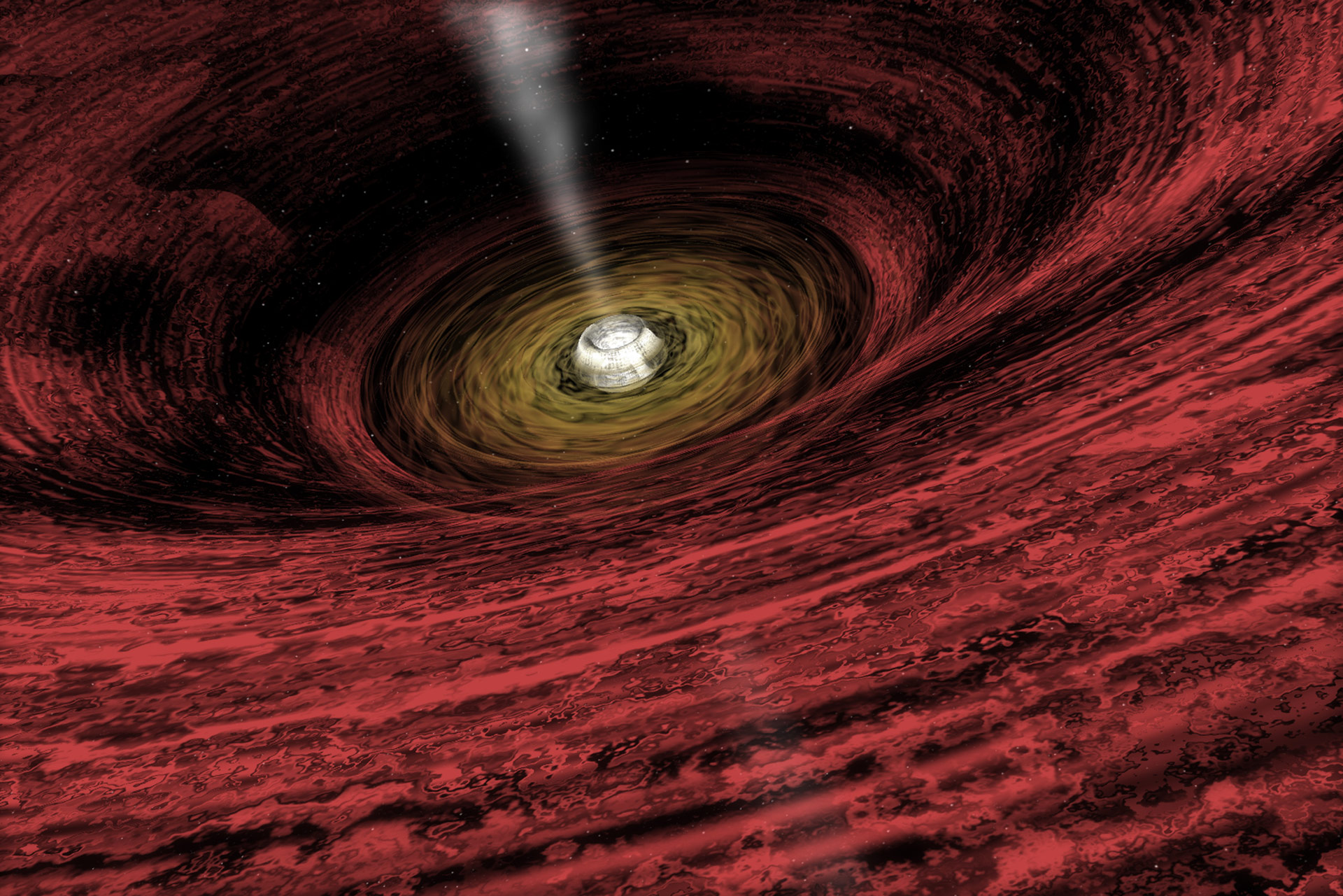
A new study from the Perimeter Institute for Theoretical Physics reveals the turbulent nature of black holes, showing that gravitational fields around black holes might eddy and swirl.
Fasten your seatbelts – gravity is about to get bumpy.
Of course, if you’re flying in the vicinity of a black hole, a bit of extra bumpiness is the least of your worries. But it’s still surprising. The accepted wisdom among gravitational researchers has been that spacetime cannot become turbulent. New research from Perimeter, though, shows that the accepted wisdom might be wrong.
The researchers followed this line of thought: Gravity, it’s thought, can behave as a fluid. One of the characteristic behaviors of fluids is turbulence – that is, under certain conditions, they don’t move smoothly, but eddy and swirl. Can gravity do that too?
Perimeter Faculty member Luis Lehner explains why it might make sense to treat gravity as a fluid. “There’s a conjecture in physics – the holographic conjecture – which says gravity can be described as a field theory,” he says. “And we also know that at high energies, field theories can be described with the mathematical tools we use to describe fluids. So it’s a two-step dance: gravity equals field theory, and field theory equals fluids, so gravity equals fields equals fluids. That’s called the gravity/fluids duality.”
The gravity/fluids duality is not new work – it’s been developing over the past six years. But hidden at the heart of it is a tension. If gravity can be treated as a fluid, then what about turbulence?
“For many years, the folklore among physicists was that gravity could not be turbulent,” notes Lehner. The belief was that gravity is described by a set of equations that are sufficiently different from fluid dynamics equations, such that there would not be turbulence under any circumstances.
Lehner highlights the emerging paradox: “Either there was a problem with the duality and gravity really can’t be fully captured by a fluid description, or there was a new phenomenon in gravity and turbulent gravity really can exist.” A team of researchers – Lehner, Huan Yang (Perimeter and the Institute for Quantum Computing), and Aaron Zimmerman (Canadian Institute for Theoretical Astrophysics) – set out to find out which.
They had hints about what directions to go. Previous simulations at Perimeter, and independent work out of MIT, had hinted that there could be turbulence around the non-realistic case of black holes confined in anti-de Sitter space. “There might be turbulence if you confine gravity in a box, essentially,” says Lehner. “The deeper question is whether this can happen in a realistic situation.”
The team decided to study fast-spinning black holes, because a fluid-dynamics description of such holes hints that the spacetime around them is less viscous than the spacetime around other kinds of black holes. Low viscosity increases the chance of turbulence – think of the way water is more swirly than molasses.
The team also decided to study non-linear perturbations of the black holes. Gravitational systems are rarely analyzed at this level of detail, as the equations are fiendishly complex. But, knowing that turbulence is fundamentally non-linear, the team decided a non-linear perturbation analysis was exactly what was called for.
They were stunned when their analysis showed that spacetime did become turbulent.
“I was quite surprised,” says Yang, who has been studying general relativity (GR) – Einstein’s theory of gravity – since his PhD. “I never believed in turbulent behavior in GR, and for good reason. No one had ever seen it in numerical simulations, even of dramatic things like binary black holes.”
“Over the past few years, we have gone from a serious doubt about whether gravity can ever go turbulent, to pretty high confidence that it can,” says Lehner.
How did this behavior hide until now? “It was hidden because the analysis needed to see it has to go to non-linear orders,” says Yang. “People didn’t have enough motivation to do a non-linear study. But, this time, we knew what we were looking for. It gave us the motivation to do a more in-depth study. We had a target and we hit it.”
This is theoretical work, but it might not stay that way. There are next-generation detectors about to come online which might soon be able to detect gravitational waves – ripples in the gravitational “fluid” that result from big events like the collision of two black holes. If gravitation can be turbulent, then those ripples might be a bit different than previous models suggest. Knowing about these differences may make gravitational waves easier to spot. And, of course, actually detecting these differences would be direct evidence of gravitational turbulence.
“There are potential observational consequences of this discovery,” says Lehner. “LIGO or LISA or some future gravitational wave experiment may be able to detect them.”
But one of the most exciting consequences of this research relates not to gravity, but to ordinary, Earth-bound turbulence. From hurricanes to cream stirred into coffee, from the bumblebee’s impossible flight to the vortices shearing off the end of airplane wings, turbulence is all around us. Yet we don’t fully understand it. It’s considered one of the greatest unsolved problems in classical physics.
This research strengthens the idea that gravity can be treated as a fluid – which also means that fluids can be treated gravitationally.
“We’ve been stuck for over 500 years on achieving a full understanding of turbulence,” says Lehner. “This gravity/fluid correspondence tells us that there is a way to use gravitational tools and gravitational intuition to take a fresh look at turbulence. We may end up as stuck as we are in our standard approach, or we may end up shedding completely new light that helps the field go forward. It’s very exciting.”
Reference: “Turbulent Black Holes” by Huan Yang, Aaron Zimmerman and Luis Lehner, 23 February 2015, Physical Review Letters.
DOI: 10.1103/PhysRevLett.114.081101
arXiv: 1402.4859
Never miss a breakthrough: Join the SciTechDaily newsletter.
Follow us on Google and Google News.
2 Comments
turbulance or change is the essence of everything also gravity
This concept is just another theoretical phenomenon called frame dragging, where gravity interacts with spacetime, which is influenced by the dense gravitational fields that are rotating around a black hole. This creates a gradient swirling vortex, like a whirlpool of spacetime, that is dragged along by the gravity of the rotating event horizon.