
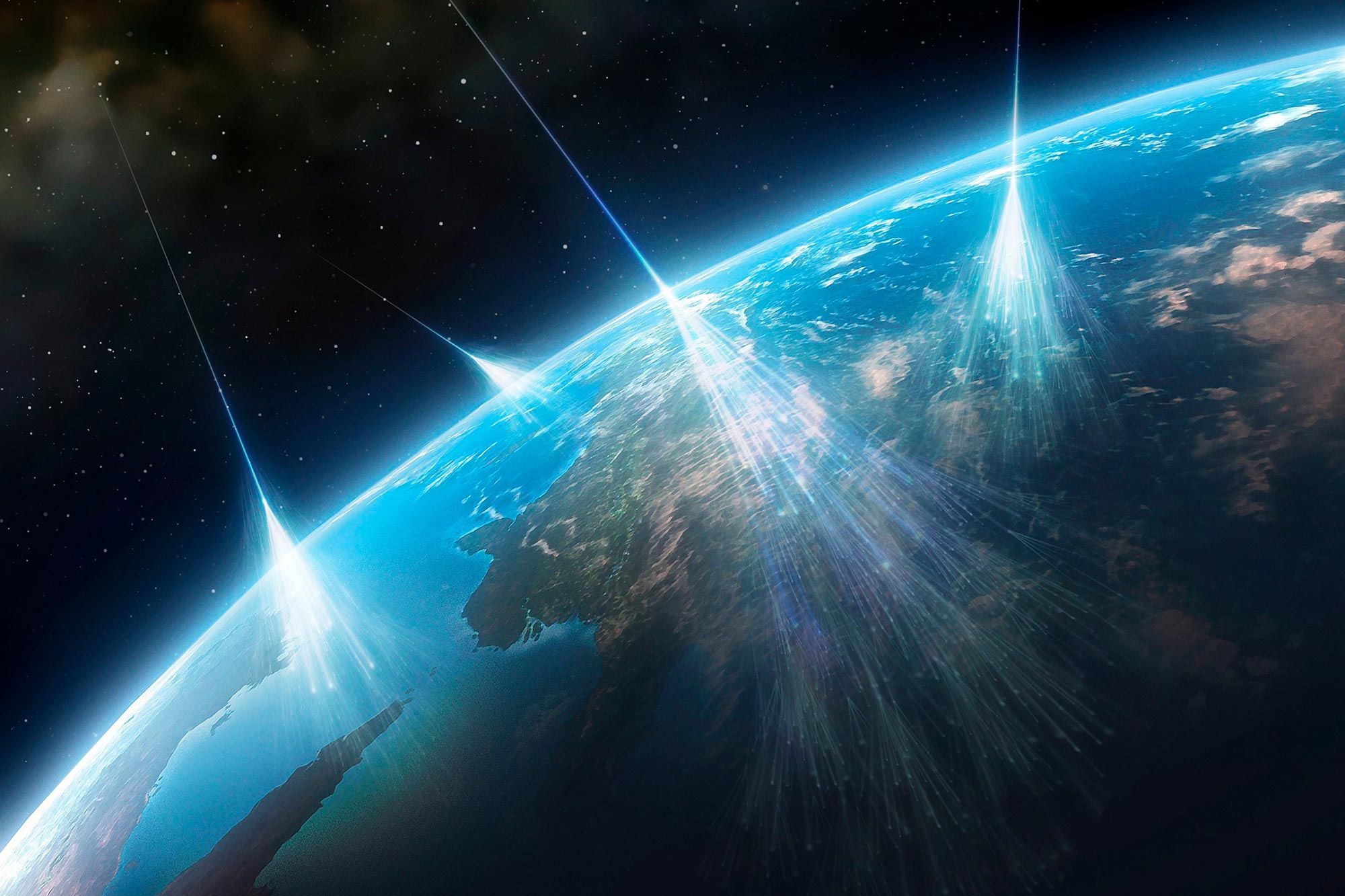
Chinese researchers have identified black holes as the likely source of the high-energy component of the cosmic-ray “knee.”
Milestone findings released on November 16 by the Large High Altitude Air Shower Observatory (LHAASO) have provided a major breakthrough in explaining a long-standing puzzle in cosmic ray research. Scientists have spent decades trying to understand why the cosmic ray energy spectrum shows a sudden drop in particle numbers above 3 PeV, a feature commonly referred to as the “knee.”
The reason behind this “knee” has remained unresolved since it was first identified nearly 70 years ago. For many years, researchers have suggested that it might be tied to the maximum energies achievable by astrophysical sources that produce cosmic rays, possibly marking a shift from one power-law pattern in the spectrum to another.
Today, new evidence is pointing to a clearer explanation. Two studies, published in National Science Review and Science Bulletin, show that micro-quasars powered by black hole system accretion act as highly efficient particle accelerators within the Milky Way. These systems now appear to be the most likely contributors to the “knee,” and the findings also shed new light on the extreme physical activity associated with black holes.
Scientists from the Institute of High Energy Physics of the Chinese Academy of Sciences (CAS), Nanjing University, the University of Science and Technology of China of CAS, La Sapienza University of Rome, and several partner institutions participated in the research effort.
First Systematic Detection of Ultra-High-Energy Gamma Rays
Black holes are among the most mysterious objects in the cosmos. When they draw in material from companion stars in binary systems, they produce fast-moving jets that create what are known as “micro-quasars.” In the new study, LHAASO reported the first systematic detection of ultra-high-energy gamma rays from five such micro-quasars: SS 433, V4641 Sgr, GRS 1915+105, MAXI J1820+070, and Cygnus X-1.
In particular, the ultra-high-energy radiation from SS 433 was found to overlap with a giant atomic cloud, strongly suggesting that the high-energy protons are accelerated by the black hole and collide with surrounding matter. The proton energy in this system exceeded 1 PeV, with a total power output of approximately 1032 joules per second, equivalent to the energy released per second by four trillion of the most powerful hydrogen bombs.

The gamma-ray energy from V4641 Sgr was found to reach 0.8 PeV, making it another “super PeV particle accelerator,” while the parent particles generating these gamma rays had energies exceeding 10 PeV.
These results prove that micro-quasars are significant PeV particle accelerators in the Milky Way, addressing a long-standing issue in science: While supernova remnants were historically recognized as cosmic ray sources, both observational and theoretical studies have shown that they cannot accelerate cosmic rays to the energies of the “knee” and beyond.
A Breakthrough in Measuring Proton Spectra
To fully understand this phenomenon, precise measurements of the energy spectra of the various cosmic ray species including their respective “knees” are essential. The first step is to measure the energy spectrum of the lightest nuclei—protons. However, cosmic rays in the “knee” region are sparse and satellite detectors have limited acceptance, making detection akin to finding a needle in a haystack. In ground-based indirect measurements of cosmic ray particles, it is impossible to avoid atmospheric interference. This makes it difficult to distinguish protons from other nuclei. For a long time, this measurement was considered impossible.
In this study, leveraging its world-leading ground-based cosmic ray observational equipment, LHAASO developed multi-parameter measurement techniques and selected a large statistical sample of high-purity protons, allowing for precise measurement of their energy spectrum, with precision comparable to that of satellite experiments. This measurement revealed an energy spectrum structure that was entirely unexpected, clearly displaying a new “high-energy component” instead of a simple transition between power-law spectra.
LHAASO’s new findings, together with the low-energy component measured by the space-borne AMS-02 experiment and the intermediate-energy component measured by the space-borne DArk Matter Particle Explorer (DAMPE) experiment, revealed the existence of multiple accelerators within the Milky Way, with each possessing its own unique acceleration capability and energy range. The “knee” represents the acceleration limit of the sources responsible for generating the high-energy component.
A Unified Scientific Picture Emerges
The complex structure of the proton energy spectrum indicates that cosmic ray protons in the PeV energy range primarily originate from “new sources” such as micro-quasars, which have an acceleration limit significantly higher than that of supernova remnants. This enables them to generate high-energy cosmic rays that exceed the “knee.”
These two discoveries support each other, presenting a comprehensive scientific picture. This not only marks a significant advancement in resolving the long-standing mystery of the “knee” origin, but also offers crucial observational evidence for understanding the role of black holes in the origin of cosmic rays.
LHAASO’s hybrid detector array design allows for the detection of cosmic ray sources through ultra-high-energy gamma rays, while enabling precise measurement of cosmic ray particles in the vicinity of the solar system. This approach offers insights into the acceleration capabilities of sources at PeV energies and the spectral characteristics they contribute to cosmic rays. For the first time, the “knee” structure has been observationally connected to a specific type of astrophysical source—the black hole jet system.
LHAASO, which was designed, constructed, and is operated by Chinese scientists, has taken the lead in high-energy cosmic-ray research due to its sensitivity in both gamma-ray astronomical exploration and cosmic ray precision measurement. It has achieved a series of discoveries that have a global impact, thereby contributing to our knowledge of the extreme physical processes in the universe.
References: “Precise measurements of the cosmic ray proton energy spectrum in the “knee” region” by the LHAASO Collaboration, 12 November 2025, Science Bulletin.
DOI: 10.1016/j.scib.2025.10.048
“Ultrahigh-energy gamma-ray emission associated with black hole-jet systems” by the LHAASO Collaboration, 16 November 2025, National Science Review.
DOI: 10.1093/nsr/nwaf496
Never miss a breakthrough: Join the SciTechDaily newsletter.
Follow us on Google and Google News.
6 Comments
I must admit, the language here, as an outsider, has me puzzled me. The ‘knee,’ it says, shows lees particles in the higher range. (“spectrum shows a sudden drop in particle numbers”).
I presume they must be thinking photons as particles – where photons are specifically quantized description for energy, not particles in fact – even though the catchy Pho ‘fire’ (light) tons (ions) means ‘light-particle’ – which was Lewis’ name for Einstein’s Energy Packets, a quip offered reporters of the time.
Ya know, they’ll have hard time going beyond the Standard Model if they keep this stuff up. But as long as you’re sure you’re right when working with a system you believe is wrong – you’re gonna have a hard time getting out of your rut.
VERY GOOD!!! Photons are specifically quantized description for energy.
The Topological Vortex Theory (TVT) predicts the existence of spacetime vortices in the universe, and has been validated and applied in multiple fields:
1. Climate Change Research: Studies based on TVT have analyzed paleoclimate data and fluid dynamics simulations, verifying the influence of the axial tilt coupling effect of cosmic-scale vortex networks on Earth’s energy redistribution. This provides a new explanation for climate phenomena that cannot be explained by traditional Earth-Sun distance theories.
2. Antimatter Research: The theory offers a new perspective on understanding antimatter, suggesting that the distinction between matter and antimatter has strict topological origins. It also questions whether the “antiparticles” observed in existing experiments are the strict antimatter counterparts of their corresponding particles.
3. Artificial Intelligence (AI): TVT has been applied to simulate the abrupt, leap-like characteristics of human thought. By abstracting the activation patterns of neuronal clusters as a topological phase transition process in a spacetime vortex network, it provides a theoretical framework for developing AI systems with human-like cognitive abilities.
Although vortex rings are extremely simple, their interactions are exceptionally complex. Physics needs to develop more and richer mathematical languages to understand and describe them. Quantized description is just the tip of the iceberg of these vortex ring interactions.
—— References https://scitechdaily.com/microscope-spacecrafts-most-precise-test-of-key-component-of-the-theory-of-general-relativity/#comment-910399.
The key difference between TVT and traditional physics (e.g., Newtonian mechanics, relativity, quantum mechanics) lies in its perspective on describing the universe. TVT emphasizes the ideal fluid properties and topological structure of space, rather than focusing solely on the direct interactions of particles and forces. This perspective offers a new paradigm for understanding the structure of the universe. Its core predictions (e.g., cosmic-scale vortex networks) have been confirmed across multiple disciplines. For example:
Topological structures, such as vortices, are prevalent in nature and science across a wide range of length scales, ranging from macroscopic cosmic strings (1), mesoscale liquid crystals (2, 3) and ferromagnets (4), nanoscale ferroelectrics and superconductor/superfluid Bose-Einstein condensate states (5, 6), down to the atomic nucleus (7).
——Excerpted from https://www.science.org/doi/10.1126/sciadv.adu6223.
VERY GOOD! Contemporary physics are sure they are right when working with a system they believe is wrong – they are gonna have a hard time getting out of their rut.
When we pursue the ultimate truth of all things, the space in which our bodies and all things exist may itself be the final and deepest puzzle we need to explore. This is not only the pursuit of physics, but also the most magnificent exploration of the origin of the universe by human reason.
Based on the Topological Vortex Theory (TVT), space is an uniformly incompressible physical entity. Space-time vortices are the products of topological phase transitions of the tipping points in space, are the point defects in spacetime. Point defects do not only impact the thermodynamic properties, but are also central to kinetic processes. They create all things and shape the world through spin and self-organization.
In today’s physics, some so-called peer-reviewed journals—including Physical Review Letters, Nature, Science, and others—stubbornly insist on and promote the following:
1. Even though θ and τ particles exhibit differences in experiments, physics can claim they are the same particle. This is science.
2. Even though topological vortices and antivortices have identical structures and opposite rotational directions, physics can define their structures and directions as entirely different. This is science.
3. Even though two sets of cobalt-60 rotate in opposite directions and experiments reveal asymmetry, physics can still define them as mirror images of each other. This is science.
4. Even though vortex structures are ubiquitous—from cosmic accretion disks to particle spins—physics must insist that vortex structures do not exist and require verification. Only the particles that like God, Demonic, or Angelic are the most fundamental structures of the universe. This is science.
5. Even though everything occupies space and maintains its existence in time, physics must still debate and insist on whether space exists and whether time is a figment of the human mind. This is science.
6. Even though space, with its non-stick, incompressible, and isotropic characteristics, provides a solid foundation for the development of physics, physics must still insist that the ideal fluid properties of space do not exist. This is science.
and go on.
Is this the counterintuitive science they widely promote? Compromising with pseudo academic publications and peer review by pseudo scholars is an insult to science and public intelligence. Some so-called scholars no longer understand what shame is. The study of Topological Vortex Theory (TVT) reminds us that the most profound problems in physics often lie at the intersection of different theories. By exploring these border regions, we can not only resolve contradictions in existing theories but also discover new physical phenomena and application possibilities.
Under the topological vortex architecture, it is highly challenging for even two hydrogen atoms or two quarks to be perfectly symmetrical, let alone counter-rotating two sets of cobalt-60. Contemporary physics and so-called peer-reviewed publications (including Physical Review Letters, Science, Nature, etc.) stubbornly believe that two sets of counter rotating cobalt-60 are two mirror images of each other, constructing a more shocking pseudoscientific theoretical framework in the history of science than the “geocentric model”. This pseudo scientific framework and system have seriously hindered scientific progress and social development.
For nearly a century, physics has been manipulated by this pseudo scientific theoretical system and the interest groups behind it, wasting a lot of manpower, funds, and time. A large amount of pseudo scientific research has been conducted, and countless pseudo scientific papers have been published, causing serious negative impacts on scientific and social progress, as well as humanistic development.
Complexity does not necessarily mean that there is no logical and architectural framework to follow. Mathematics is the language and tool that reveals the motion of spacetime, rather than the motion itself. Although the physical form of spacetime vortices is extremely simple, their interaction patterns are highly complex, and we must develop more and richer mathematical languages to describe and understand them.
The development of the Topological Vortex Theory (TVT) reflects a progression from concrete physical phenomena to abstract mathematical modeling and, ultimately, to interdisciplinary unification. Its core innovation lies in forging the continuous spacetime geometry of general relativity with the discrete interactions of quantum field theory within the same topological dynamical system.
——Excerpted from https://scitechdaily.com/microscope-spacecrafts-most-precise-test-of-key-component-of-the-theory-of-general-relativity/#comment-909171.
Compromise with pseudoscience and pseudo academic publications is to commit a crime against scientific progress and human advancement. Incommensurability is a core concept introduced by American philosophers of science Thomas Kuhn and Paul Feyerabend to describe the incomparability between successive paradigms during scientific revolutions. This theory emphasizes the fundamental differences between paradigms in their linguistic systems, taxonomic categories, and value judgments, which prevent them from being directly compared or translated through a common standard. In his work The Structure of Scientific Revolutions, Kuhn used this concept alongside “paradigm” to construct a discontinuous model of scientific development.
Topological vortex theory (TVT) not only provides a solid mathematical description for exotic excitations in low-dimensional spacetime but also plays a central role in connecting physical laws across different dimensions. The study of topological vortices and dimensional evolution not only deepens our understanding of nature’s fundamental laws but also prompts us to rethink the very nature of the most basic concepts: “spacetime” and “matter.”
——Excerpted from https://scitechdaily.com/microscope-spacecrafts-most-precise-test-of-key-component-of-the-theory-of-general-relativity/#comment-910609.
Pow-Hua! Y’all have been ZHANGED!
Thank you for your attention.
Scientific progress is the crystallization of human wisdom, while religious tribunals and corrupted peer review are irrelevant to science—they are merely dirty hands that hinder its advancement.