
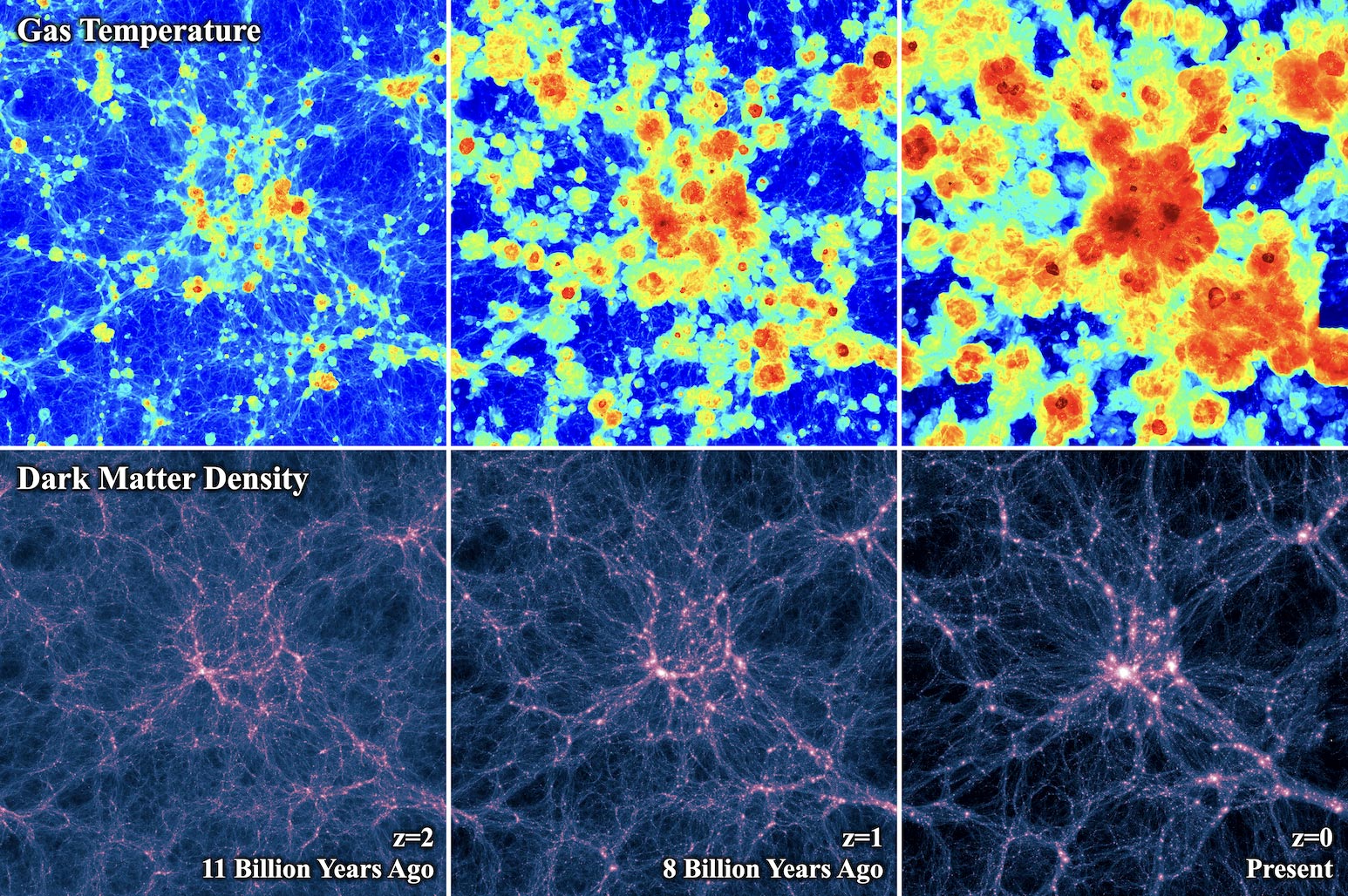
A new study reveals the universe has been steadily heating for the last 10 billion years. The universe is now 10 times hotter than it was 10 billion years ago, reaching 2 million degrees Kelvin due to the gravitational collapse of cosmic structures like galaxies.
The universe is getting hotter, a new study has found.
The study, published in the Astrophysical Journal, probed the thermal history of the universe over the last 10 billion years. It found that the mean temperature of gas across the universe has increased more than 10 times over that time period and reached about 2 million degrees Kelvin today — approximately 4 million degrees Fahrenheit.
“Our new measurement provides a direct confirmation of the seminal work by Jim Peebles — the 2019 Nobel Laureate in Physics — who laid out the theory of how the large-scale structure forms in the universe,” said Yi-Kuan Chiang, lead author of the study and a research fellow at The Ohio State University Center for Cosmology and AstroParticle Physics.
The large-scale structure of the universe refers to the global patterns of galaxies and galaxy clusters on scales beyond individual galaxies. It is formed by the gravitational collapse of dark matter and gas.
“As the universe evolves, gravity pulls dark matter and gas in space together into galaxies and clusters of galaxies,” Chiang said. “The drag is violent — so violent that more and more gas is shocked and heated up.”
The findings, Chiang said, showed scientists how to clock the progress of cosmic structure formation by “checking the temperature” of the universe.
A New Way to Measure Deep-Space Heat
The researchers used a new method that allowed them to estimate the temperature of gas farther away from Earth — which means further back in time — and compare them to gases closer to Earth and near the present time. Now, he said, researchers have confirmed that the universe is getting hotter over time due to the gravitational collapse of cosmic structure, and the heating will likely continue.
To understand how the temperature of the universe has changed over time, researchers used data on light throughout space collected by two missions, Planck and the Sloan Digital Sky Survey. Planck is the European Space Agency mission that operates with heavy involvement from NASA; Sloan collects detailed images and light spectra from the universe.
Redshift Reveals the Universe’s Age and Heat
They combined data from the two missions and evaluated the distances of the hot gases near and far via measuring redshift, a notion that astrophysicists use to estimate the cosmic age at which distant objects are observed. (“Redshift” gets its name from the way wavelengths of light lengthen. The farther away something is in the universe, the longer its wavelength of light. Scientists who study the cosmos call that lengthening the redshift effect.)
The concept of redshift works because the light we see from objects farther away from Earth is older than the light we see from objects closer to Earth — the light from distant objects has traveled a longer journey to reach us. That fact, together with a method to estimate temperature from light, allowed the researchers to measure the mean temperature of gases in the early universe — gases that surround objects farther away — and compare that mean with the mean temperature of gases closer to Earth — gases today.
Those gases in the universe today, the researchers found, reach temperatures of about 2 million degrees Kelvin — approximately 4 million degrees Fahrenheit, around objects closer to Earth. That is about 10 times the temperature of the gases around objects farther away and further back in time.
The universe, Chiang said, is warming because of the natural process of galaxy and structure formation. It is unrelated to the warming on Earth. “These phenomena are happening on very different scales,” he said. “They are not at all connected.”
For more on this research, read Galaxies Have Gotten Hotter – A Warming Predicted by Dark Matter Theory.
Reference: “The Cosmic Thermal History Probed by Sunyaev–Zeldovich Effect Tomography” by Yi-Kuan Chiang, Ryu Makiya, Brice Ménard and Eiichiro Komatsu, 12 October 2020, Astrophysical Journal.
DOI: 10.3847/1538-4357/abb403
This study was completed in collaborations with researchers at the Kavli Institute for the Physics and Mathematics of the Universe, Johns Hopkins University, and the Max Planck Institute for Astrophysics.
Never miss a breakthrough: Join the SciTechDaily newsletter.
Follow us on Google and Google News.
11 Comments
The universe, Chiang said, is warming because of the natural process of galaxy and structure formation. It is unrelated to the warming on Earth. “These phenomena are happening on very different scales,” he said. “They are not at all connected.”
—————————————————————–
Maybe not connected. Probably not connected. But suggestive of the possibility that this warming dynamic may not be uniform. There is a node-like aspect to galaxy formation. It may be warmer nearer the nodes. Perhaps therefore there are regions of space that are warmer than others. Such an exogenous effect would explain the possible warming of Mars, Jupiter and Saturn, which cannot be due to solar activity.
[1/2 due to two links]
That does not fit the climate science observation and theory of man made global warming on Earth specifically, which is caused by our greenhouse gas release (mainly CO2) and not the primary heating source of the Sun.
Then, in a factually unrelated manner – irradiation and different greenhouse gas atmospheres, so different climate trends depending on forcing factors – you refer to climate myths:
“What climate change is happening to other planets in the solar system?
What The Science Says:
Mars and Jupiter are not warming, and anyway the sun has recently been cooling slightly.
Climate Myth: Other planets are warming
“[E]vidence that CO2 is not the principle driver of warming on this planet is provided by the simultaneous warming of other planets and moons in our solar system, despite the fact that they obviously have no anthropogenic emissions of greenhouse gases.
Mars, Triton, Pluto and Jupiter all show global warming, pointing to the Sun as the dominating influence in determining climate throughout the solar system.” (Ian McClintock)
This argument is part of a greater one that other planets are warming. If this is happening throughout the solar system, clearly it must be the sun causing the rise in temperatures – including here on Earth.
It is curious that the theory depends so much on sparse information – what we know about the climates on other planets and their history – yet its proponents resolutely ignore the most compelling evidence against the notion. Over the last fifty years, the sun’s output has decreased slightly: it is radiating less heat.
But if the sun’s output has levelled off or even diminished, then what is causing other planets to warm up? Are they warming at all?
The planets and moons that are claimed to be warming total roughly eight out of dozens of large bodies in the solar system. Some, like Uranus, may be cooling. All the outer planets have vastly longer orbital periods than Earth, so any climate change on them may be seasonal. Saturn and its moons take 30 Earth years to orbit the Sun, so three decades of observations equates to only 1 Saturnian year. Uranus has an 84-year orbit and 98° axial tilt, so its seasons are extreme. Neptune has not yet completed a single orbit since its discovery in 1846.”
[ https://skepticalscience.com/print.php?r=147 ]
The rest of the page discuss how these myths has been constructed, say by conflating weather and climate.
After further rubbin’ the noggin’ after posting how dust thermometers imply galactic and intergalactic gas doesn’t contribute significantly and the whole solar system heat flow is dominated by the Sun, I don’t think Jupiter should be mentioned at all. It famously has an internal heat source, which remains a mystery but may be coupled to the dilute core that the Juno mission now sees.
[It looks like Jupiter core accreted but that the high pressures have dissolved the rocks into some slush analog, and maybe that process and gravitational assortment after has liberated the heat we now see. In any case, its atmosphere temperatures are not a good measure of solar output.]
[2/2]
So what about the universe?
My comment on the article implies that if we start in a cosmic void and let a body attain temperature equilibrium, it will become 3 K – compared with greenhouse Earth of ~300 K.
If we then move into the cosmic web structures, the intergalactic gas heating is dilute – even if the gas comprise 50 % of the normal matter and compares to dark matter at 1 prt to 5 on average it fills a vast volume.
It is far more interesting to look at our galaxy dark and baryon matter halos, who both reach halfway to Andromeda and still are dilute, and onwards into the more dense dust of our system – still much dilute – which we can observe the temperature of. The dust thermal radiation was about 50 % of the cosmic background signal and lies close to the cosmic background as black body [ https://www.sciencedirect.com/topics/earth-and-planetary-sciences/zodiacal-dust ]. So we can estimate that it lies between 3 and 250 K – no greenhouse gas contribution – and does not contribute to the greenhouse climate effect – it is correlated with the solar output.
I should note that the dust is used as a thermometer – they are small and have no internal heat sources so attain temperatures that any heated gas (dilute) and foremost solar radiation (huge thermal flux) forces on them.
“The findings, Chiang said, showed scientists how to clock the progress of cosmic structure formation by “checking the temperature” of the universe.”
The press release is a bit unclear with that it is only the cosmic web structures that are heating up over time. The average temperature of the universe is set by the cosmic background photons, which outnumber matter at 10^10 times since the matter-antimatter annihilation phase that created radiation at the expense of remaining net matter. That temperature at 3 K today is far from 2*10^6 K, and has been decreasing from originally 3*10^3 K as the universe prceed to heat death due to the expnasion cooling [ https://en.wikipedia.org/wiki/Heat_death_of_the_universe ].
“If the topology of the universe is open or flat, or if dark energy is a positive cosmological constant (both of which are consistent with current data), the universe will continue expanding forever, and a heat death is expected to occur,[2] with the universe cooling to approach equilibrium at a very low temperature after a very long time period.”
,… three as a matter of fact?!(a flat, a open, a closed) would be possible…
However, if small dimensions exist and they are curled one or another way, there can be big ones too.
Although, that small dimensions are bit hurt by some gravity findings. So! there is a small chance, though….
… three as a matter of fact?!(a flat, a open, a closed) would be possible…
However, if small dimensions exist and they are curled one or another way, there can be big ones too.
Although, that small dimensions are bit hurt by some gravity findings. So! there is a small chance, though….
I thing it is one more evidence of the “Decreasing Universe Model”
[[[ https://www.scirp.org/journal/PaperInformation.aspx?PaperID=91689 ]]]
Evidences from Decreasing Universe model:
————————————–
A)-VERIFIED
1-Hubble’s law formula can be derived (verified)
It’s in the theory text.
2-Postulation of dark energy is not necessary (verified)
It’s in the theory text.
3-Expansion of the universe doubles every 10 billion years (verified)
“Universe mysteriously expanding, will double in size in 10 billion years, finds Hubble”
http://www.indiatoday.in
Universe expanding mysteriously, will double in size in 10 billion years, finds Hubble
Hubble has studied 42 mile-stones in space and shown that the universe is expanding mysteriously and is on its course to double in size.
http://www.indiatoday.in http://www.indiatoday.in
Which was exactly the evidence I was hoping for, that’s exactly what my theory predicted:
[“…Some Values ??…. Tj=3.15E17?s = 10 billion years
That is, the Jocaxian Time, the time necessary for our space to contract in half, is 10 billion years…”]
4-The Universe is getting hotter (verified)
-Unexpectedly, The Universe Is Getting Hotter and Hotter as It Expands
Unexpectedly, The Universe Is Getting Hotter And Hotter as It Expands
For almost a century, astronomers have understood that the Universe is in a state of expansion.
http://www.sciencealert.com http://www.sciencealert.com
5-Comoving and proper distances (verified)
Comoving distance factors out the expansion of the universe,
giving a distance that does not change in time due to the expansion of space
(though this may change due to other, local factors, such as the motion of a galaxy within a cluster).
Comoving distance and proper distance are defined to be equal at the present time.
At other times, the Universe’s expansion results in the proper distance changing,
while the comoving distance remains constant.
https://en.wikipedia.org/wiki/Comoving_and_proper_distances
“… is the distance between them which would be measured with rulers at the time they are being observed
(the proper distance) divided by the ratio of the scale factor of the Universe then to now.
In other words the proper distance multiplied by (1 + z).”
Distance Measures in Cosmology
From the equation (E10) from my paper, we have :
D(t) = D0 * exp(H0*t)
( It is the size measured now as a function of the size that would have been measured at the time of photon emission.)
We can then identify as D0 = proper distance.
Substituting
D(t)=Lambta (=L) (wave length reaching us) and D0 = Lambta0 (=L0) ( wave length emited )
We have: L = L0 * exp(H0*t)
So L/L0 = Z + 1 = exp((H0*t) = D / D0
Therefore:
D = D0 * ( Z + 1 ) ( deducted from my paper )
……a notion that astrophysicists use to estimate the cosmic age……
An here is me thinking that the red-shift/big bang story was absolute dogma. Merely a notion after all……
Gor’ blimey; too much CO2 and CH4 escaping into Outer Space! We are DOOMED! DOOMED I say!