
Warm, deep water is shifting closer to Antarctica, threatening ice shelves and altering global ocean circulation, with implications for sea level and climate.
A long-term analysis of ocean data has revealed that heat stored deep in the ocean is moving closer to Antarctica, raising concerns about the stability of the ice shelves that surround the continent.
The research, led by the University of Cambridge in collaboration with the University of California and published in Communications Earth & Environment, brought together decades of measurements from research vessels and robotic floats. The team found that a body of warm water known as circumpolar deep water has both expanded and shifted toward the Antarctic continental shelf over the past 20 years.
Until now, scientists lacked enough consistent observations to confirm this warming trend. “It’s concerning because this warm water can flow beneath Antarctic ice shelves, melting them from below and destabilizing them,” said Joshua Lanham, lead author of the study from Cambridge’s Department of Earth Sciences.
Antarctic Ice Shelves and Sea Level Threat
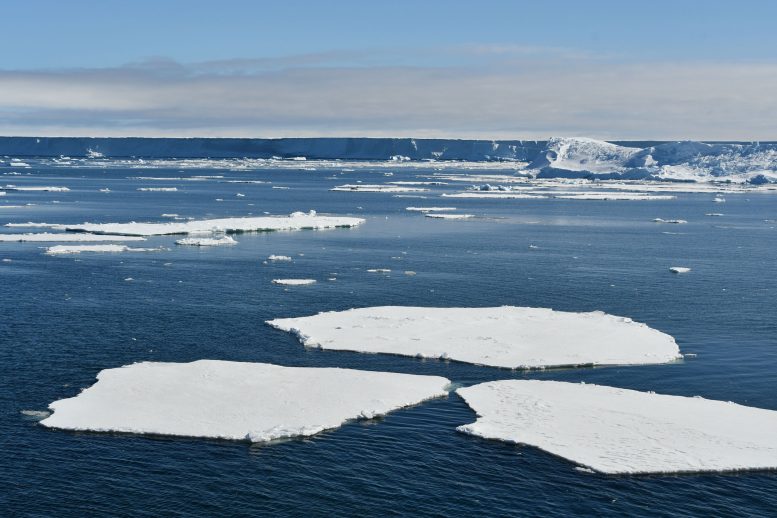
Ice shelves act as barriers that slow the flow of glaciers and ice sheets into the ocean. Together, these ice reserves contain enough freshwater to raise global sea levels by about 58 meters (about 190 feet).
Lanham noted that this is the first clear evidence of deep ocean heat shifting across the Southern Ocean. “It’s something that had been predicted by climate models due to global warming, but we hadn’t seen it in data.”
Historically, observations in the Southern Ocean relied on ship-based surveys conducted about once every ten years. These surveys provided detailed snapshots of temperature, salinity, and nutrients, but gaps between measurements made it difficult to track long-term changes in heat distribution.
Filling Data Gaps With Floats and Machine Learning
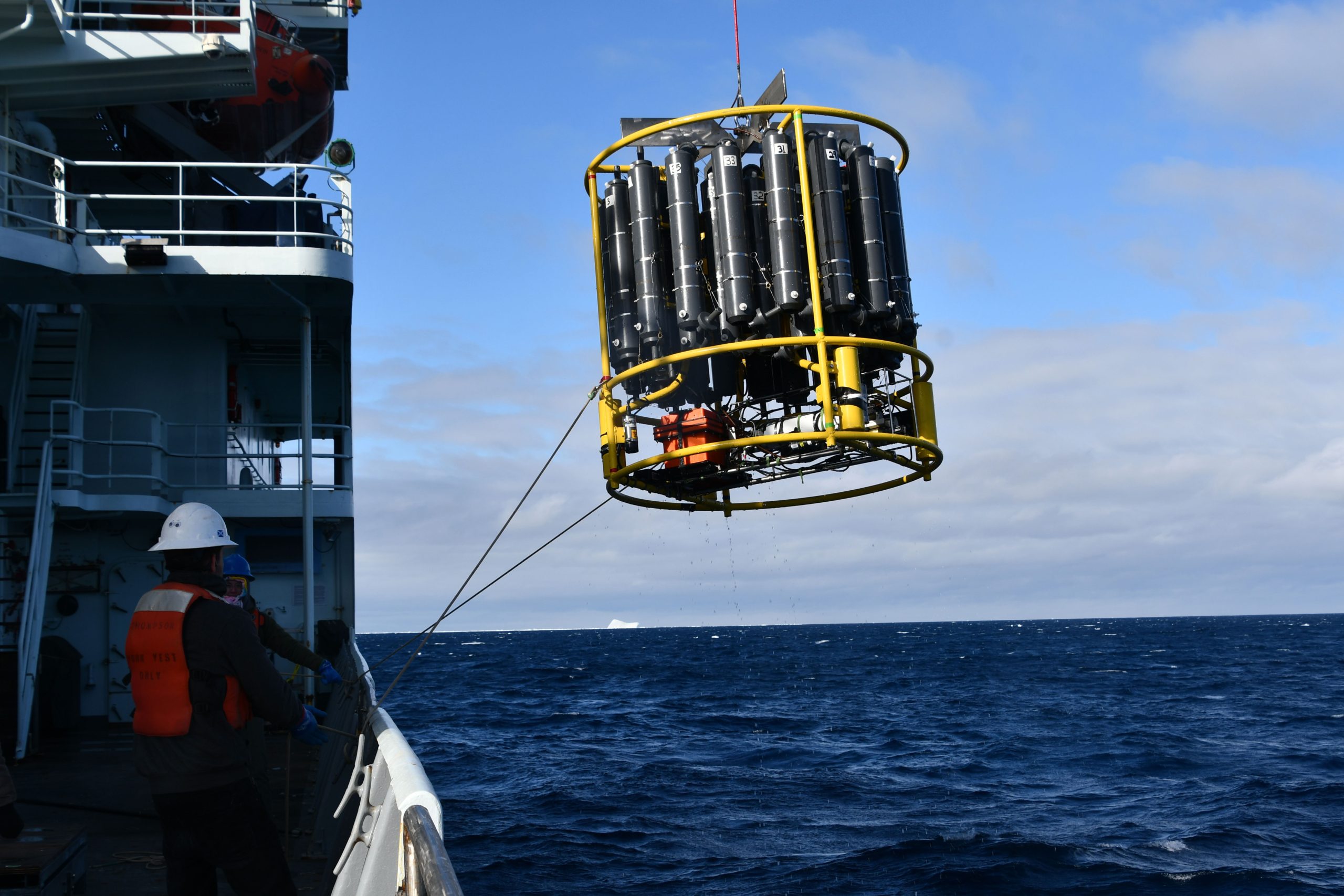
To improve coverage, researchers added data from a global network of autonomous Argo floats, which drift through the upper ocean and collect continuous measurements. Although these floats offer more frequent data, they have not been operating as long as ship-based surveys.
Argo floats, pictured here, are robotic devices that drift through the upper water column collecting real-time ocean data. A global network of these instruments provides continuous snapshots of the ocean, but the programme hasn’t been running as long as ships have been collecting detailed hydrographic sections. Credit: Scripps Institution of Oceanography, UC San Diego
The team used machine learning to merge float data with long-term ship observations, creating a detailed monthly record spanning the past 40 years. This approach revealed the gradual movement of warm water toward Antarctica.
“In the past, the ice sheets were protected by a bath of cold water, preventing them from melting. Now it looks like the ocean’s circulation has changed, and it’s almost like someone turned on the hot tap and now the bath is getting warmer!” said Professor Sarah Purkey, one of the senior authors of the study from Scripps Institution of Oceanography. She added that the expansion of this warm water is expected, since more than 90 percent of excess heat from global warming is stored in the ocean, with the Southern Ocean absorbing a large share.
Global Climate and Ocean Circulation Impacts
The shift in ocean heat has implications beyond Antarctica, said Professor Ali Mashayek from Cambridge. “The Southern Ocean plays a key role in regulating global heat and carbon storage, so changes in heat distribution here have wider implications for the global climate system.”
In polar regions, freezing and dense water sinks to the deep ocean, helping drive a global circulation system often described as a conveyor belt. This system includes the Atlantic Meridional Overturning Circulation (AMOC), which moves water through the Atlantic Ocean.
Climate models used by the IPCC suggest that rising air temperatures and increased freshwater from melting ice are reducing the formation of this dense water in the North Atlantic. This process could weaken the AMOC.
Evidence Climate Predictions Are Already Happening
Similar patterns are now expected in the Southern Ocean. Models have predicted that less cold, dense water will form near Antarctica, allowing warmer circumpolar deep water to move in and fill the gap.
“We can now see this scenario is already emerging in the observations,” said Lanham. “This isn’t just a possible future scenario suggested by models; it’s something that is happening now, bringing wider implications for how carbon, nutrients, and heat are cycled through the global ocean.”
Reference: “Poleward migration of warm Circumpolar Deep Water towards Antarctica” by Joshua Lanham, Sarah Purkey, Kaushik Srinivasan, Matthew Mazloff, Laura Cimoli and Ali Mashayek, 28 April 2026, Communications Earth & Environment.
DOI: 10.1038/s43247-026-03426-x
Never miss a breakthrough: Join the SciTechDaily newsletter.
Follow us on Google and Google News.
6 Comments
“Warm, deep water is shifting closer to Antarctica, …”
For starters, the statement about “deep water” is an oxymoron. It is far from what would normally associate with “warm.” If one were to find themselves immersed in the water there, they would die of hypothermia within just a few minutes. Whereas it is warmer than the ice it is melting, it is just barely so. The analogy presented, “it’s almost like someone turned on the hot tap and now the bath is getting warmer!”, is very misleading. Following a reference to “warming,” it will almost certainly result in the casual reader assuming that so-called Anthropogenic Global Warming is driving the ice melting, when the actual cause is wind and changing ocean currents causing deep water, barely above the freezing point of saltwater, to melt ice that reflects the average interior temperature over centuries. The above press release never mentions the actual temperatures measured! Instead, it focuses on contradictory statements such as, “Models have predicted that less cold, dense water will form near Antarctica, …”. Since when is “less cold” water denser than the surrounding ‘warmer’ water? (Yes, I’m aware that there is anomalous behavior in the density of water around the freezing point, but there isn’t enough information provided for me to know if it is applicable.)
The “conveyor belt” description is generalized as a sinking of cold, high-salinity water at the poles and transport to the tropics, where up-welling occurs. Their descriptions do not conform to that common picture.
Strangely, there is no mention in this press release of the Antarctic Circumpolar Vortex, or even in the published article, which has implications for both weather and the stratospheric ozone concentration during the Winter months. Isn’t it strange that during the coldest months both the air and water circle around Antarctica, yet melting is primarily a phenomenon of West Antarctica? Perhaps it is because the coldest air temperatures in the dark Winter occur in East Antarctica.
The actual peer-reviewed, published paper is so full of acronyms and initialisms that it is almost unreadable unless one works in the field of Antarctic oceanography or has an exceptional memory for otherwise meaningless strings of letters from the alphabet. Is it any wonder that lay readers have difficulty understanding science when jargon is mixed in as well.
“Ice shelves act as barriers that slow the flow of glaciers and ice sheets into the ocean.”
One often reads this poorly-supported assertion. If it were true, one would expect to see compression ridges and stacked sheets of ice at the point of contact between the glacier and the supposedly resisting ice shelf. One does sometimes see compression ridges above and behind a grounding line. However, once the ice starts floating, one is more likely to see tension cracks which often develop into deep crevasses that serve as boundaries for incipient calving. I suspect that this is another ‘urban legend’ that glaciologists haven’t bothered to verify. What one does also see, especially in the Arctic, is pack ice that has been blown by the wind into stacked blocks and sheets. We are supposed to believe that ice that can be blown around by the wind is an effective buttress to an irresistible force!
“She added that the expansion of this warm water is expected, since more than 90 percent of excess heat from global warming is stored in the ocean, with the Southern Ocean absorbing a large share.”
This statement is really a non sequitur. There is no explanation of how a warming atmosphere, supposedly resulting from increasing CO2, is going to get the warmth communicated to abyssal waters. That is, it must move from the atmosphere, into the epipelagic zone, which only warms about half as fast as the lower troposphere, and then not only move into, but across, the thermocline. See the NOAA graphic here: https://oceanservice.noaa.gov/facts/thermocline.html Once past the mixed-layer of the oceans, that claimed added heat energy (90%) has to be communicated to the abyssal waters. That is, it has to be conducted across an essentially static boundary. It is generally accepted that movement of polar water towards the tropics takes about a millennium. I have not seen any estimates on the vertical conduction rate(s), but the existence of the sharp change in temperature at the base of the thermocline suggests to me that conduction is very slow, probably slower than the horizontal currents. Once again, despite having access to actual measurements from the Argo fleet, there is a lot of poorly supported conjecture. It is not what I would call compelling interpretation. That is, I would call it poor science, conducted by technicians with the best technology that modern science can provide.
As I read the comments, I detect scientifically literate and maybe even professional scientists with deep and studied knowledge ‘throwing their hands and arms’ in despair and alarm at the shoddy science described in the article.
Yes, I believe this article is an addition to what is now normally accepted notion that the Antarctic ice is melting. In addition the mention of Argo floats as well as larger water temperature monitoring devices is interesting. I don’t this this article takes away the importance of the issues that global warming and antarctic ice melt are for Global Human health.
Amazing how quickly articles like this invoke immediate comments- clearly written by the big oil companies- that will attempt to dissuade the reader from believing climate change is real. How terribly evil and sad.