
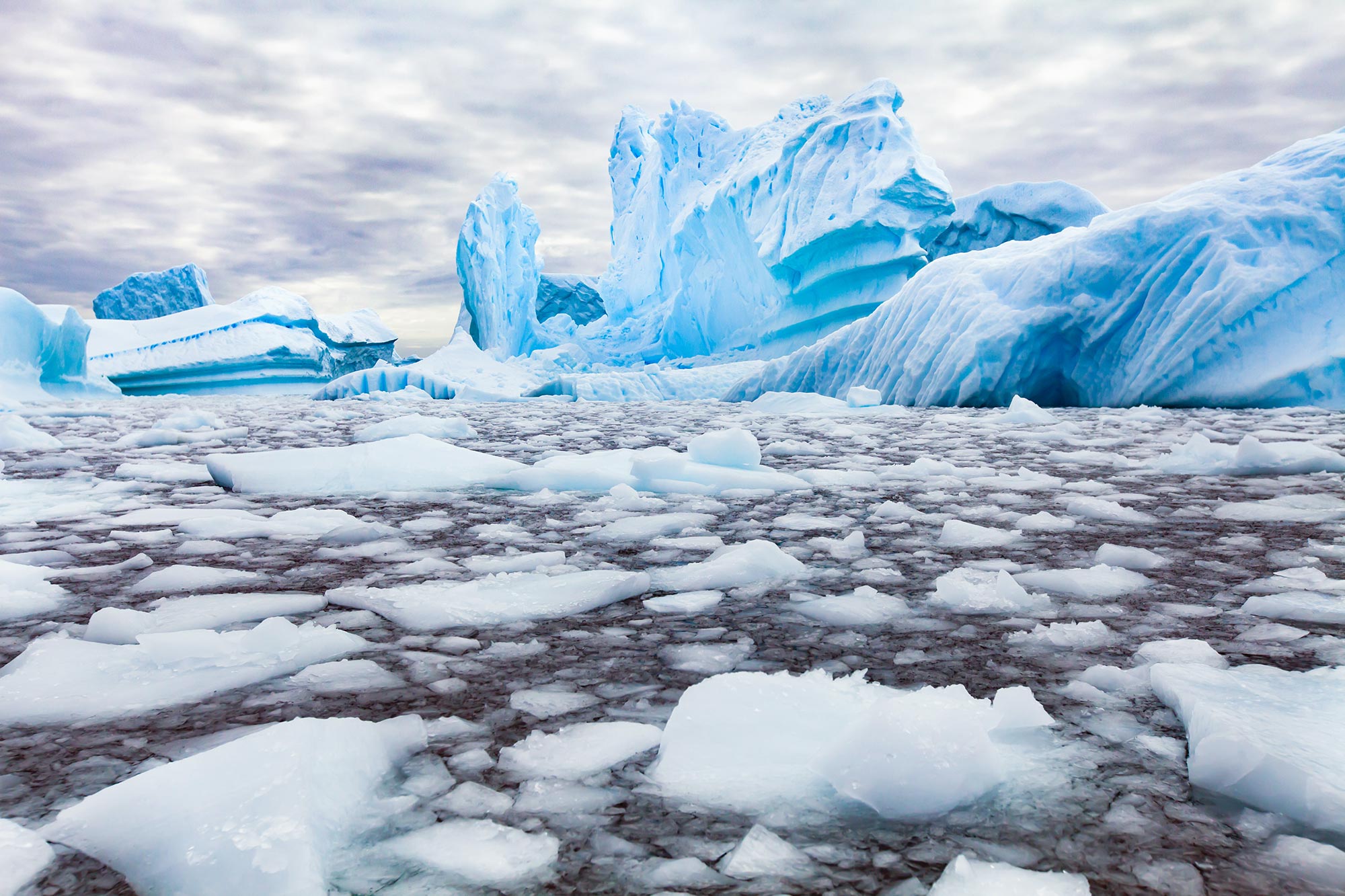
Sea level rise due to ice loss in Antarctica could become a major risk for coastal protection even in the near term, scientists say.
“The ‘Antarctica Factor’ turns out to be the greatest risk, and also the greatest uncertainty, for sea levels around the globe,” says lead-author Anders Levermann from the Potsdam Institute of Climate Impact Research (PIK) and Columbia University’s LDEO in New York. “While we saw about 19 centimeters (7.5 inches) of sea-level rise in the past 100 years, Antarctic ice-loss could lead to up to 58 centimeters (23 inches) within this century. Coastal planning cannot merely rely on the best guess. It requires a risk analysis. Our study provides exactly that: The sea level contribution of Antarctica is very likely not going to be more than 58 centimeters.”
Thermal expansion of the ocean water under global warming and melting of mountain glaciers, which to date have been the most important factors for sea-level rise, will come on top of the contribution from Antarctic ice loss. The overall sea-level rise risk is thus even bigger, yet the ‘Antarctica Factor’ is about to become the most important one, according to the study now published in the journal Earth System Dynamics of the European Geosciences Union (EGU).
Large range of estimates makes the results very robust
The range of sea-level rise estimates from the ‘Antarctica Factor’ provided by the scientists is rather large. Assuming that humanity keeps on emitting greenhouse gases as before, the range the scientists call “very likely” to capture the future is between 6 and 58 centimeters (2.4 and 23 inches) for this century. If greenhouse gas emissions were to be reduced rapidly, it is between 4 and 37 centimeters (1.6 and 14.6 inches). Importantly, the difference between a scenario of business-as-usual and a scenario of emissions reductions becomes substantially greater on longer time scales, hence farther in the future.
The researchers accounted for a number of uncertainties in the computations, from the atmospheric warming response to carbon emissions to oceanic heat transport to the Southern ocean. 16 ice sheet modeling groups comprised of 36 researchers from 27 institutes contributed to the new study, which was coordinated by PIK. A similar study six years earlier had to rely on the output of only five ice sheet models. This development reflects the increasing importance of research on the Antarctic ice sheet.
“Risks for coastal metropolises from New York to Mumbai, Hamburg to Shanghai”
“The more computer simulation models we use, all of them with slightly different dynamic representations of the Antarctic ice sheet, the wider the range of results that we yield – but also the more robust the insights that we gain,” says co-author Sophie Nowicki of the NASA Goddard Space Flight Center and lead author of the Intergovernmental Panel on Climate Change who led the overarching ice sheet model intercomparison project, ISMIP6. “There are still large uncertainties, but we are constantly improving our understanding of the largest ice sheet on Earth. Comparing model outputs is a forceful tool to provide society with the necessary information for rational decisions.”
Over the long term, the Antarctic ice sheet has the potential to raise the sea level by tens of meters. “What we know for certain,” says Levermann, “is that not stopping to burn coal, oil, and gas will drive up the risks for coastal metropolises from New York to Mumbai, Hamburg or Shanghai.”
Reference: “Projecting Antarctica’s contribution to future sea level rise from basal ice shelf melt using linear response functions of 16 ice sheet models (LARMIP-2)” by Anders Levermann, Ricarda Winkelmann, Torsten Albrecht, Heiko Goelzer, Nicholas R. Golledge, Ralf Greve, Philippe Huybrechts, Jim Jordan, Gunter Leguy, Daniel Martin, Mathieu Morlighem, Frank Pattyn, David Pollard, Aurelien Quiquet, Christian Rodehacke, Helene Seroussi, Johannes Sutter, Tong Zhang, Jonas Van Breedam, Reinhard Calov, Robert DeConto, Christophe Dumas, Julius Garbe, G. Hilmar Gudmundsson, Matthew J. Hoffman, Angelika Humbert, Thomas Kleiner, William H. Lipscomb, Malte Meinshausen, Esmond Ng, Sophie M. J. Nowicki, Mauro Perego, Stephen F. Price, Fuyuki Saito, Nicole-Jeanne Schlegel, Sainan Sun and Roderik S. W. van de Wal, 14 February 2020, Earth System Dynamics.
DOI: 10.5194/esd-11-35-2020
Never miss a breakthrough: Join the SciTechDaily newsletter.
Follow us on Google and Google News.
1 Comment
Es braucht rund 10 000 Sandbagger Schiffe die das Meer tiefer graben und das ausgehobene Material über den Meeresspiegel heben, um den aktuellen Anstieg zu stoppen. Ist das Utopie? Nein, das wird längst schon praktiziert und bringt sogar sofortigen Nutzen und erzielt Gewinne.