
Close Menu
    Facebook X (Twitter) Instagram
    SciTechDaily
    • Biology
    • Chemistry
    • Earth
    • Health
    • Physics
    • Science
    • Space
    • Technology
    Facebook X (Twitter) Pinterest YouTube RSS
    SciTechDaily
    Home»Biology»Scientists Create Synthetic Nanopores Made From DNA
    Biology

    Scientists Create Synthetic Nanopores Made From DNA

    By Aarhus UniversityFebruary 13, 2020No Comments3 Mins Read
    Facebook Twitter Pinterest Telegram LinkedIn WhatsApp Email Reddit
    Share
    Facebook Twitter LinkedIn Pinterest Telegram Email Reddit
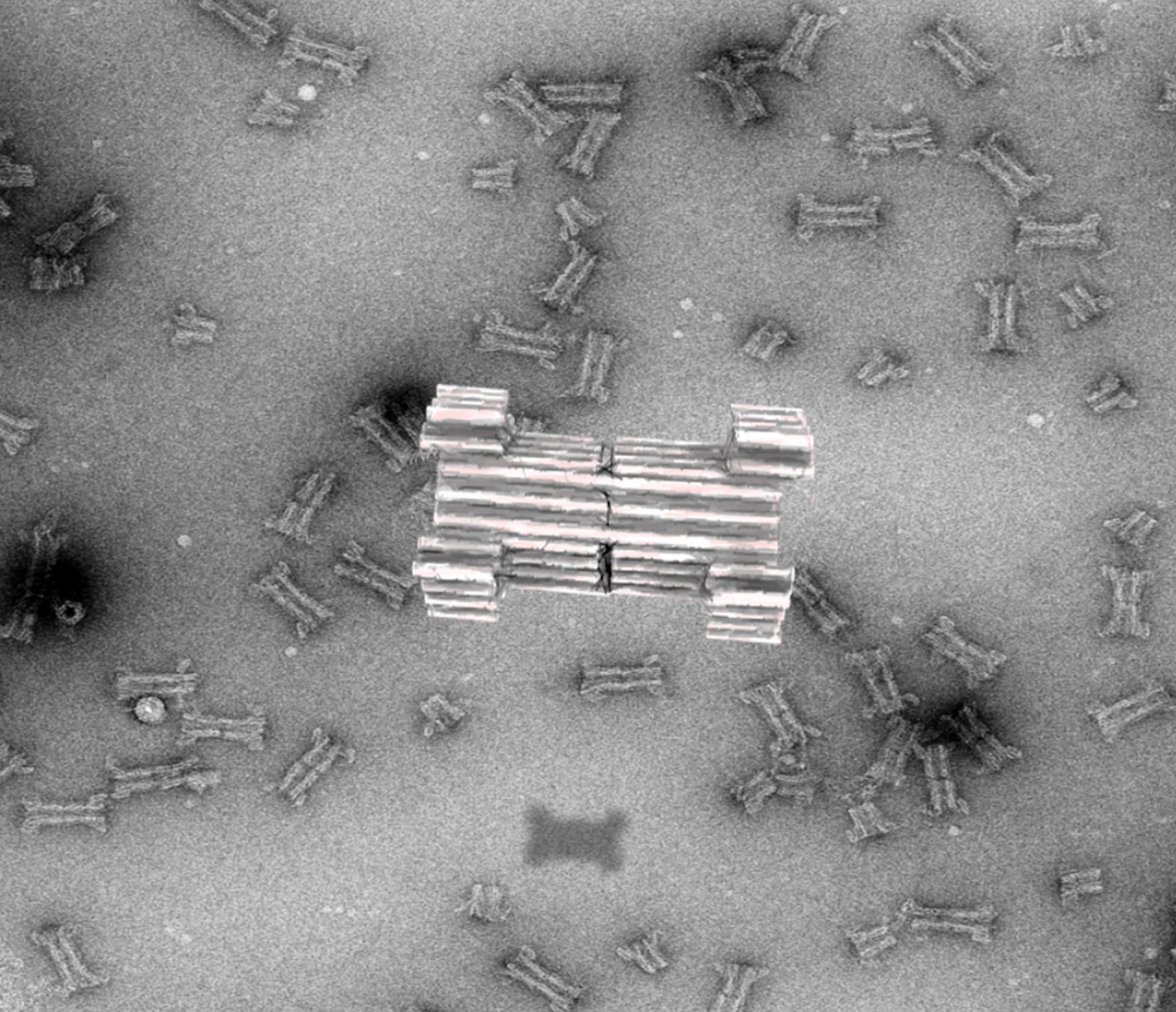
    Synthetic Nanopores Made from DNA
    The construction of a synthetic DNA nanopore capable of selectively translocating protein-size macromolecules across lipid bilayers. Credit: Rasmus Peter Thomsen, Aarhus University

    A scientific collaboration led by researchers at iNANO/Department of Molecular Biology and Genetics at Aarhus University and the Department of Chemistry at the University of Copenhagen has resulted in the construction of a synthetic DNA nanopore capable of selectively translocating protein-size macromolecules across lipid bilayers.

    In 2015, the first commercial nanopore DNA sequencing device was introduced by Oxford Nanopore Technologies. Based on a synthetically engineered transmembrane protein, nanopore sequencing allows long DNA strands to be channeled through the central lumen of the pore where changes in the ionic current work as a sensor of the individual bases in the DNA. This technique was a key milestone for DNA sequencing and the achievement was only made possible after decades of research.

    Since then, researchers have tried to extend this principle and build larger pores to accommodate proteins for sensing purposes, but a major challenge has been the limited understanding of artificial protein design. As an alternative, a new technique based on the artificial folding of DNA into complex structures, the so-called 3D-origami technique, first reported by the AU group in 2009, has emerged. Compared to proteins, DNA origami has been shown to have an unprecedented design space for constructing nanostructures that mimic and extend naturally occurring complexes.
    Synthetic Nanopore Researchers
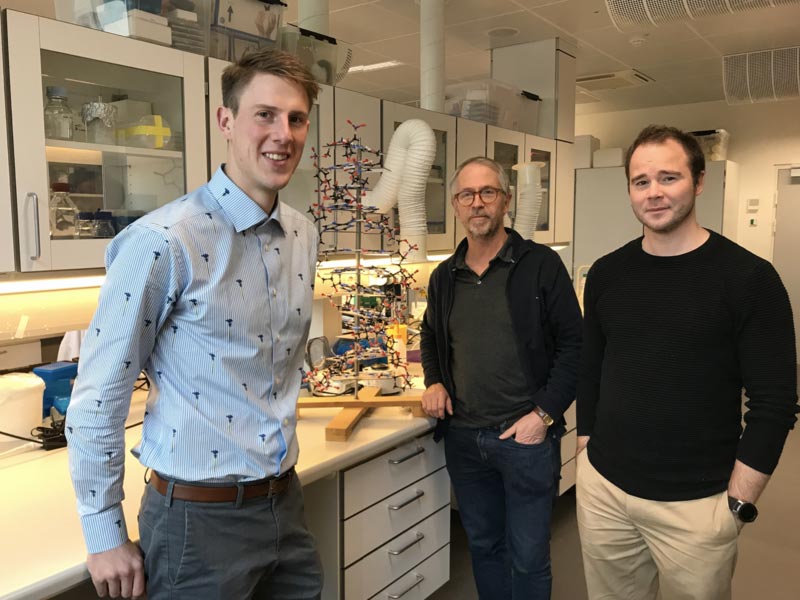
    The researchers from Aarhus University behind the scientific article (from left): Rasmus P. Thomsen, Jørgen Kjems and Rasmus Schøler Sørensen. Credit: Anne Færch Nielsen, Aarhus University

    In a new article, published in Nature Communications, the researchers now report the creation of a large synthetic nanopore made from DNA. This nanopore structure is capable of translocating large protein-sized macromolecules between compartments separated by a lipid bilayer. In addition, a functional gating system was introduced inside the pore to enable the biosensing of very few molecules in the solution.

    With the use of powerful optical microscopes, the researchers could follow the flow of molecules through individual nanopores. By introducing a controllable plug in the pore, it was furthermore possible to size-selectively control the flow of protein-size molecules and demonstrate label-free, real-time, bio-sensing of a trigger molecule.

    Lastly, the pore was equipped with a set of controllable flaps, allowing targeted insertion into membranes displaying particular signal molecules. In the future, this mechanism will potentially enable the insertion of the sensor specifically into diseased cells and may allow diagnosis at the single-cell level.

    Reference: “A large size-selective DNA nanopore with sensing applications” by Rasmus P. Thomsen, Mette Galsgaard Malle, Anders Hauge Okholm, Swati Krishnan, Søren S.-R. Bohr, Rasmus Schøler Sørensen, Oliver Ries, Stefan Vogel, Friedrich C. Simmel, Nikos S. Hatzakis and Jørgen Kjems, 11 December 2019, Nature Communications.
    DOI: 10.1038/s41467-019-13284-1

    Never miss a breakthrough: Join the SciTechDaily newsletter.
    Follow us on Google and Google News.

    Aarhus University Biochemistry DNA Genetics Microbiology
    Share. Facebook Twitter Pinterest LinkedIn Email Reddit

    Related Articles

    Quadruple Helix DNA Formation Tracked in Live Human Cells for the First Time

    Pioneering Research Reveals Certain Human Genes Relate to Gut Bacteria

    Did Life Emerge in the “Primordial Soup” via DNA or RNA? Surprising Answer From New Research

    DNA May Not Be the Blueprint for Life – Just a Scrambled List of Ingredients

    New Tool Developed to Sequence Circular DNA

    Icelandic DNA Jigsaw-Puzzle Puts Together New Image of Neanderthals

    Viral Dark Matter: Giant Viruses Have Metabolic Genes – Even Though Viruses Don’t Have a Metabolism

    UCLA Researchers Show Link Between Diet, Genetics and Obesity

    New DNA Entity in Mammalian Cells

    Leave A Reply Cancel Reply

    • Facebook
    • Twitter
    • Pinterest
    • YouTube

    Don't Miss a Discovery

    Subscribe for the Latest in Science & Tech!

    Trending News

    Scientists Discover 132-Million-Year-Old Dinosaur Tracks on South Africa’s Coast

    Scientists Uncover the Secret Ingredient Behind the Spark That May Have Started Life on Earth

    Physicists Observe Matter in Two Places at Once in Mind-Bending Quantum Experiment

    Stanford Scientists Discover Hidden Brain Circuit That Fuels Chronic Pain

    New Study Reveals Why Ozempic Works Better for Some People Than Others

    Climate Change Is Altering a Key Greenhouse Gas in a Way Scientists Didn’t Expect

    New Study Suggests Gravitational Waves May Have Created Dark Matter

    Scientists Discover Why the Brain Gets Stuck in Schizophrenia

    Follow SciTechDaily
    • Facebook
    • Twitter
    • YouTube
    • Pinterest
    • Newsletter
    • RSS
    SciTech News
    • Biology News
    • Chemistry News
    • Earth News
    • Health News
    • Physics News
    • Science News
    • Space News
    • Technology News
    Recent Posts
    • Researchers Discover Long-Lost Words of Ancient Greek Philosopher After 2,000 Years
    • New Study Warns: Asia’s Lifeline Water Source Is Rapidly Draining
    • 100 Times Worse? Thawing Permafrost May Be More Dangerous Than Previously Thought
    • “Pretty Close to Home”: The Hidden Earthquake Threat Beneath Seattle
    • The Surprising Reason You Might Want To Sleep Without a Pillow
    Copyright © 1998 - 2026 SciTechDaily. All Rights Reserved.
    • Science News
    • About
    • Contact
    • Editorial Board
    • Privacy Policy
    • Terms of Use

    Type above and press Enter to search. Press Esc to cancel.