
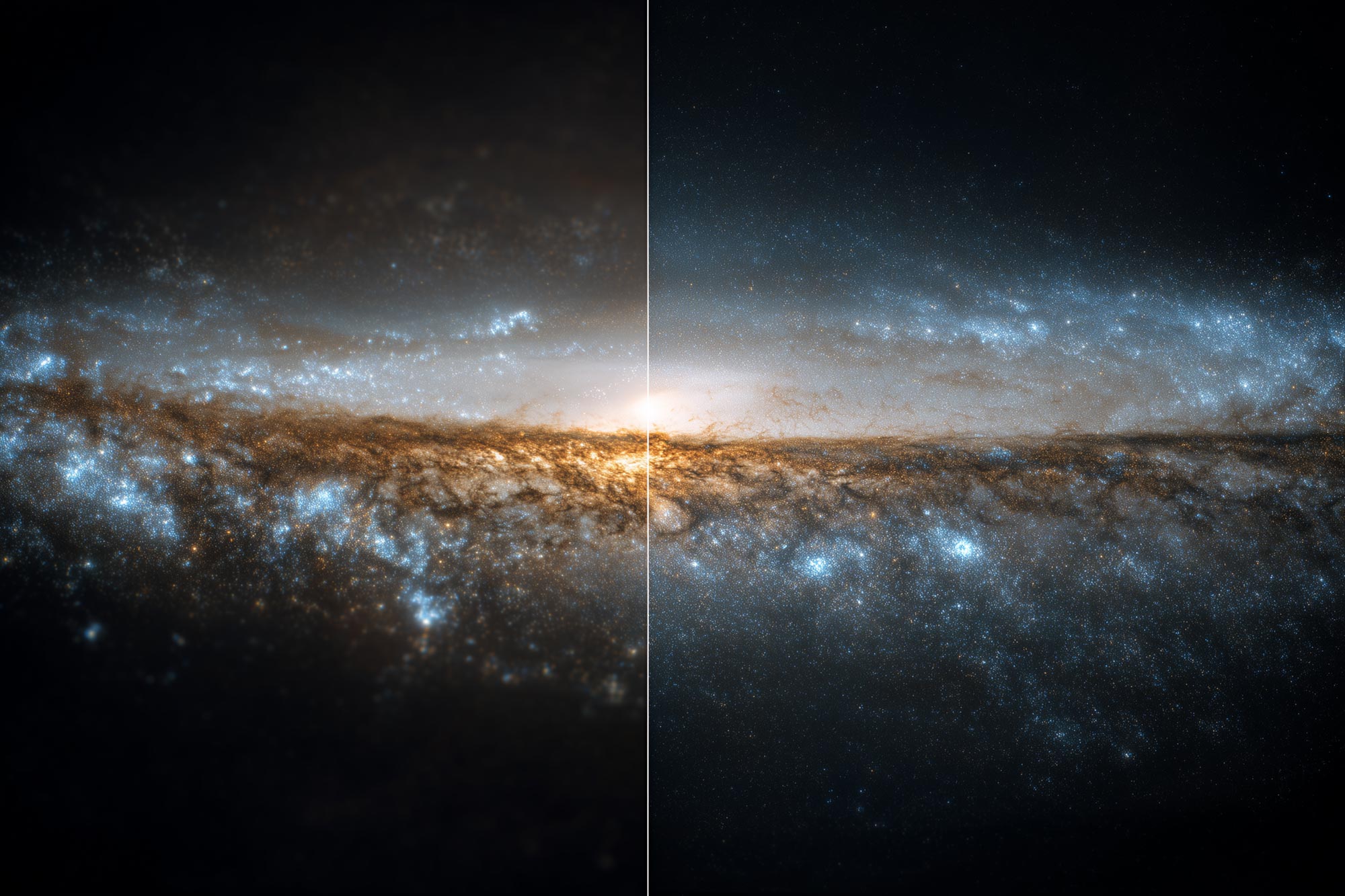
Astronomers have finally identified where the Milky Way’s star-making activity fades, uncovering a long-sought boundary in our galaxy.
Determining how far the Milky Way extends has always been tricky because its disk does not end abruptly — it gradually fades into space. Now, researchers have identified a clear boundary for where new stars are actively forming. By studying stellar ages, an international team has shown that most star formation in our galaxy takes place within about 40,000 light-years of the galactic center.
The team combined observations of bright giant stars with advanced simulations of how galaxies evolve. This approach revealed a distinct “U-shaped” pattern in the ages of stars, which marks the outer limit of the Milky Way’s star-forming region.
“The extent of the Milky Way’s star-forming disc has long been an open question in Galactic archaeology; by mapping how stellar ages change across the disc, we now have a clear, quantitative answer,” remarked the paper’s lead author, Dr. Karl Fiteni, now based at the University of Insubria.
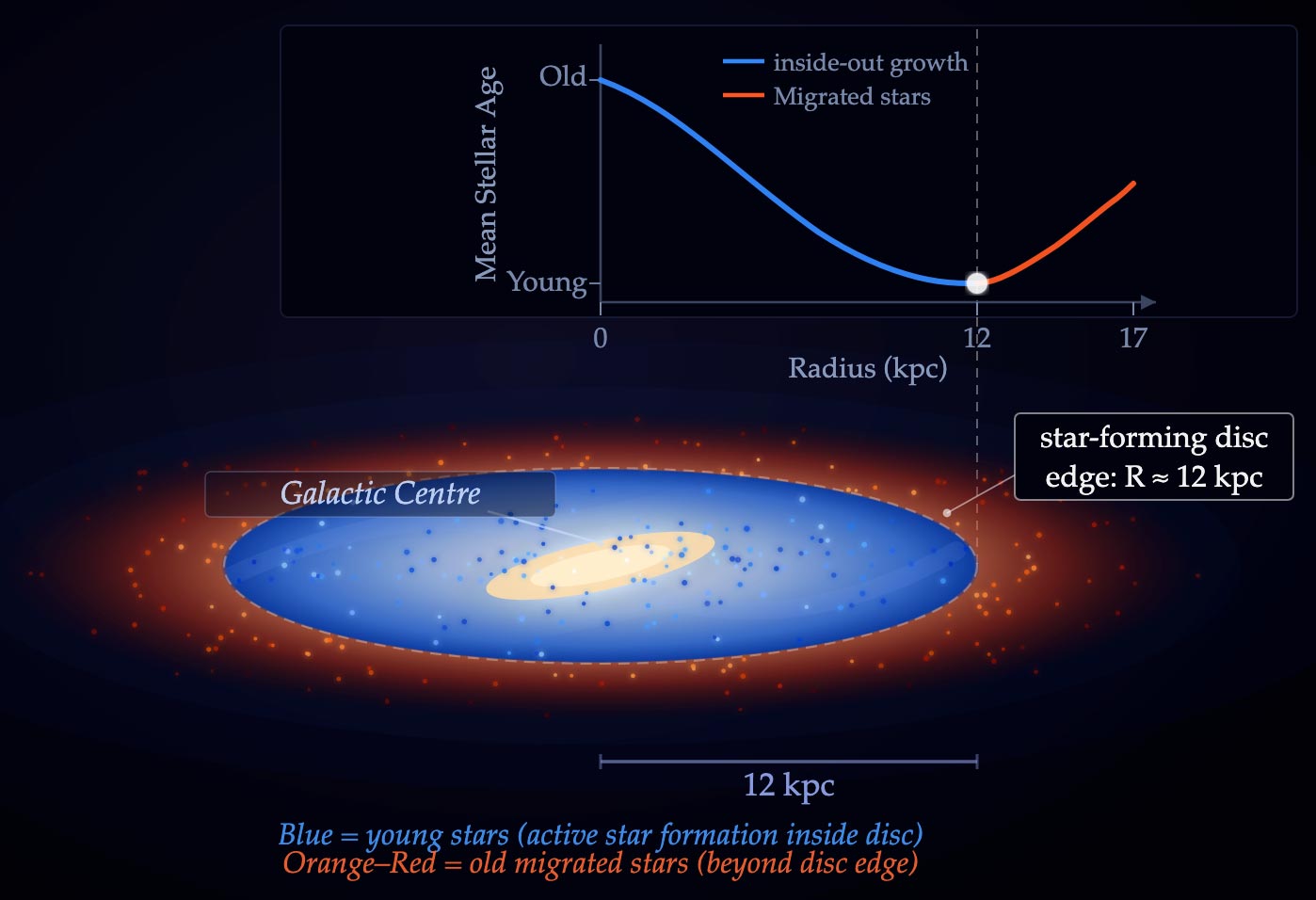
How the Milky Way Grew From the Inside Out
Galaxies do not create stars evenly across their disks. Instead, they grow outward over time. Star formation begins in dense central regions and gradually spreads toward the outer disk over billions of years, a process known as “inside-out” growth. Because of this, stars tend to be younger at greater distances from the center.
The Milky Way follows this expected pattern, but only up to a certain point. The study found that stellar ages decrease with distance from the center until about 35,000 to 40,000 light-years. Beyond that, the trend flips and stars become older again as distance increases. This creates the characteristic U-shaped age pattern.
By comparing this pattern with detailed galaxy simulations, the researchers confirmed that the youngest region corresponds to a sharp drop in star formation efficiency. This marks the true boundary of the Milky Way’s star-forming disk. “The data now available allow increasingly precise stellar ages to serve as powerful tools for decoding the story of the Milky Way, ushering in a new era of discovery about our home Galaxy,” commented Prof. Joseph Caruana, co-author and supervisor of the project based at the University of Malta.
Stars born in the inner disc interact with spiral arms throughout their lifetimes. These repeated gravitational encounters gradually push them outward, causing them to migrate into the outer disc regions beyond the star-forming edge (~12 kpc). This process helps explain why older stars dominate the outermost Galactic disc even though they were not born there. Credit: Prof. Joseph Caruana, University of Malta
Why Stars Exist Beyond the Star-Forming Boundary
If star formation falls off so sharply at this boundary, it raises an obvious question: why are there still stars farther out?
The answer lies in a process called “radial migration” — stars slowly moving away from their birthplaces by interacting with spiral waves that travel through the Galaxy. Similar to surfers riding ocean waves, stars can gain energy from spiral arms and drift outward over time.
Most stars found beyond the boundary were not born there. Instead, they gradually migrated outward. Because this process is slow and occurs randomly over time, stars that have traveled the farthest distances tend to be the oldest.
Importantly, these outer stars follow nearly circular orbits. This shows they were not thrown outward by galaxy collisions. Their current positions are the result of long-term internal processes within the Milky Way. Prof. Victor P. Debattista, co-author and co-supervisor of the study at the University of Lancashire, explained: “A key point about the stars in the outer disc is that they are on close to circular orbits, meaning that they had to have formed in the disc. These are not stars that have been scattered to large radii by an infalling satellite galaxy.”
Mapping the Milky Way With Stellar Surveys
To identify this boundary, the researchers analyzed more than 100,000 giant stars. They used spectroscopic data from the LAMOST and APOGEE surveys, combined with highly accurate measurements from the Gaia satellite, which is mapping stars across the Milky Way.
By focusing on stars in the Galaxy’s main disk, the team was able to isolate the signature of inside-out growth and separate it from other processes that influence stellar motion. Prof. Laurent Eyer, a co-author from the University of Geneva, remarked: “Gaia is delivering on its promise: by combining its data with ground-based spectroscopy and galaxy simulations, it allows us to decipher the formation history of our galaxy.”
To validate their findings, the researchers turned to advanced simulations. These models showed that the U-shaped age pattern naturally appears when star formation declines sharply and older stars migrate outward.
“In astrophysics, we use simulations run on supercomputers to identify the physical mechanisms responsible for the features we observe in galaxies”, explained co-author Dr. João A. S. Amarante, from Shanghai Jiao Tong University. In this study, he added, “they allowed us to demonstrate how stellar migration shapes the age profile of the disc and to identify where the star-forming region ends.”
What Causes the Drop in Star Formation?
While the location of the boundary is now well defined, the reason for the drop in star formation at this distance is still unclear. One possibility is the influence of the Milky Way’s central bar, which may cause gas to collect at certain radii. Another is the galaxy’s outer warp, where the disk bends and could disrupt the conditions needed for star formation.
Even though the exact cause remains uncertain, the study shows that the U-shaped age pattern is a reliable indicator of where star formation effectively stops.
Looking Ahead
Future surveys such as 4MOST and WEAVE will provide even more detailed data, helping astronomers refine these measurements and better understand what determines the edge of the Milky Way’s star-forming disk.
This work also highlights how stellar ages, once difficult to measure accurately, have become a powerful tool for studying the history of galaxies. By tracing how stars formed and moved over billions of years, scientists are gaining a clearer picture of how the Milky Way developed.
“In astrophysics, we use simulations run on supercomputers as a tool to identify the physical mechanisms responsible for creating the features we observe in galaxies, such as the Milky Way. In our current study, for example, these simulations helped us to demonstrate how stellar migration shapes the stellar age profile of galaxies, allowing us to identify the edge of our Galaxy’s star-forming disc,” said Dr. João A. S. Amarante, Shanghai Jiao Tong University.
Reference: “The edge of the Milky Way’s star-forming disc: Evidence from a ’U-shaped’ stellar age profile” by Karl Fiteni, Stuart Robert Anderson, Victor. P. Debattista, Joseph Caruana, João A. S. Amarante, Steven Gough-Kelly, Laurent Eyer, Leandro Beraldo e Silva, Tigran Khachaturyants and Virginia Cuomo, 13 April 2026, Astronomy & Astrophysics.
DOI: 10.1051/0004-6361/202558144
Never miss a breakthrough: Join the SciTechDaily newsletter.
Follow us on Google and Google News.
1 Comment
Interesting finding. I propose that if the relative gravitational attraction across the entire diameter of the galactic disk were mapped it would form a Bell curve with the highest gravitational pull centered perpendicular to the center of the galactic plane which would also directly correspond with the mass density curve plot across the diameter of the galactic plane. If true, that would set the boundaries of star formation across the plane of the disk according to a percentage of the mass density and gravitational slope curve relative to the flat geometry of the disk. My guess is about 2/3 or roughly 68.27% (1 sigma) +/- 5%, which would be in the star forming region where the majority of the hydrogen and stellar matter is gravitationally concentrated.