
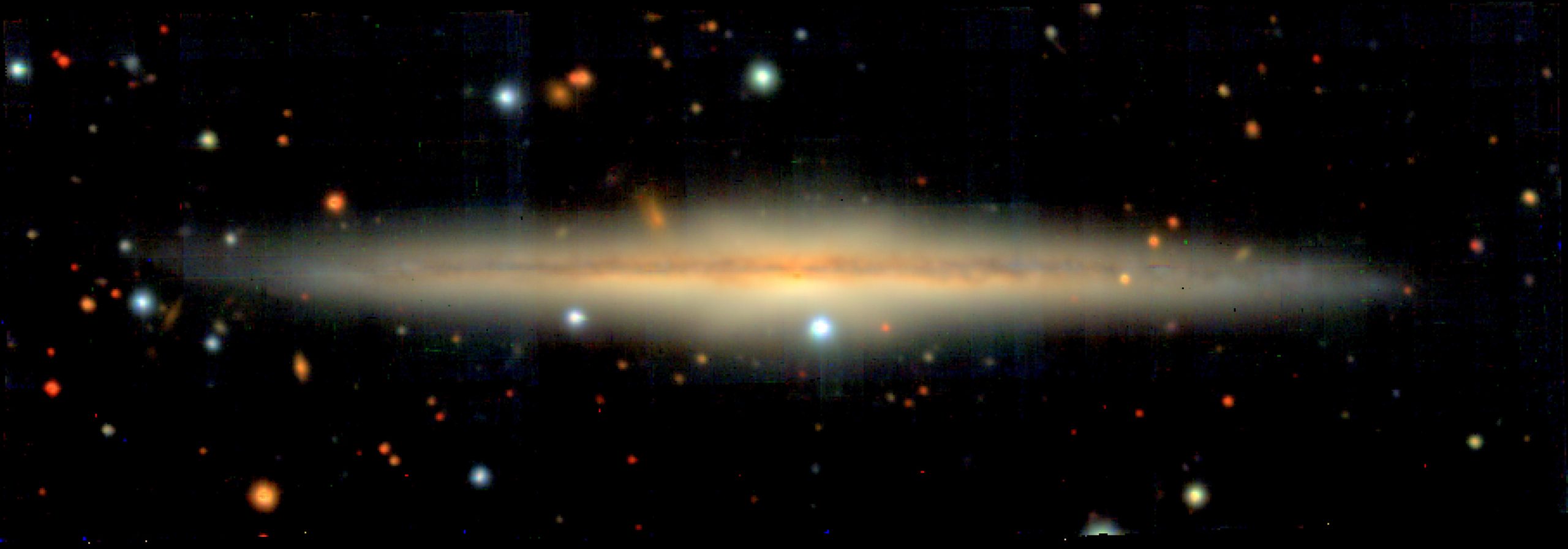
A new study of galaxy UGC 10738 reveals that the Milky Way likely formed gradually through peaceful evolution rather than violent galactic collisions.
The first detailed cross-section of a galaxy broadly similar to the Milky Way, published today, reveals that our galaxy evolved gradually, instead of being the result of a violent mash-up. The finding throws the origin story of our home into doubt.
The galaxy, dubbed UGC 10738, turns out to have distinct ‘thick’ and ‘thin’ discs similar to those of the Milky Way. This suggests, contrary to previous theories, that such structures are not the result of a rare long-ago collision with a smaller galaxy. They appear to be the product of more peaceful change.
And that is a game-changer. It means that our spiral galaxy home isn’t the product of a freak accident. Instead, it is typical.
The finding was made by a team led by Nicholas Scott and Jesse van de Sande, from Australia’s ARC Centre of Excellence for All Sky Astrophysics in 3 Dimensions (ASTRO 3D) and the University of Sydney.
Rethinking Galactic Formation Models
“Our observations indicate that the Milky Way’s thin and thick discs didn’t come about because of a gigantic mash-up, but a sort-of ‘default’ path of galaxy formation and evolution,” said Dr. Scott.
“From these results, we think galaxies with the Milky Way’s particular structures and properties could be described as the ‘normal’ ones.”
This conclusion — published in The Astrophysical Journal Letters — has two profound implications.
“It was thought that the Milky Way’s thin and thick discs formed after a rare violent merger, and so probably wouldn’t be found in other spiral galaxies,” said Dr. Scott. “Our research shows that’s probably wrong, and it evolved ‘naturally’ without catastrophic interventions. This means Milky Way-type galaxies are probably very common.
“It also means we can use existing very detailed observations of the Milky Way as tools to better analyze much more distant galaxies which, for obvious reasons, we can’t see as well.”
Reading Star Chemistry to Uncover Galactic History
The research shows that UGC 10738, like the Milky Way, has a thick disc consisting mainly of ancient stars — identified by their low ratio of iron to hydrogen and helium. Its thin disc stars are more recent and contain more metal.
(The Sun is a thin disc star and comprises about 1.5% elements heavier than helium. Thick disc stars have three to 10 times less.)
Although such discs have been previously observed in other galaxies, it was impossible to tell whether they hosted the same type of star distribution — and therefore similar origins. Scott, van de Sande, and colleagues solved this problem by using the European Southern Observatory’s Very Large Telescope in Chile to observe UGC 10738, situated 320 million light-years away.
The galaxy is angled “edge-on,” so looking at it offered effectively a cross-section of its structure.
“Using an instrument called the multi-unit spectroscopic explorer, or MUSE, we were able to assess the metal ratios of the stars in its thick and thin discs,” explained Dr. van de Sande.
“They were pretty much the same as those in the Milky Way — ancient stars in the thick disc, younger stars in the thin one. We’re looking at some other galaxies to make sure, but that’s pretty strong evidence that the two galaxies evolved in the same way.”
Geometry Helps Dissect Galaxy Layers
Dr. Scott said UGC 10738’s edge-on orientation meant it was simple to see which type of stars were in each disc.
“It’s a bit like telling apart short people from tall people,” he said. “If you try to do it from overhead it’s impossible, but if you look from the side it’s relatively easy.”
Co-author Professor Ken Freeman from the Australian National University said, “This is an important step forward in understanding how disk galaxies assembled long ago. We know a lot about how the Milky Way formed, but there was always the worry that the Milky Way is not a typical spiral galaxy. Now we can see that the Milky Way’s formation is fairly typical of how other disk galaxies were assembled.”
ASTRO 3D director, Professor Lisa Kewley, added: “This work shows how the Milky Way fits into the much bigger puzzle of how spiral galaxies formed across 13 billion years of cosmic time.”
Reference: “Identification of an [α/Fe]—Enhanced Thick Disk Component in an Edge-on Milky Way Analog” by Nicholas Scott, Jesse van de Sande, Sanjib Sharma, Joss Bland-Hawthorn, Ken Freeman, Ortwin Gerhard, Michael R. Hayden and Richard McDermid, 24 May 2021, The Astrophysical Journal Letters.
DOI: 10.3847/2041-8213/abfc57
Other co-authors are based at Macquarie University in Australia and Germany’s Max-Planck-Institut fur Extraterrestrische Physik.
Never miss a breakthrough: Join the SciTechDaily newsletter.
Follow us on Google and Google News.