
Close Menu
    Facebook X (Twitter) Instagram
    SciTechDaily
    • Biology
    • Chemistry
    • Earth
    • Health
    • Physics
    • Science
    • Space
    • Technology
    Facebook X (Twitter) Pinterest YouTube RSS
    SciTechDaily
    Home»Space»Milky Way-Andromeda Collision on Course in 4 Billion Years
    Space

    Milky Way-Andromeda Collision on Course in 4 Billion Years

    By SciTechDailyJune 1, 2012No Comments3 Mins Read
    Facebook Twitter Pinterest Telegram LinkedIn WhatsApp Email Reddit
    Share
    Facebook Twitter LinkedIn Pinterest Telegram Email Reddit
    andromeda-milky-way-collision
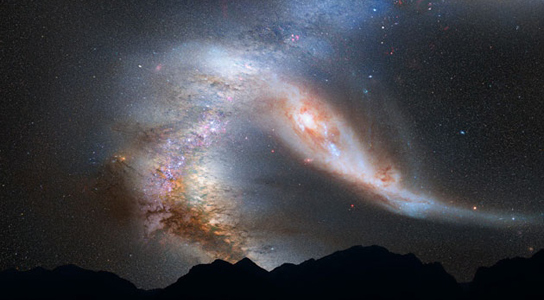
    The Milky Way is heading for a collision with the Andromeda galaxy in 4 billion years.

    It’s been known for years that the Andromeda galaxy would collide with the Milky Way, two of the largest galaxies in the Local Group, in about 4 billion years. However, because of stellar distances, it’s a good probability that a lot of the stars will remain intact in the tumultuous merging. The Solar System would probably get pushed to the outskirts of the newly merged galaxy.

    Researchers reported their conclusions in an upcoming issue of the Astrophysical Journal. Astronomers have been painstakingly tracking the motion of Andromeda using the Hubble Space Telescope between 2002 and 2010 to verify this finding. Andromeda, roughly 2.5 million light years away (770,000 parsecs), is the nearest large spiral galaxy to the Milky Way.
    ngc5426-gemini

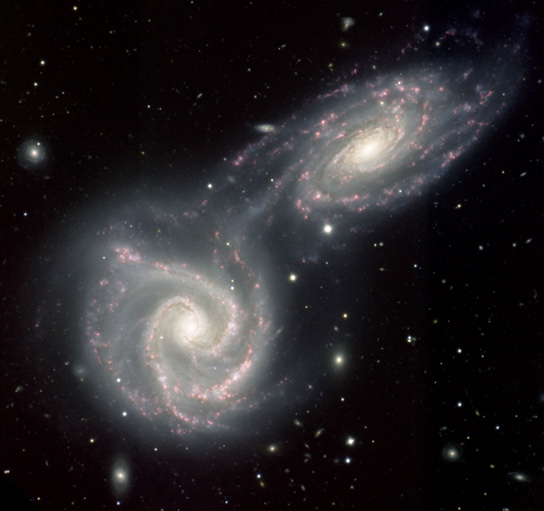
    The scientists were able to extract dynamical information about Andromeda that was hidden from astronomers for a century. It’s been decades since astronomers have known that Andromeda has been moving towards the Milky Way at approximately 110 km/h (68 mph) and that the two might eventually collide as a result of their mutual gravity. However, astronomers hadn’t been able to determine whether the collision would be a major merger, a near-miss, or a glancing blow.

    Thanks to Hubble, astronomers have been able to determine Andromeda’s sideway motion. The merger of Andromeda and the Milky Way is inevitable. After the collision, it will take another 2 billion years for them to form a single unified galaxy.
    andromeda-milky-way-sea

    The key to understanding the measurement was the evolution of the Local Group, among which Andromeda and the Milky Way are the most massive galaxies. The new simulations based on Hubble’s data allowed the astronomers to run the simulations backward and forward.

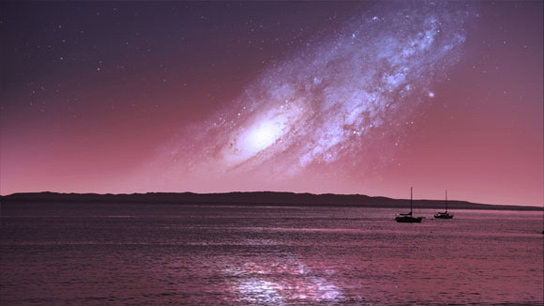
    There is a 9% chance that M33, a satellite galaxy of Andromeda, will hit the Milky Way before Andromeda does. The Milky Way-Andromeda collision will move the sun away from its current position at 26,000 light-years (8,000 parsecs) from the galactic center to more than 160,000 light-years (50,000 parsecs) away from the center of the newly merged galactic bodies.

    References:

    “The M31 Velocity Vector. I. Hubble Space Telescope Proper-Motion Measurements” by Sangmo Tony Sohn, Jay Anderson and Roeland P. van der Marel, 8 June 2012, The Astrophysical Journal.
    DOI: 10.1088/0004-637X/753/1/7

    “The M31 Velocity Vector. II. Radial Orbit Toward the Milky Way and Implied Local Group Mass” by Roeland P. van der Marel, Mark Fardal, Gurtina Besla, Rachael L. Beaton, Sangmo Tony Sohn, Jay Anderson, Tom Brown and Puragra Guhathakurta, 8 June 2012, The Astrophysical Journal.
    DOI: 10.1088/0004-637X/753/1/8

    “The M31 Velocity Vector. III. Future Milky Way M31–M33 Orbital Evolution, Merging, and Fate of the Sun” by Roeland P. van der Marel, Gurtina Besla, T. J. Cox, Sangmo Tony Sohn and Jay Anderson, 8 June 2012, The Astrophysical Journal.
    DOI: 10.1088/0004-637X/753/1/9

    Never miss a breakthrough: Join the SciTechDaily newsletter.
    Follow us on Google and Google News.

    Andromeda Astronomy Astrophysics Collision Local Group Milky Way
    Share. Facebook Twitter Pinterest LinkedIn Email Reddit

    Related Articles

    Hubble Shows Us the Future: A Galactic Collision

    New Survey Maps Where Stars Are Born

    Detailed 3D Map Reveals Peanut Shape of Milky Way’s Inner Regions

    Chandra Views Milky Way’s Supermassive Black Hole Rejecting Food

    Study Suggests Andromeda Crashed into the Milky Way 10 Billion Years Ago

    Sideways Motions of Distant Stars Shed New Light on Milky Way Evolution

    The Triangulum Stream, Remnant of a Star Cluster Being Ingested by the Milky Way

    Ancient Galactic Collision Created Stellar Swirls of NGC 5907

    Astronomers Combine Hundreds of Images of Carina Nebula to Reveal Thousands of Stars in Stellar Nursery

    Leave A Reply Cancel Reply

    • Facebook
    • Twitter
    • Pinterest
    • YouTube

    Don't Miss a Discovery

    Subscribe for the Latest in Science & Tech!

    Trending News

    Why Popular Diabetes Drugs Like Ozempic Don’t Work for Everyone: The “Genetic Glitch”

    Scientists Stunned After Finding Plant Thought Extinct for 60 Years

    Scientists Discover Tiny New Spider That Hunts Prey 6x Its Size

    Natural Component From Licorice Shows Promise for Treating Inflammatory Bowel Disease

    Scientists Warn: Popular Sweetener Linked to Dangerous Metabolic Effects

    Monster Storms on Jupiter Unleash Lightning Beyond Anything on Earth

    Scientists Create “Liquid Gears” That Spin Without Touching

    The Simple Habit That Could Help Prevent Cancer

    Follow SciTechDaily
    • Facebook
    • Twitter
    • YouTube
    • Pinterest
    • Newsletter
    • RSS
    SciTech News
    • Biology News
    • Chemistry News
    • Earth News
    • Health News
    • Physics News
    • Science News
    • Space News
    • Technology News
    Recent Posts
    • 100,000-Year-Old Neanderthal Fossils in Poland Reveal Unexpected Genetic Connections
    • Unexpected Hormone Discovery Could Change How We Treat Arthritis
    • Scientists Supercharge “Natural Killer” Cells To Break Through Cancer’s Defenses
    • Simple “Gut Reset” May Prevent Weight Gain After Ozempic or Wegovy
    • 2.8 Days to Disaster: Scientists Warn Low Earth Orbit Could Suddenly Collapse
    Copyright © 1998 - 2026 SciTechDaily. All Rights Reserved.
    • Science News
    • About
    • Contact
    • Editorial Board
    • Privacy Policy
    • Terms of Use

    Type above and press Enter to search. Press Esc to cancel.