
Australian telescopes and European satellite combine to reveal unexpected motions among the Galaxy’s rarest objects.
Theories on how the Milky Way formed are set to be rewritten following discoveries about the behavior of some of its oldest stars.
An investigation into the orbits of the Galaxy’s metal-poor stars – assumed to be among the most ancient in existence – has found that some of them travel in previously unpredicted patterns.
“Metal-poor stars – containing less than one-thousandth the amount of iron found in the Sun – are some of the rarest objects in the galaxy,” said Professor Gary Da Costa from Australia’s ARC Centre of Excellence in All Sky Astrophysics in 3 Dimensions (ASTRO 3D) and the Australian National University.
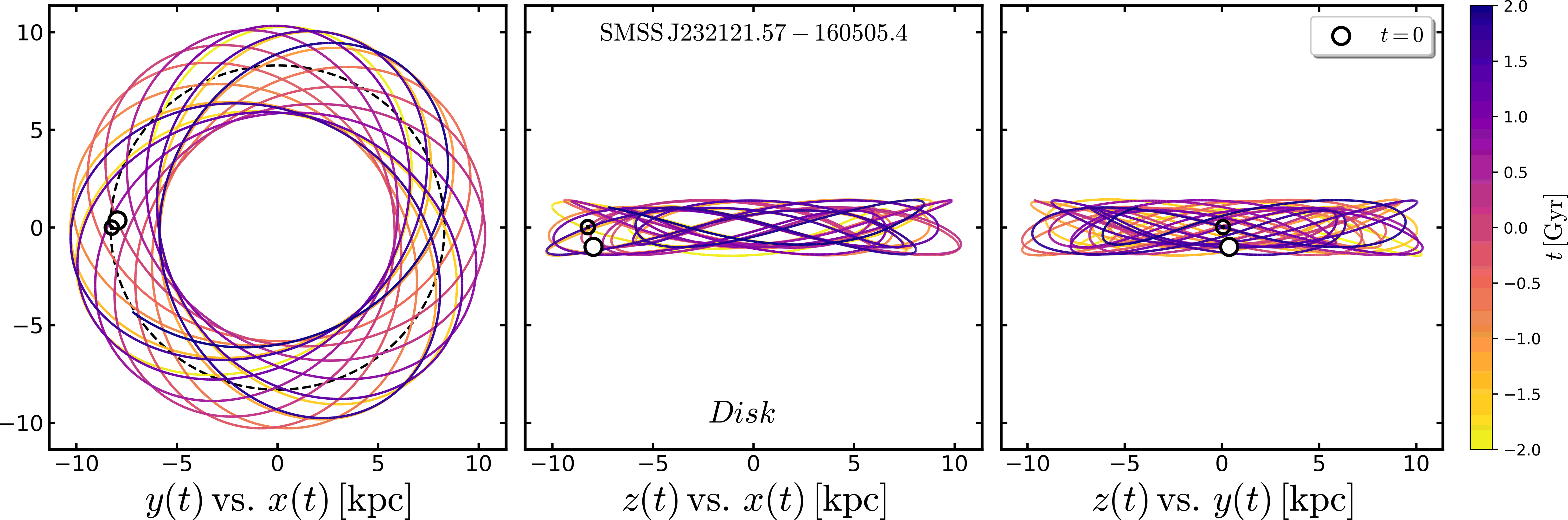
“We’ve studied 475 of them and found that about 11 percent orbit in the almost flat plane that is the Milky Way’s disc. They follow an almost circular path – very much like the Sun. That was unexpected, so astronomers are going to have to rethink some of our basic ideas.”
Previous studies had shown that metal-poor stars were almost exclusively confined to the Galaxy’s halo and bulge, but this study revealed a significant number orbiting the disk itself.
The Sun also orbits within the disk, which is why it manifests as the comparatively thin, ribbon-like structure easily visible from Earth in the night sky. In effect, we are seeing it edge-on.
“In the last year our view of the Milky Way has dramatically changed,” said lead author Giacomo Cordoni from the University of Padova in Italy, who performed the bulk of the study while on a recent study placement at the ANU, funded by the European Research Council’s GALFOR Project.
“This discovery is not consistent with the previous Galaxy formation scenario and adds a new piece to the puzzle that is the Milky Way. Their orbits are very much like that of the Sun, even though they contain just a tiny fraction of its iron. Understanding why they move in the way that they do will likely prompt a significant reassessment of how the Milky Way developed over many billions of years.”
The ancient stars were identified using three very high-tech pieces of kit: ANU’s SkyMapper and 2.3-meter (7.5-foot) telescopes, and the European Space Agency’s Gaia satellite.
The low metal content was identified by the telescopes, and the satellite was then used to determine their orbits.
The results – crunched by researchers from Australia, Italy, Sweden, the United States, and Germany – found that the orbits of ancient stars fell into a number of different patterns, all but one of which matched previous predictions and observations.
As expected, many of the stars had largely spherical orbits, clustering around the Galaxy’s “stellar halo” – a structure thought to be at least 10 billion years old.
Others had uneven and “wobbly” paths assumed to be the result of two cataclysmic collisions with smaller galaxies that occurred in the distant past – creating structures known as the Gaia Sausage and the Gaia Sequoia.
Some stars were orbiting retrograde – effectively going the wrong way around the Galaxy – and a few, about five percent, appeared to be in the process of leaving the Milky Way altogether.
And then there were the remaining 50 or so, with orbits that aligned with the Galaxy’s disk.
“I think this work is full of important and new results, but if I had to choose one that would be the discovery of this population of extremely metal-poor disk stars,” said Cordoni. “Future scenarios for the formation of our Galaxy will have to account for this finding – which will change our ideas quite dramatically.”
Cordoni’s team included scientists from Italy’s Centre of Studies and Activities for Space, the Max Planck Institutes for Astrophysics and Astronomy in Germany, the Massachusetts Institute of Technology in the US, Sweden’s Uppsala and Stockholm universities, and Australia’s Monash University, University of New South Wales and ANU.
The team included Australia’s Brian Schmidt, winner of the 2011 Nobel Prize in Physics.
An advance version of the study is now available in the Monthly Notices of the Royal Astronomical Society.
Reference: “Exploring the Galaxy’s halo and very metal-weak thick disk with SkyMapper and Gaia DR2” by G Cordoni, G S Da Costa, D Yong, A D Mackey, A F Marino, S Monty, T Nordlander, J E Norris, M Asplund, M S Bessell, A R Casey, A Frebel, K Lind, S J Murphy, B P Schmidt, X D Gao, T Xylakis-Dornbusch, A M Amarsi and A P Milone, 4 November 2020, Monthly Notices of the Royal Astronomical Society.
DOI: 10.1093/mnras/staa3417
Never miss a breakthrough: Join the SciTechDaily newsletter.
Follow us on Google and Google News.