
Researchers find evidence of a cataclysmic flare that punched so far out of the galaxy its impact was felt 200,000 light years away.
A titanic, expanding beam of energy sprang from close to the supermassive black hole in the center of the Milky Way just 3.5 million years ago, sending a cone-shaped burst of radiation through both poles of the Galaxy and out into deep space.
That’s the finding arising from research conducted by a team of scientists led by Professor Joss Bland-Hawthorn from Australia’s ARC Center of Excellence for All Sky Astrophysics in 3 Dimensions (ASTRO 3D) and soon to be published in The Astrophysical Journal.
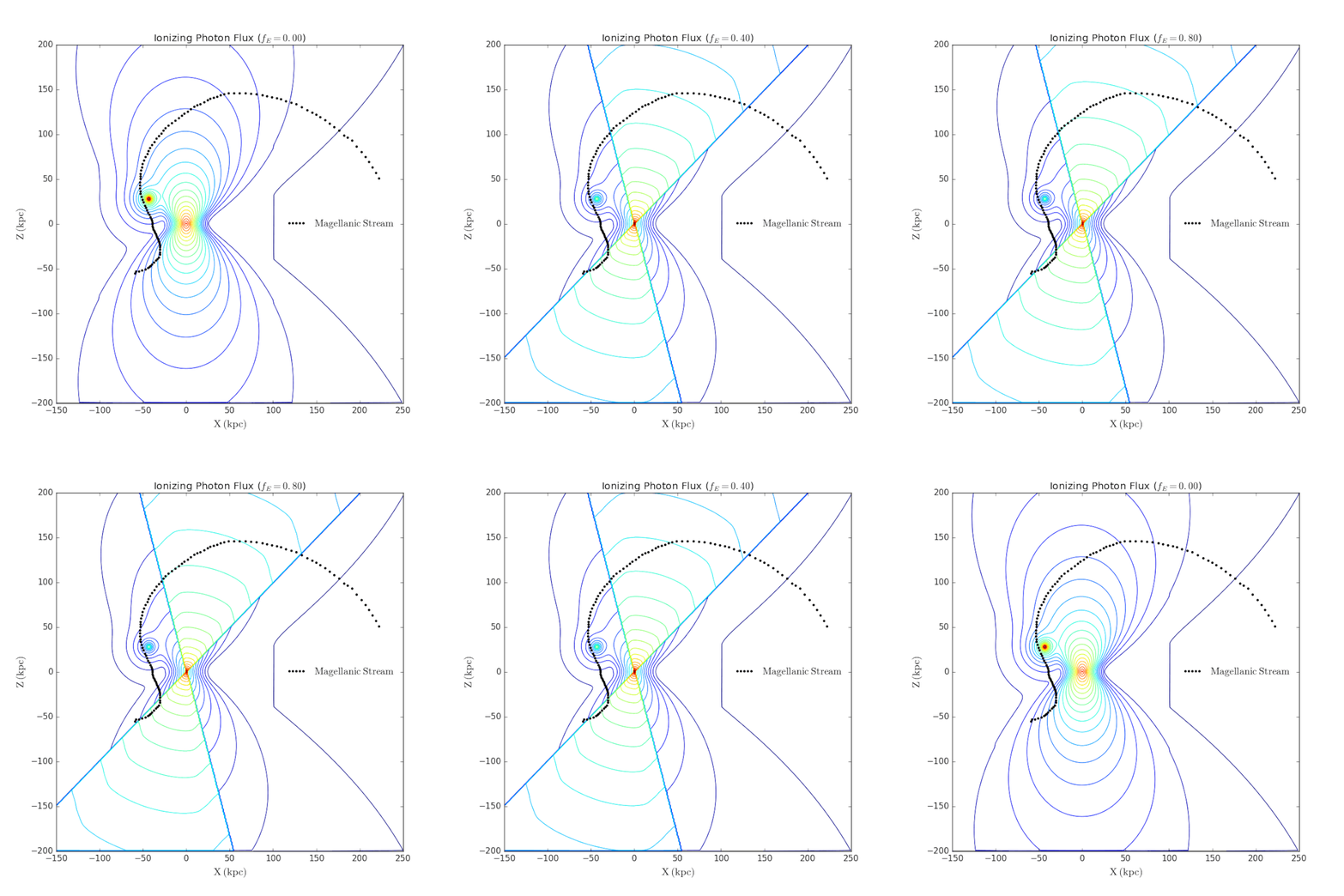
The phenomenon, known as a Seyfert flare, created two enormous ‘ionization cones’ that sliced through the Milky Way — beginning with a relatively small diameter close to the black hole, and expanding vastly as they exited the Galaxy.
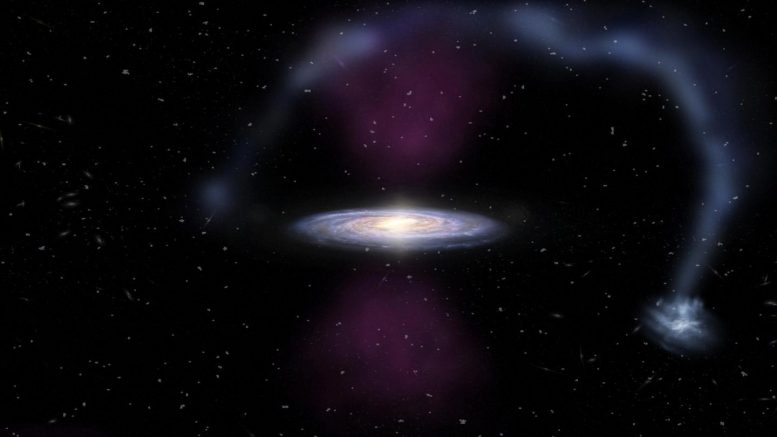
So powerful was the flare that it impacted the Magellanic Stream — a long trail of gas extending from nearby dwarf galaxies called the Large and Small Magellanic Clouds. The Magellanic Stream lies an average of 200,000 light years from the Milky Way.
The explosion was too huge, says the Australian-US research team, to have been triggered by anything other than nuclear activity associated with the black hole, known as Sagittarius A, or Sgr A*, which is about 4.2 million times more massive than the Sun.
“This is a dramatic event that happened a few million years ago in the Milky Way’s history,” says Professor Lisa Kewley, Director of ASTRO 3D.
“A massive blast of energy and radiation came right out of the galactic center and into the surrounding material. This shows that the center of the Milky Way is a much more dynamic place than we had previously thought.” — Professor Lisa Kewley
“The flare must have been a bit like a lighthouse beam,” says Professor Bland-Hawthorn, who is also at the University of Sydney.
“Imagine darkness, and then someone switches on a lighthouse beacon for a brief period of time.”
Using data gathered by the Hubble Space Telescope, the researchers calculated that the massive explosion took place a little more than three million years ago.
In Galactic terms, that is astonishingly recent. On Earth at that point, the asteroid that triggered the extinction of the dinosaurs was already 63 million years in the past, and humanity’s ancient ancestors, the Australopithecines, were afoot in Africa.
“This is a dramatic event that happened a few million years ago in the Milky Way’s history,” says Professor Lisa Kewley, Director of ASTRO 3D.
“A massive blast of energy and radiation came right out of the galactic center and into the surrounding material. This shows that the center of the Milky Way is a much more dynamic place than we had previously thought. It is lucky we’re not residing there!”
The blast, the researchers estimate, lasted for perhaps 300,000 years — an extremely short period in galactic terms.
In conducting the research, Professor Bland-Hawthorn was joined by colleagues from the Australia National University and the University of Sydney, and, in the US, the University of North Carolina, the University of Colorado, and the Space Telescope Science Institute in Baltimore.
The paper follows on from research also led by Professor Bland-Hawthorn and published in 2013. The earlier work looked at evidence of a massive explosive event beginning in the center of the Milky Way, ruled out a nuclear starburst as the cause, and tentatively tied it to activity in SgrA*.
“These results dramatically change our understanding of the Milky Way,” says co-author Magda Guglielmo from the University of Sydney.
“We always thought about our Galaxy as an inactive galaxy, with a not-so-bright center. These new results instead open the possibility of a complete reinterpretation of its evolution and nature.
“The flare event that occurred three million years ago was so powerful that it had consequences on the surrounding of our Galaxy. We are the witness to the awakening of the sleeping beauty.”
The latest work firms up SgrA* as the prime suspect, but, the researchers concede, there is still a lot more work to be done. How black holes evolve, influence, and interact with galaxies, they conclude, “is an outstanding problem in astrophysics.”
Reference: “The Large-scale Ionization Cones in the Galaxy” by Joss Bland-Hawthorn, Philip R. Maloney, Ralph Sutherland, Brent Groves, Magda Guglielmo, Wenhao Li, Andrew Curzons, Gerald Cecil and Andrew J. Fox, 18 November 2019, The Astrophysical Journal.
DOI 10.3847/1538-4357/ab44c8
Never miss a breakthrough: Join the SciTechDaily newsletter.
Follow us on Google and Google News.
4 Comments
nougat is in the center of the milky way…
Andy’s right. I’ve got photo proof of that. What’re these people talking about??
If this had occurred say 30,000 years ago what effect would it have on earth today?
Could the cause have been the Magellenic galaxy’s magnetic energy being drawn off into the Milky Way’s magnetically compressed perfect sphere aka ‘bh’?
Was the Magellenic galaxy split into the Greater and Lesser clouds at this time? Note the the M galaxy would have been right angles to the MW galaxy at that time.