

Close Menu
    Facebook X (Twitter) Instagram
    SciTechDaily
    • Biology
    • Chemistry
    • Earth
    • Health
    • Physics
    • Science
    • Space
    • Technology
    Facebook X (Twitter) Pinterest YouTube RSS
    SciTechDaily
    Home»Chemistry»Gem-Like Nanoparticles of Precious Metals Shine As Catalysts – Can Lead to Better Fuel Cells
    Chemistry

    Gem-Like Nanoparticles of Precious Metals Shine As Catalysts – Can Lead to Better Fuel Cells

    By Northwestern UniversityOctober 6, 20192 Comments4 Mins Read
    Facebook Twitter Pinterest Telegram LinkedIn WhatsApp Email Reddit
    Share
    Facebook Twitter LinkedIn Pinterest Telegram Email Reddit
    Colored Version of Nanoparticles
    Northwestern University researchers have developed a new method for making highly desirable catalysts from metal nanoparticles that could lead to better fuel cells, among other applications. This is a false color scanning electron microscopy image of tetrahexahedral nanoparticles. Credit: Northwestern University

    A Northwestern University research team has developed a new method for making highly desirable catalysts from metal nanoparticles that could lead to better fuel cells, among other applications. The researchers also discovered the method can take spent catalysts and recycle them into active catalysts.

    Made mainly of precious metals, these coveted catalysts are shaped like gems. Each particle has 24 different faces that present atoms at the surface in ways that make them more catalytically active than those available commercially.

    The methodology takes basic metal precursors, and, using heat and stabilizing trace elements, rapidly transforms their shape into structures that are highly active catalytically. Commercial products such as fuel cells — important sources of clean energy — rely on such catalysts.

    The method is a general one; the study shows it works with five monometallic nanoparticles and a library of bimetallic nanoparticles, spanning seven different metals, including platinum, cobalt, and nickel.
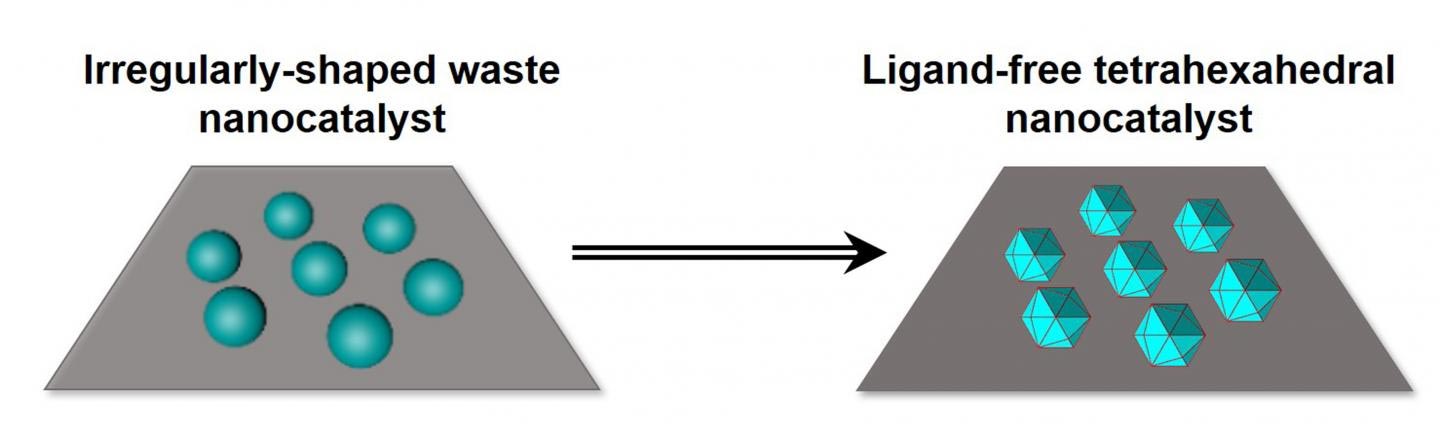
    Recycling of Waste Catalyst
    Northwestern University researchers have developed a new method that can recycle spent catalysts into active catalysts. Each particle has 24 different faces that present atoms at the surface in ways that make them more catalytically active than those available commercially. Credit: Northwestern University

    “Many of these precious metals are responsible for catalyzing some of the most important chemical transformations used in the chemical, oil, and fuel cell industries,” said Chad A. Mirkin, the George B. Rathmann Professor of Chemistry in the Weinberg College of Arts and Sciences, who led the research.

    “We not only can prepare commercially desirable catalysts, but we can recycle used fuel cell catalysts into the most active forms. Catalysts slowly degrade over time and change, so the fact that we can reclaim and reactivate these catalysts made of expensive materials is extremely valuable,” Mirkin said.

    The study, which includes both simulations and experiments, was published on September 13, 2019, in the journal Science.

    The new catalysts are called high-index facet nanoparticle catalysts — an optimal form for accelerating chemical reactions. Mirkin’s team found their platinum catalysts were 20 times faster than the commercial low-index form for the formic acid electrooxidation reaction (based upon platinum content).

    “Platinum in the high-index facet form is different and better than it is in other nanoparticle forms,” said Chris Wolverton, a co-author of the study and the Jerome B. Cohen Professor of Materials Science and Engineering at Northwestern’s McCormick School of Engineering.

    “It’s all about chemistry,” added Mirkin, who also is director of Northwestern’s International Institute for Nanotechnology.
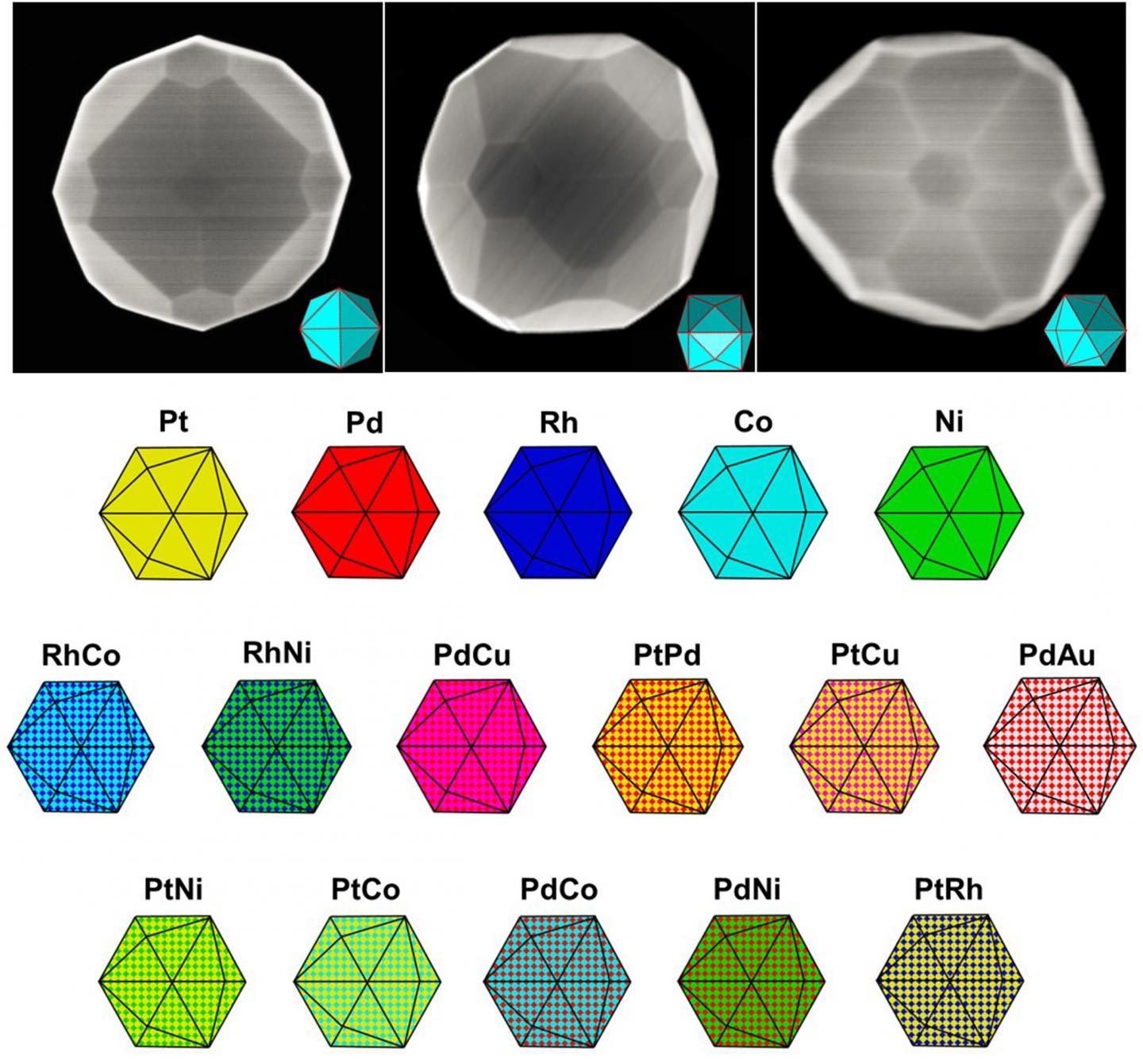
    Platinum Nanoparticles and Library of Nanoparticles
    Top row: Three representative scanning electron microscopy images of tetrahexahedra platinum particles recorded along the [100], [110] and [111] crystal directions. Bottom: A library of monometallic and bimetallic alloy tetrahexahedral nanoparticles. Credit: Northwestern University

    Mirkin’s multidisciplinary team also includes Vinayak Dravid, the Abraham Harris Professor of Materials Science and Engineering, at McCormick. Catalysis contributes to more than 35% of the world’s gross domestic product, according to the American Chemistry Council. The new catalysts can be made in mass and without the use of ligands, which can compromise catalytic activity. The process that can both create new catalysts and recycle spent catalysts is fast and scalable. Mirkin said the technology may not be far away from being used commercially. “This type of technology is ready to be scaled up and utilized widely in the catalysis community,” he said.

    Reference: “Shape regulation of high-index facet nanoparticles by dealloying” by Liliang Huang, Mohan Liu, Haixin Lin, Yaobin Xu, Jinsong Wu, Vinayak P. Dravid, Chris Wolverton and Chad A. Mirkin, 13 September 2019, Science.
    DOI: 10.1126/science.aax5843

    The Science paper is titled “High-index facet nanoparticle-shape regulation by dealloying.” The first author is Liliang Huang, a graduate student in Mirkin’s lab.

    Never miss a breakthrough: Join the SciTechDaily newsletter.
    Follow us on Google and Google News.

    Catalysts Nanoparticles Northwestern University
    Share. Facebook Twitter Pinterest LinkedIn Email Reddit

    Related Articles

    Unprecedented View of a Single Catalyst Nanoparticle at Work Under Reaction Conditions

    Mysterious Organic Scum Boosts Chemical Reaction Efficiency – Discovery May Reduce Environmental Impact of Manufacturing

    “Swiss Army Knife” Nanoparticle Catalyst Can Make Natural Gas Burn Cleaner

    Super-Particles: The Importance of Good Neighbors in Catalysis

    New Nanoreactor Visualizes the Activity of Individual Catalytic Nanoparticles

    New Nanoparticle Catalysts Improve Reactivity with Much Less Platinum

    Cobalt-Graphene Catalyst Performs Nearly As Well as Platinum

    Working to Recycle Greenhouse Gases

    Gold Improves the Performance of Nanoparticle Fuel-Cell Reactions

    2 Comments

    1. Dr. Amna Sirelkhatim on October 8, 2019 7:49 am

      SciTechDaily is very beneficial forresearchers to be updated with the latest studies. I am researcher in the field of Nanotechnology and Nanoscience.
      Thanks to SciTechDaily
      Dr. Amna,Sudan University of Science and Technology

      Reply
    2. Clyde Spencer on April 13, 2022 9:15 am

      “This is a FALSE color scanning electron microscopy image of tetrahexahedral nanoparticles.”

      It is almost certainly a pseudocolor image. False-color images are created by combining two or three images captured at different wavelengths, or by different kinds of sensors. In this case, someone just added arbitrary colors by ‘Photoshopping’ the single SEM image, for ‘artistic’ purposes. It serves no real scientific purpose.

      Reply
    Leave A Reply Cancel Reply

    • Facebook
    • Twitter
    • Pinterest
    • YouTube

    Don't Miss a Discovery

    Subscribe for the Latest in Science & Tech!

    Trending News

    Popular Sugar-Free Sweetener Linked to Liver Disease, Study Warns

    What Is Hantavirus? The Deadly Disease Raising Alarm Worldwide

    Scientists Just Discovered How the Universe Builds Monster Black Holes

    Scientists Unveil New Treatment Strategy That Could Outsmart Cancer

    A Simple Vitamin May Hold the Key to Treating Rare Genetic Diseases

    Scientists Think the Real Fountain of Youth May Be Hiding in Your Gut

    Ravens Don’t Follow Wolves, They Predict Them

    This Common Knee Surgery May Be Doing More Harm Than Good

    Follow SciTechDaily
    • Facebook
    • Twitter
    • YouTube
    • Pinterest
    • Newsletter
    • RSS
    SciTech News
    • Biology News
    • Chemistry News
    • Earth News
    • Health News
    • Physics News
    • Science News
    • Space News
    • Technology News
    Recent Posts
    • Popular Supplement Ingredient Linked to Shorter Lifespan in Men
    • Scientists May Have Found a Way To Repair Nerve Damage in Multiple Sclerosis
    • GLP-1 Weight Loss Linked To Dramatically Lower Risk of Sleep Apnea, Kidney Disease and More
    • Scientists Uncover the Surprising Source of Strange Clouds Near the Milky Way’s Supermassive Black Hole
    • This Dazzling Green Snake Was Hiding in Plain Sight for Decades
    Copyright © 1998 - 2026 SciTechDaily. All Rights Reserved.
    • Science News
    • About
    • Contact
    • Editorial Board
    • Privacy Policy
    • Terms of Use

    Type above and press Enter to search. Press Esc to cancel.