
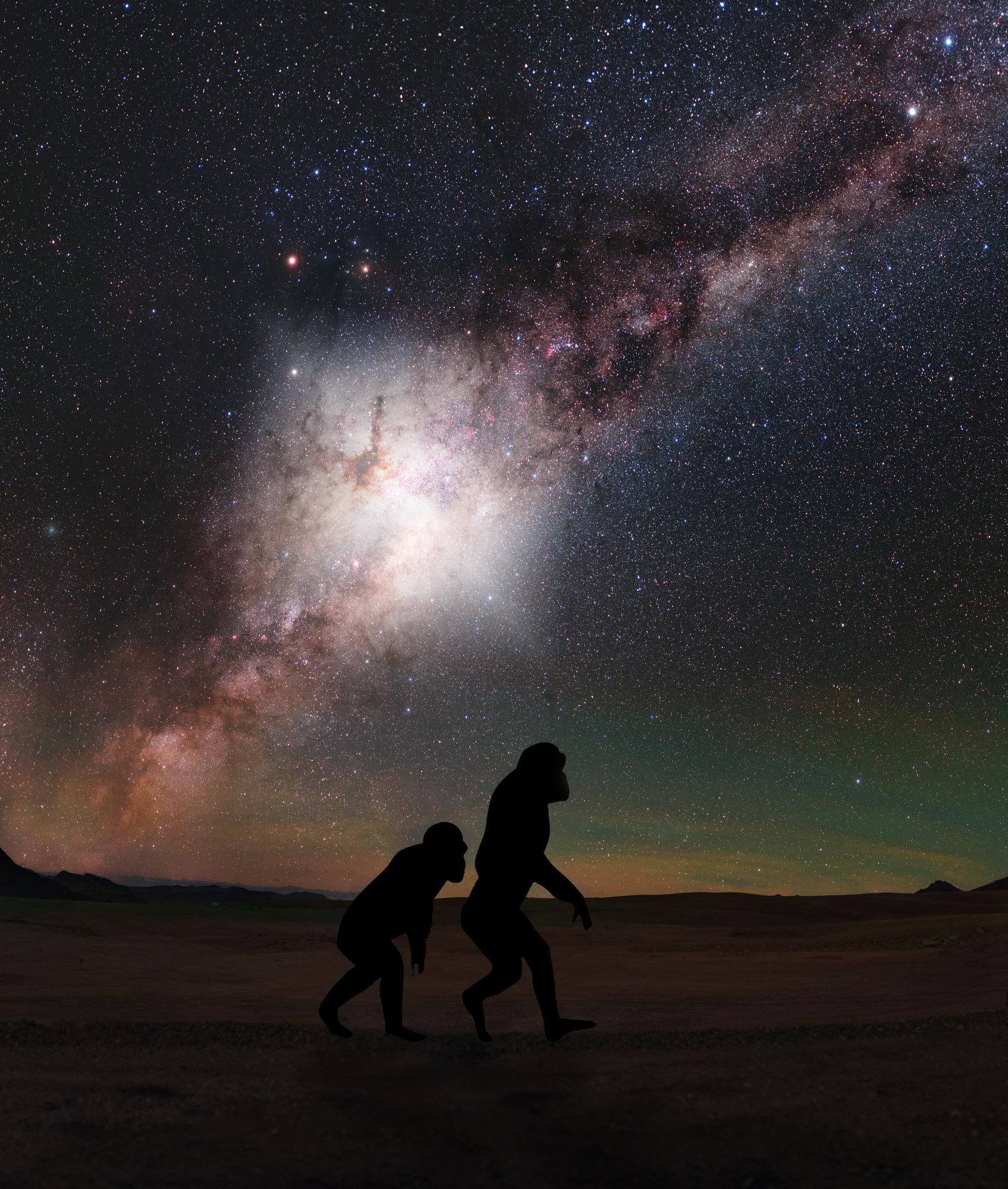
About 3.5 million years ago, the supermassive black hole at the center of our Milky Way galaxy unleashed an enormous burst of energy. Our primitive ancestors, already afoot on the African plains, likely would have witnessed this flare as a ghostly glow high overhead in the constellation Sagittarius. It might have persisted for 1 million years.
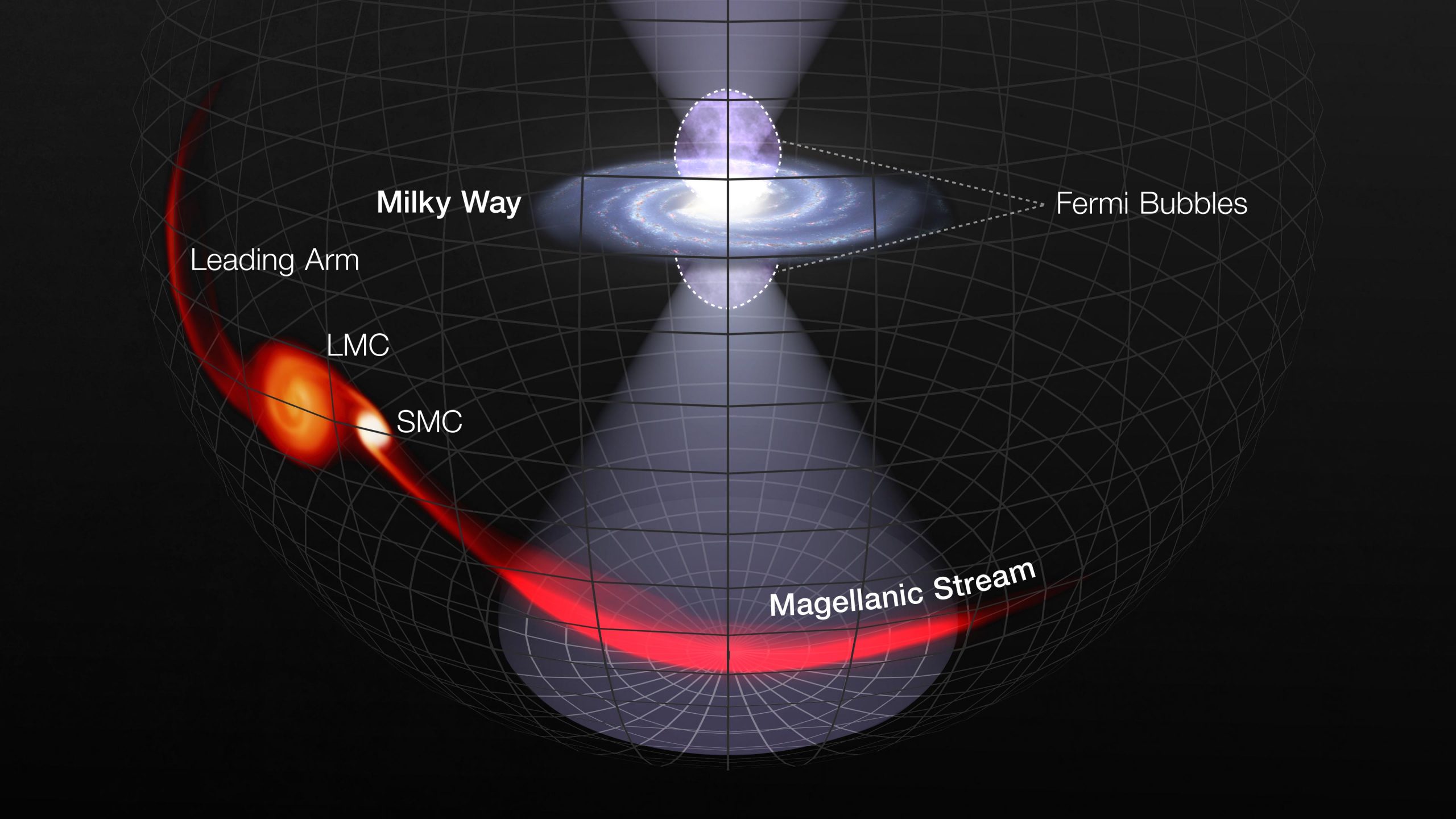
Now, eons later, astronomers are using NASA’s Hubble Space Telescope’s unique capabilities to uncover even more clues about this cataclysmic explosion. Looking to the far outskirts of our galaxy, they found that the black hole’s floodlight reached so far into space it illuminated a vast train of gas trailing the Milky Way’s two prominent satellite galaxies: the Large Magellanic Cloud (LMC) and its companion, the Small Magellanic Cloud (SMC).
The black hole outburst was probably caused by a large hydrogen cloud up to 100,000 times the Sun’s mass falling onto the disk of material swirling near the central black hole. The resulting outburst sent cones of blistering ultraviolet radiation above and below the plane of the galaxy and deep into space.
The radiation cone that blasted out of the Milky Way’s south pole lit up a massive ribbon-like gas structure called the Magellanic Stream. The flash lit up a portion of the stream, ionizing its hydrogen (enough to make 100 million Suns) by stripping atoms of their electrons.
“The flash was so powerful that it lit up the stream like a Christmas tree — it was a cataclysmic event!” said Principal Investigator Andrew Fox of the Space Telescope Science Institute (STScI) in Baltimore. “This shows us that different regions of the galaxy are linked — what happens in the galactic center makes a difference to what happens out in the Magellanic Stream. We’re learning about how the black hole impacts the galaxy and its environment.”
Fox’s team used Hubble’s ultraviolet capabilities to probe the stream by using background quasars — the bright cores of distant, active galaxies — as light sources. Hubble’s Cosmic Origins Spectrograph can see the fingerprints of ionized atoms in the ultraviolet light from the quasars. The astronomers studied sightlines to 21 quasars far behind the Magellanic Stream and 10 behind another feature called the Leading Arm, a tattered and shredded gaseous “arm” that precedes the LMC and SMC in their orbit around the Milky Way.
“When the light from the quasar passes through the gas we’re interested in, some of the light at specific wavelengths gets absorbed by the atoms in the cloud,” said STScI’s Elaine Frazer, who analyzed the sightlines and discovered new trends in the data. “When we look at the quasar light spectrum at specific wavelengths, we see evidence of light absorption that we wouldn’t see if the light hadn’t passed through the cloud. From this, we can draw conclusions about the gas itself.”
The team found evidence that the ions had been created in the Magellanic Stream by an energetic flash. The burst was so powerful that it lit up the stream, even though this structure is about 200,000 light-years from the galactic center.
Unlike the Magellanic Stream, the Leading Arm did not show evidence of being lit up by the flare. That makes sense, because the Leading Arm is not sitting right below the south galactic pole, so it was not showered with the burst’s radiation.
The same event that caused the radiation flare also “burped” hot plasma that is now towering about 30,000 light-years above and below the plane of our galaxy. These invisible bubbles, weighing the equivalent of millions of Suns, are called the Fermi Bubbles. Their energetic gamma-ray glow was discovered in 2010 by NASA’s Fermi Gamma-ray Space Telescope. In 2015, Fox used Hubble’s ultraviolet spectroscopy to measure the expansion velocity and composition of the ballooning lobes.
Now his team managed to stretch Hubble’s reach beyond the bubbles. “We always thought that the Fermi Bubbles and the Magellanic Stream were separate and unrelated to each other and doing their own things in different parts of the galaxy’s halo,” said Fox. “Now we see that the same powerful flash from our galaxy’s central black hole has played a major role in both.”
This research was possible only because of Hubble’s unique ultraviolet capability. Because of the filtering effects of Earth’s atmosphere, ultraviolet light cannot be studied from the ground. “It’s a very rich region of the electromagnetic spectrum — there’s a lot of features that can be measured in the ultraviolet,” explained Fox. “If you work in the optical and infrared, you can’t see them. That’s why we have to go to space to do this. For this type of work, Hubble is the only game in town.”
The findings, to be published in the Astrophysical Journal, will be presented during a press conference on June 2 at the 236th meeting of the American Astronomical Society, which will be conducted virtually this year.
Reference: “Kinematics of the Magellanic Stream and Implications for its Ionization” by Andrew J. Fox, Elaine M. Frazer, Joss Bland-Hawthorn, Bart P. Wakker, Kathleen A. Barger and Philipp Richter, 29 June 2020, The Astrophysical Journal.
DOI: 10.3847/1538-4357/ab92a3
arXiv: 2005.05720
The Hubble Space Telescope is a project of international cooperation between NASA and ESA (European Space Agency). NASA’s Goddard Space Flight Center in Greenbelt, Maryland, manages the telescope. The Space Telescope Science Institute (STScI) in Baltimore conducts Hubble science operations. STScI is operated for NASA by the Association of Universities for Research in Astronomy in Washington, D.C.
Never miss a breakthrough: Join the SciTechDaily newsletter.
Follow us on Google and Google News.
1 Comment
very good