
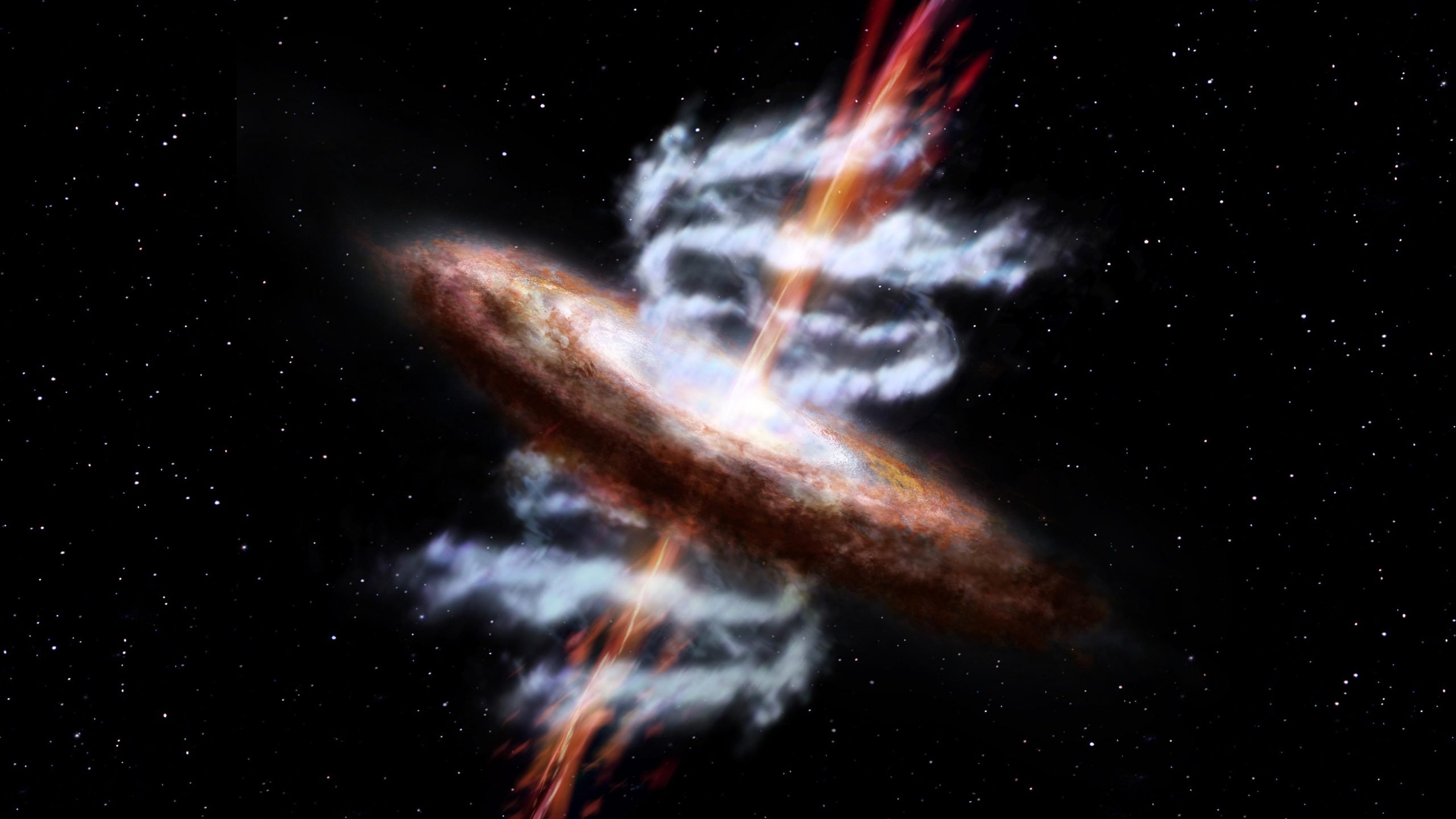
Findings could advance understanding of ultra-fast outflows’ role in evolution of galaxies.
When supermassive black holes have tantrums, galaxies sit up and take notice.
A group of scientists announced they had detected the gamma rays from a phenomenon known as an ultra-fast outflow—a powerful wind launched from very near a supermassive black hole—for the first time. These outflows, according to scientists, are crucial in controlling how fast the black hole and its host galaxy grow.
Researchers have discovered gamma rays from ultra-fast outflows in a number of nearby galaxies using data collected by NASA’s Fermi Gamma-ray Space Telescope and a stacking approach that combines signals too weak to be noticed separately. On November 10, 2021, the team—which included researchers from the University of Chicago, Clemson University, the College of Charleston, and other institutions—published the findings in The Astrophysical Journal.
They said that the findings should contribute in our understanding of the formation and expansion of our own Milky Way galaxy.
“Our gamma-ray observations show how supermassive black holes can transfer a large amount of energy to their host galaxy,” said Chris Karwin, a postdoctoral fellow at Clemson University and leader of the study. “Although these winds are challenging to detect, it is thought that they play a significant role in how a massive black hole and the host galaxy itself grow.”
‘Tsunami-Like Winds’
A supermassive black hole sits at the heart of every galaxy. Some are inactive. Others draw in and “eat” their surroundings, and these are known as active galactic nuclei.
Contrary to popular belief, black holes do not consume everything in their vicinity. “Black holes are like powerful vacuum cleaners that eject some of the dirt that gets near them instead of sucking in everything,” said Marco Ajello, an associate professor at Clemson University who is co-leading the study. “These ejections, which are tsunami-like winds, are made of highly ionized gas.”
Strong shock waves are produced when this gas interacts with the materials between star systems. According to Karwin, black holes do this by transferring a massive quantity of energy to the host galaxies.
“These ultra-fast outflows act like a piston and actually accelerate charged particles, known as cosmic rays, to near the speed of light,” he said.
These cosmic rays go on to collide with particles in the host galaxy, eventually producing the gamma rays that the scientists detected.
“That gamma-ray emission encodes a ton of information. That includes how it evolved, how it accelerates cosmic rays, and how it interacts with material in the host galaxy.”
UChicago graduate student Rebecca Diesing, a study co-author
“That gamma-ray emission encodes a ton of information,” said Rebecca Diesing, a graduate student at the University of Chicago and co-author on the paper. “That includes how it evolved, how it accelerates cosmic rays, and how it interacts with material in the host galaxy.”
Diesing created cutting-edge computational modeling techniques in collaboration with Asst. Prof. Damiano Caprioli of the Department of Astronomy and Astrophysics at the University of Chicago. These techniques determine how particles can be accelerated in astrophysical environments, particularly at the potent shock waves produced by the winds, and how such very energetic particles emit gamma rays. Together, these details shed light on the evolution of these incredibly rapid fluxes.
The galaxies near these outflows are impacted by them in a variety of ways. For instance, researchers believe that the energy from these incredibly fast outflows is injected into the galaxy, breaking up gas clouds that might otherwise grow into stars and feed the supermassive black hole .“This becomes a self-regulating process, which physically links supermassive black holes with their host galaxies, causing them to grow together,” said Diesing.
“The black hole at the center of the galaxy and the galaxy itself have a mechanism to grow together in mass—and this is the mechanism,” Ajello said.
Understanding the Milky Way
Scientists may be able to better understand events in our own Milky Way galaxy based on the study’s findings.
The supermassive black hole at the center of the Milky Way, known as Sagittarius A*, has a mass that is roughly four million times that of the sun. “Fermi bubbles,” massive spherical structures of hot gas emerging from the galactic core, extend above and below the Milky Way’s disc. (They are known as Fermi bubbles because they were found in 2010 by the Fermi Gamma-Ray Space Telescope, which provided the data for the current study).
“Today, our black hole, Sagittarius A*, is not active, but it’s possible it was active in the recent past, maybe up until a few hundred years ago,” Karwin said. “Our model supports the hypothesis that these Fermi bubbles may be remnants of past ultra-fast outflow-like activity from the supermassive black hole in the center of our galaxy.”
Ajello said future work includes studying galaxies that have had active ultra-fast outflow winds for tens of millions of years that have already traveled to the outskirts of the galaxy.
Reference:: “Gamma Rays from Fast Black-hole Winds.” by M. Ajello, L. Baldini, J. Ballet, G. Barbiellini, D. Bastieri, R. Bellazzini, A. Berretta, E. Bissaldi, R. D. Blandford, E. D. Bloom, R. Bonino, P. Bruel, S. Buson, R. A. Cameron, D. Caprioli, R. Caputo, E. Cavazzuti, G. Chartas, S. Chen, C. C. Cheung, G. Chiaro, D. Costantin, S. Cutini, F. D’Ammando, P. de la Torre Luque, F. de Palma, A. Desai, R. Diesing, N. Di Lalla, F. Dirirsa, L. Di Venere, A. Domínguez, S. J. Fegan, A. Franckowiak, Y. Fukazawa, S. Funk, P. Fusco, F. Gargano, D. Gasparrini, N. Giglietto, F. Giordano, M. Giroletti, D. Green, I. A. Grenier, S. Guiriec, D. Hartmann, D. Horan, G. Jóhannesson, C. Karwin, M. Kerr, M. Kovacevic, M. Kuss, S. Larsson, L. Latronico, M. Lemoine-Goumard, J. Li, I. Liodakis, F. Longo, F. Loparco, M. N. Lovellette, P. Lubrano, S. Maldera, A. Manfreda, S. Marchesi, L. Marcotulli, G. Martí-Devesa, M. N. Mazziotta, I. Mereu, P. F. Michelson, T. Mizuno, M. E. Monzani, A. Morselli, I. V. Moskalenko, M. Negro, N. Omodei, M. Orienti, E. Orlando, V. Paliya, D. Paneque, Z. Pei, M. Persic, M. Pesce-Rollins, T. A. Porter, G. Principe, J. L. Racusin, S. Rainò, R. Rando, B. Rani, M. Razzano, A. Reimer, O. Reimer, P. M. Saz Parkinson, D. Serini, C. Sgrò, E. J. Siskind, G. Spandre, P. Spinelli, D. J. Suson, D. Tak, D. F. Torres, E. Troja, K. Wood, G. Zaharijas and J. Zrake, 10 November 2021, The Astrophysical Journal.
DOI: 10.3847/1538-4357/ac1bb2
Never miss a breakthrough: Join the SciTechDaily newsletter.
Follow us on Google and Google News.
5 Comments
Could DARK ENERGY ( flowing space-time ) be the ultra-fast outflows ,tsunami-like winds .Does a black hole have to go to the toilet sometimes ?
My thoughts:
https://gravityisfluidspacetime.blogspot.com/2020/08/gravity-is-not-curved-space-time-it-is.html
That’s fascinating as black holes are my understanding from a recent post by mathematician and physicist is that black holes are still purely theoretical they merely explain certain cosmological variables that eluded explanation before I’d be happy if someone could correct me on this because I’ve heard both versions black holes are real or black holes are in fact mathematical theory
Yhere seems a strong possibility that gamma ŕays are produced due to dark energy.This is root of accelerated part of expansion of the galaxìes.
Gravitational interactiòns among the galaxies are due to dark energy,produces gamma rays on super massive black hoĺes can generate daŕk matter.ln this way growth of galaxìes àre continued and rate of expansion is accelerated with resultant increase in their masses.
Gravitational interactiòns among the galaxies are due to dark energy,produces gamma rays on super massive black hoĺes can generate daŕk matter.ln this way growth of galaxìes àre continued and rate of expansion is accelerated with resultant increase in their masses.
As we view linear velocity of any galaxy relative to òther galaxìes is defined by the Hubble’s law has constant expansion is by visible matter.This constant expansion is originated from Big Bang.
Thus accelerated part of expansion due to gravitational effects on any galaxy due to all òthers produce rotation or effective dark energy/matter(by conversion).