
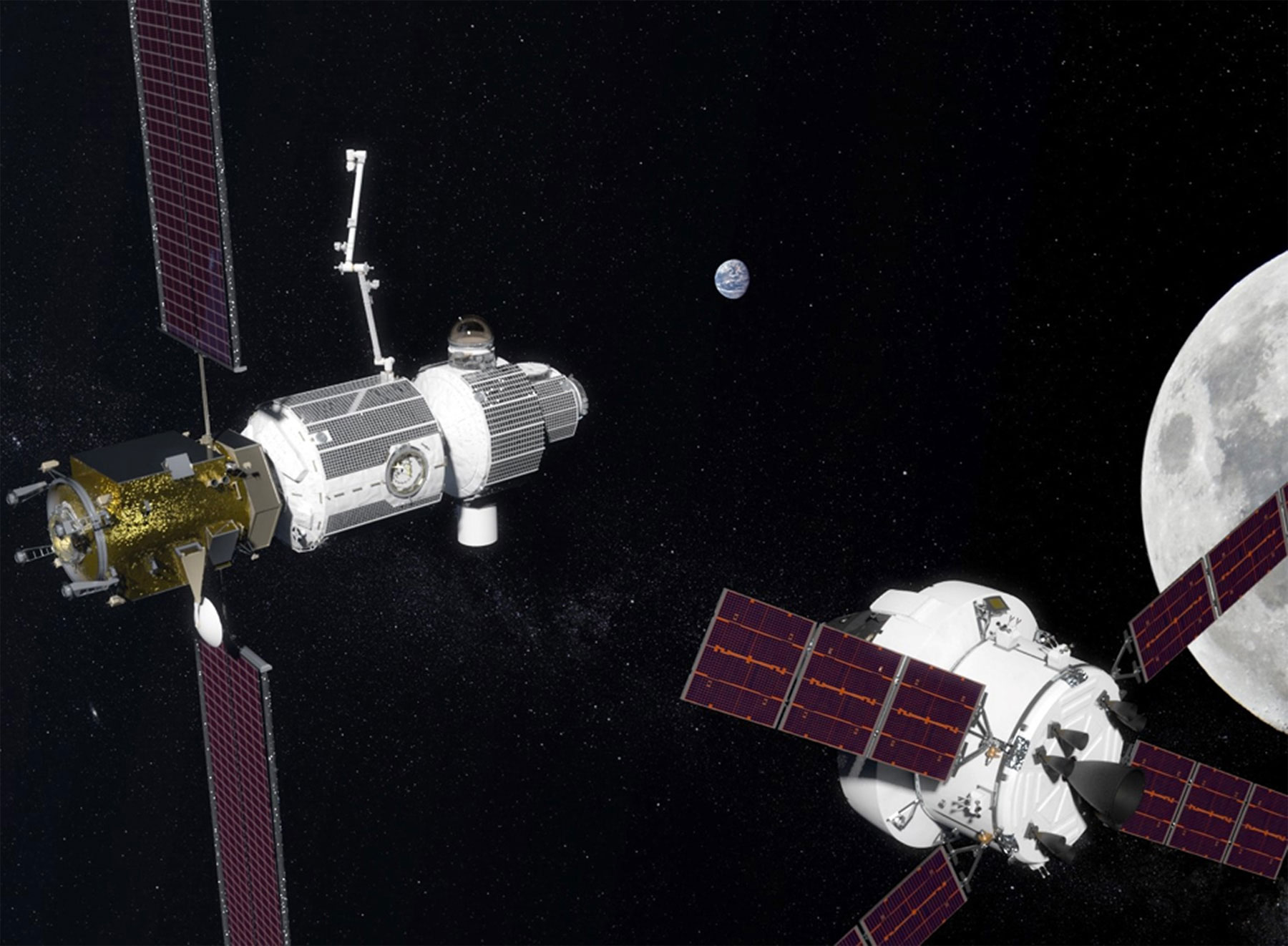
As NASA sets its sights on returning to the Moon, and preparing for Mars, the agency is developing new opportunities in lunar orbit to provide the foundation for human exploration deeper into the solar system.
For months, the agency has been studying an orbital outpost concept in the vicinity of the Moon with U.S. industry and the International Space Station partners. As part of the fiscal year 2019 budget proposal, NASA is planning to build the Lunar Orbital Platform-Gateway in the 2020s.
The platform will consist of at least a power and propulsion element and habitation, logistics, and airlock capabilities. While specific technical and mission capabilities as well as partnership opportunities are under consideration, NASA plans to launch elements of the gateway on the agency’s Space Launch System or commercial rockets for assembly in space.
“The Lunar Orbital Platform-Gateway will give us a strategic presence in cislunar space. It will drive our activity with commercial and international partners and help us explore the Moon and its resources,” said William Gerstenmaier, associate administrator, Human Exploration and Operations Mission Directorate, at NASA Headquarters in Washington. “We will ultimately translate that experience toward human missions to Mars.”
The power and propulsion element will be the initial component of the gateway, and is targeted to launch in 2022. Using advanced high-power solar electric propulsion, the element will maintain the gateway’s position and can move the gateway between lunar orbits over its lifetime to maximize science and exploration operations. As part of the agency’s public-private partnership work under Next Space Technologies for Exploration Partnerships, or NextSTEP, five companies are completing four-month studies on affordable ways to develop the power and propulsion element. NASA will leverage the capabilities and plans of commercial satellite companies to build the next generation of all-electric spacecraft.
The power and propulsion element will also provide high-rate and reliable communications for the gateway including space-to-Earth and space-to-lunar uplinks and downlinks, spacecraft-to-spacecraft crosslinks, and support for spacewalk communications. Finally, it also can accommodate an optical communications demonstration – using lasers to transfer large data packages at faster rates than traditional radio frequency systems.
Habitation capabilities launching in 2023 will further enhance our abilities for science, exploration, and partner (commercial and international) use. The gateway’s habitation capabilities will be informed by NextSTEP partnerships, and also by studies with the International Space Station partners. With this capability, crew aboard the gateway could live and work in deep space for up to 30 to 60 days at a time.
Crew will also participate in a variety of deep space exploration and commercial activities in the vicinity of the Moon, including possible missions to the lunar surface. NASA also wants to leverage the gateway for scientific investigations near and on the Moon. The agency recently completed a call for abstracts from the global science community, and is hosting a workshop in late February to discuss the unique scientific research the gateway could enable. NASA anticipates the gateway will also support the technology maturation and development of operating concepts needed for missions beyond the Earth and Moon system.
Adding an airlock to the gateway in the future will enable crew to conduct spacewalks, enable science activities and accommodate docking of future elements. NASA is also planning to launch at least one logistics module to the gateway, which will enable cargo resupply deliveries, additional scientific research and technology demonstrations and commercial use.
Following the commercial model the agency pioneered in low-Earth orbit for space station resupply, NASA plans to resupply the gateway through commercial cargo missions. Visiting cargo spacecraft could remotely dock to the gateway between crewed missions.
Drawing on the interests and capabilities of industry and international partners, NASA will develop progressively complex robotic missions to the surface of the Moon with scientific and exploration objectives in advance of a human return. NASA’s exploration missions and partnerships will also support the missions that will take humans farther into the solar system than ever before.
NASA’s Space Launch System rocket and Orion spacecraft are the backbone of the agency’s future in deep space. Momentum continues toward the first integrated launch of the system around the Moon in fiscal year 2020 and a mission with crew by 2023. The agency is also looking at a number of possible public/private partnerships in areas including in-space manufacturing and technologies to extract and process resources from the Moon and Mars, known as in-situ resource utilization.
For more information about NASA’s deep space exploration plans, visit: https://www.nasa.gov/journeytomars
Never miss a breakthrough: Join the SciTechDaily newsletter.
Follow us on Google and Google News.