
Close Menu
    Facebook X (Twitter) Instagram
    SciTechDaily
    • Biology
    • Chemistry
    • Earth
    • Health
    • Physics
    • Science
    • Space
    • Technology
    Facebook X (Twitter) Pinterest YouTube RSS
    SciTechDaily
    Home»Physics»CERN Reports Observation of Pentaquark Particles
    Physics

    CERN Reports Observation of Pentaquark Particles

    By CERNJuly 14, 20151 Comment4 Mins Read
    Facebook Twitter Pinterest Telegram LinkedIn WhatsApp Email Reddit
    Share
    Facebook Twitter LinkedIn Pinterest Telegram Email Reddit
    CERN’s LHCb Experiment Detects Exotic Pentaquark Particles
    Illustration of the possible layout of the quarks in a pentaquark particle such as those discovered at LHCb. The five quarks might be tightly bonded (left). They might also be assembled into a meson (one quark and one antiquark) and a baryon (three quarks), weakly bound together. Credit: CERN

    Physicists at CERN’s Large Hadron Collider have reported the discovery of a class of particles known as pentaquarks.

    “The pentaquark is not just any new particle,” said LHCb spokesperson Guy Wilkinson. “It represents a way to aggregate quarks, namely the fundamental constituents of ordinary protons and neutrons, in a pattern that has never been observed before in over fifty years of experimental searches. Studying its properties may allow us to understand better how ordinary matter, the protons and neutrons from which we’re all made, is constituted.”

    Our understanding of the structure of matter was revolutionized in 1964 when American physicist, Murray Gell-Mann, proposed that a category of particles known as baryons, which includes protons and neutrons, are comprised of three fractionally charged objects called quarks, and that another category, mesons, are formed of quark-antiquark pairs. Gell-Mann was awarded the Nobel Prize in Physics for this work in 1969. This quark model also allows the existence of other quark composite states, such as pentaquarks composed of four quarks and an antiquark. Until now, however, no conclusive evidence for pentaquarks had been seen.

    LHCb researchers looked for pentaquark states by examining the decay of a baryon known as Λb (Lambda b) into three other particles, a J/ψ- (J-psi), a proton and a charged kaon. Studying the spectrum of masses of the J/ψ and the proton revealed that intermediate states were sometimes involved in their production. These have been named Pc(4450)+ and Pc(4380)+, the former being clearly visible as a peak in the data, with the latter being required to describe the data fully.
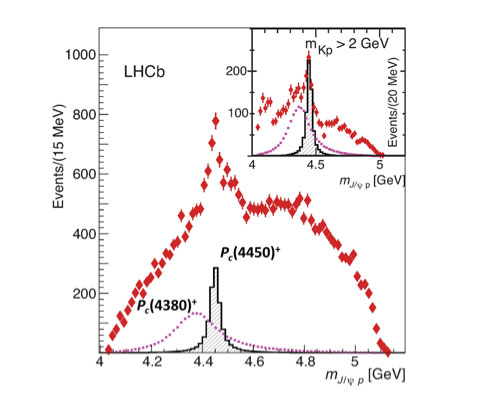
    CERN Experiment Detects Pentaquark Particles
    The mass of J/ψ–proton (J/ψ p) combinations from Λb → J/ψpK-decays. The data are shown as red diamonds. The predicted contributions from the Pc(4380)+ and Pc(4450)+ states are indicated in the purple and black distributions, respectively. Inset: the mass of J/ψ p combinations for a restricted range of the K-p mass, where the contribution of the wider Pc(4380)+ state is more pronounced. (The other contributions from conventional hadrons, which are responsible for the remaining features in the data distributions, are not displayed.) Credit: CERN / LHCb Collaboration

    “Benefiting from the large data set provided by the LHC, and the excellent precision of our detector, we have examined all possibilities for these signals, and conclude that they can only be explained by pentaquark states”, says LHCb physicist Tomasz Skwarnicki of Syracuse University.

    “More precisely the states must be formed of two up quarks, one down quark, one charm quark, and one anti-charm quark.”

    Earlier experiments that have searched for pentaquarks have proved inconclusive. Where the LHCb experiment differs is that it has been able to look for pentaquarks from many perspectives, with all pointing to the same conclusion. It’s as if the previous searches were looking for silhouettes in the dark, whereas LHCb conducted the search with the lights on, and from all angles. The next step in the analysis will be to study how the quarks are bound together within the pentaquarks.

    “The quarks could be tightly bound,” said LHCb physicist Liming Zhang of Tsinghua University, “or they could be loosely bound in a sort of meson-baryon molecule, in which the meson and baryon feel a residual strong force similar to the one binding protons and neutrons to form nuclei.”

    More studies will be needed to distinguish between these possibilities, and to see what else pentaquarks can teach us. The new data that LHCb will collect in LHC run 2 will allow progress to be made on these questions.

    The collaboration has submitted a paper reporting these findings to the journal Physical Review Letters.

    Reference: “Observation of J/ψp resonances consistent with pentaquark states in Λ0b→J/ψK−p decays decays” by R. Aaij et al. (LHCb Collaboration), 12 August 2015, Physical Review Letters.
    DOI: 10.1103/PhysRevLett.115.072001
    arXiv: 1507.03414

    Never miss a breakthrough: Join the SciTechDaily newsletter.
    Follow us on Google and Google News.

    Antiquark CERN Large Hadron Collider Particle Physics
    Share. Facebook Twitter Pinterest LinkedIn Email Reddit

    Related Articles

    New CERN Study Suggests Subatomic Particles Could Defy the Standard Model

    CERN Experiments Reveal No Difference in Mass of Proton and Antiproton

    Physicists Confirm Discovery of Four-Quark Hadron

    New Results Indicate That Particle Discovered at LHC Is a Higgs Boson

    The Large Hadron Collider Prepares for Shutdown

    CERN to Announce the Latest Results from ATLAS and CMS

    Discussing the Search for the Higgs Particle

    More Data of Elusive Higgs Boson from Defunct US Tevatron Collider

    Higgs Boson Signals Gain Strength at Large Hadron Collider

    1 Comment

    1. zianez on July 6, 2020 1:42 am

      thanks for the helpful information shared.

      Reply
    Leave A Reply Cancel Reply

    • Facebook
    • Twitter
    • Pinterest
    • YouTube

    Don't Miss a Discovery

    Subscribe for the Latest in Science & Tech!

    Trending News

    New Study Reveals Why Ozempic Works Better for Some People Than Others

    Climate Change Is Altering a Key Greenhouse Gas in a Way Scientists Didn’t Expect

    New Study Suggests Gravitational Waves May Have Created Dark Matter

    Scientists Discover Why the Brain Gets Stuck in Schizophrenia

    Scientists Engineer “Tumor-Eating” Bacteria That Devour Cancer From Within

    Even “Failed” Diets May Deliver Long-Term Health Gains, Study Finds

    NIH Scientists Discover Powerful New Opioid That Relieves Pain Without Dangerous Side Effects

    Collapsing Plasma May Hold the Key to Cosmic Magnetism

    Follow SciTechDaily
    • Facebook
    • Twitter
    • YouTube
    • Pinterest
    • Newsletter
    • RSS
    SciTech News
    • Biology News
    • Chemistry News
    • Earth News
    • Health News
    • Physics News
    • Science News
    • Space News
    • Technology News
    Recent Posts
    • This 15,000-Year-Old Discovery Changes What We Know About Early Human Creativity
    • 35-Million-Year-Old Mystery: Strange Arachnid Discovered Preserved in Amber
    • Revolutionary Gas Turbine Generates Power Without Air Compression
    • Is AI Really Just a Tool? It Could Be Altering How You See Reality
    • JWST Reveals a “Forbidden” Planet With a Baffling Composition
    Copyright © 1998 - 2026 SciTechDaily. All Rights Reserved.
    • Science News
    • About
    • Contact
    • Editorial Board
    • Privacy Policy
    • Terms of Use

    Type above and press Enter to search. Press Esc to cancel.