
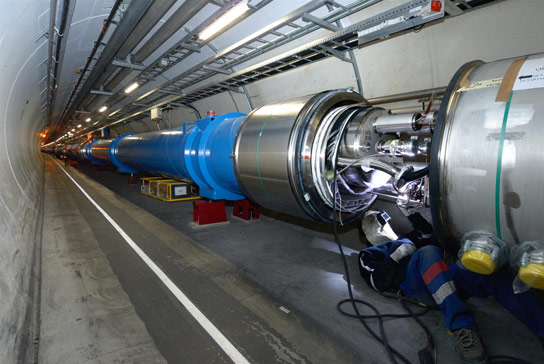
On February 14, 2013, the Large Hadron Collider will begin “Long Shutdown 1,” a shutdown period of almost two years during which the LCH will undergo large-scale work to modernize the infrastructure and prepare the LHC for operation at higher energy.
The Large Hadron Collider (LHC) has provided physicists with a huge quantity of data to analyze since the first physics run in 2009. Now it’s time for the machine, along with CERN’s other accelerators, to get a facelift. “Long Shutdown 1” (LS1) will begin on 14 February 2013, but this doesn’t mean that life at CERN will be any less rich and exciting. Although there will be no collisions for a period of almost two years, the whole CERN site will be a hive of activity, with large-scale work underway to modernize the infrastructure and prepare the LHC for operation at higher energy.
“A whole series of renovation work will be carried out around the LHC during LS1,” says Simon Baird, deputy head of the Engineering department. “The key driver is of course the consolidation of the 10,170 high-current splices between the superconducting magnets. The teams will start by opening up the 1695 interconnections between each of the cryostats of the main magnets. They will repair and consolidate around 500 interconnections simultaneously. The maintenance work will gradually cover the entire 27-kilometer circumference of the LHC.”
The LHC will be upgraded as well as renovated during the period concerned. In the framework of the Radiation to Electronics project (R2E), sensitive electronic equipment protection will be optimized by relocating the equipment or by adding shielding.
The work will by no means be confined to the LHC. Major renovation work is scheduled, for example, for the Proton Synchrotron (PS) and the Super Proton Synchrotron (SPS). During LS1 the upgrade of the PS access control system, which includes the installation of 25 new biometrically controlled access points, will continue. The whole tunnel ventilation system will also be dismantled and replaced, with 25 air-handling units representing a cumulated flow rate of 576,000 cubic meters (152 million gallons) per hour to be installed around the accelerator’s 628-meter (2,060-foot) circumference. Meanwhile, at the SPS, about 100 kilometers (62 miles) of radiation-damaged cables used in the instrumentation and control systems will be removed or replaced.
CERN will take advantage of LS1 to improve the installations connected with the experiments, accelerators, electronics, and so on, with a view to a spectacular resumption of its main activities after the shutdown. While the shutdown work is in progress, life at the laboratory will be anything but boring. Stay tuned to keep abreast of all the developments.
Never miss a breakthrough: Join the SciTechDaily newsletter.
Follow us on Google and Google News.
2 Comments
Notice the glaring omission of how many more billions this will cost. typical, if you don’t get the results you were looking for, its not because you were wrong, its because you just didn’t dump enough cash into it.
considering the ever increasing gaps in the way we think, the only thing we can hope is that we keep looking regardless off cost, without r+d were would we be ? still burning witches. grow up , this is a fantastic opertunity and I for one would love the opertunity to visit / work on a project like it.