
Where does the Higgs boson come from?
The CERN Theoretical Physics department hosted a workshop to explore unconventional explanations for the Higgs boson’s properties and origin. While no evidence for “natural” solutions has been found, future data from ATLAS and CMS experiments will guide the path forward, potentially changing our understanding of fundamental physics.
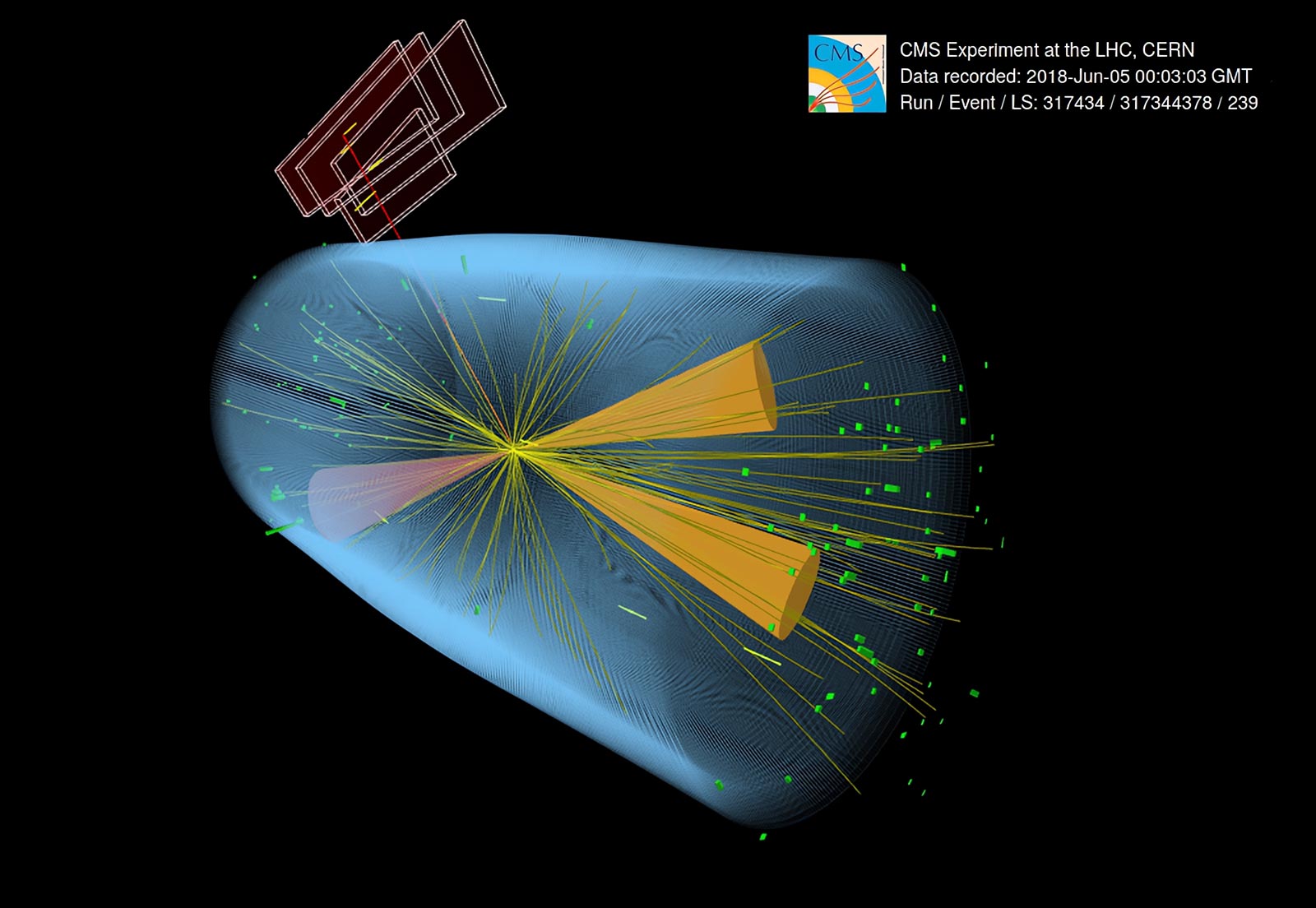
The discovery of the Higgs boson at the Large Hadron Collider (LHC) in 2012 was a triumph of theoretical and experimental physics, yet its implications are only just beginning to be understood. Precise measurements by the ATLAS and CMS collaborations show that this fundamental particle, which is responsible for generating the masses of elementary particles, behaves as predicted by the half-century-old Standard Model of particle physics. But where does the Higgs boson come from? And why is it so light that the LHC is able to produce it in droves? Such conundrums were discussed during a week-long workshop, Exotic Approaches to Naturalness, hosted by the CERN Theoretical Physics department from 30 January to 3 February.
The Electroweak Hierarchy Problem
The Higgs boson is the simplest known particle: a “fragment of vacuum” with no charge or spin. As with all elementary particles, it is an excitation, or quantum, of a more fundamental entity called a field – the uniquely featureless Brout–Englert–Higgs field, which fills all space uniformly. This field is understood to have come into existence during an epochal “electroweak” phase transition a fraction of a nanosecond after the Big Bang; whereas, previously, elementary particles such as the electron had moved at the speed of light, they were forever after forced to interact with this quantum molasses, which imbued them with the property of mass. But if this picture is true, the Higgs boson itself should gain mass from the interactions of known particles with its parent field. Totting up these so-called quantum corrections would suggest a value for the Higgs-boson mass that is many orders of magnitude larger than is observed. Apart from putting it beyond the reach of any conceivable experiment, such a heavyweight Higgs would not allow the universe as we know it to have formed.
Natural vs. Exotic Solutions
Aware of this paradox (called the electroweak hierarchy problem) long before the Higgs boson was discovered, and guided by the possible existence of particles and forces beyond those described by the Standard Model, physicists have come up with various explanations. One is that the Higgs boson is made of more basic entities held together by very strong forces, which circumvents the impact of quantum corrections. Another is that space-time possesses additional “supersymmetric” dimensions that would imply the existence of an entirely new mirror-world of particles that cancel out the troublesome quantum corrections from standard ones. So far, however, no evidence for such “natural” solutions to the electroweak hierarchy problem has been found.
Enter Exotic Approaches to Naturalness, which drew on such concepts as generalised symmetries, ultraviolet/infrared mixing, weak-gravity conjectures and “magic zeroes” to try to explain the Higgs boson’s mass, and other unnatural numbers in physics. If the language is abstruse, it’s because participants of the February workshop were encouraged to challenge conventions and to plant seeds of ideas at the edge of knowledge – including those that reject the concept of naturalness entirely. The latter would be a radical break from past successes. After all, the mass of the Higgs boson is not the only seemingly unnatural number in nature: where physicists were once perplexed about why the electrical energy of the electron does not grow infinitely large at short distances, for instance, the mystery vanished with the discovery that the electron has an antimatter partner, the positron, that cancels out the unphysical divergence. The unnatural mass of the Higgs boson might even be linked to the exceedingly small but non-zero value of the cosmological constant, which is responsible for the accelerating expansion of the universe.
“This workshop provided us with a fantastic forum to bring a fresh perspective on naturalness problems, both in a variety of physical systems and for particle physics specifically,” says workshop co-organiser Tim Cohen of CERN. “Our community has been pondering the Higgs’s naturalness problem for decades, and yet many of us suspect that we have not found the right idea yet. If we can eventually understand how nature has addressed the electroweak hierarchy problem, there is a very high likelihood of learning something that will change our perspective on fundamental physics, and the reductionist philosophy that has served us since the beginning of our discipline.”
While theorists let their imaginations run free, the conclusion of the CERN workshop was clear: the path ahead will be guided by data. Larger samples of Higgs bosons to be collected by ATLAS and CMS in the coming years – and by experiments at a dedicated “Higgs factory” proposed to follow the LHC – will enable physicists to study the unique interaction of the Higgs boson with itself. This will provide information about the precise shape and form of the Brout–Englert–Higgs field and the nature of the electroweak phase transition, and possibly tell us whether the Higgs boson is natural or weirdly fine-tuned for our existence.
Never miss a breakthrough: Join the SciTechDaily newsletter.
Follow us on Google and Google News.
4 Comments
The natural order of things has the most ignorant enamored by their own knowledge; while the most intelligent and knowledgeable are humbled by how much they don’t know. What do we do with those who know a lot, but are always surprised by something they didn’t know?
According to the gravitational field theory of topological vortex, the physical real mirror image of nature only exists between the topological vortex and its twin antivortex. It is meaningless to discuss the CP of two particles (or things) that are not mirror images of each other. This type of discussion is full of deception and misleading. Its detestable aspect lies in:
1. Firstly, subjectively determine that two particles (or things) are mirror images of each other.
2. Subsequently, experimental detection revealed that the two particles (or things) are asymmetric.
The experiment showed that the previous subjective determination was incorrect. According to common sense, it should be concluded that the two particles (or things) are not mirror images of each other.
However, physical science today does not do so. Their conclusion is:
The two particles (or things) that are mirror images of each other are asymmetric.
This blatant sophistry and misleading behavior is completely a desecration to public wisdom.
“This will provide information about the precise shape and form of the Brout–Englert–Higgs field and the nature of the electroweak phase transition, and possibly tell us whether the Higgs boson is natural or weirdly fine-tuned for our existence.”
So such fine tuning would appear unnatural?
Common sense says that the Brout–Englert–Higgs Field is exactly such that… there is no dark side of the moon really, as a matter of fact it’s all dark.