
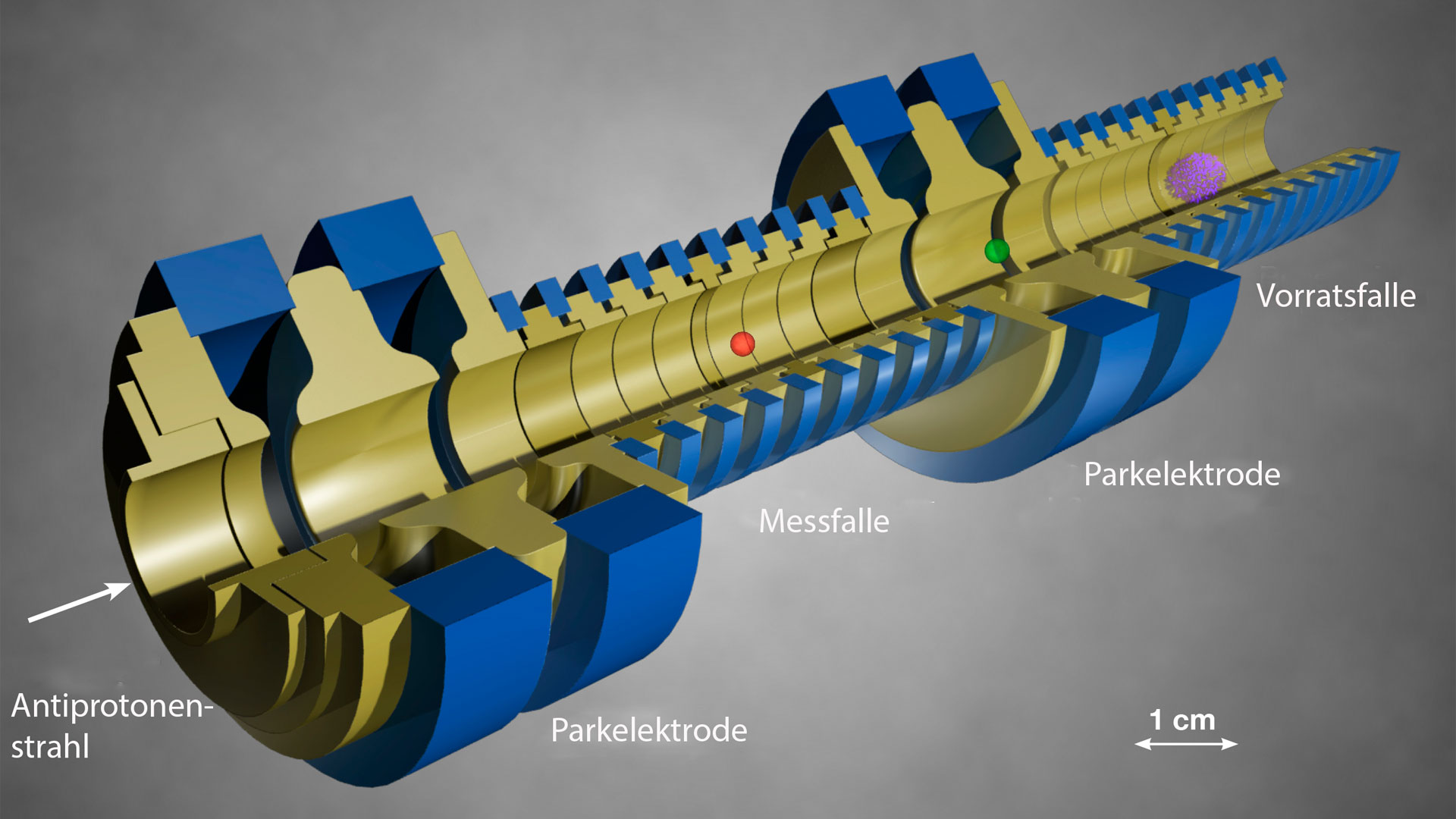
The most precise experiments ever to compare the mass of the proton and antiproton reveal no difference between the particles, determining that the masses of the proton and antiproton are identical to eleven decimal places.
The existence of our world is anything but self-evident. The Big Bang created matter and antimatter in equal measure. Why only matter, which makes up the celestial bodies in the universe, ultimately remained behind, is the focus of a Japanese-German cooperative project called BASE, which includes researchers from the Max Planck Institute for Nuclear Physics in Heidelberg and other institutions. In their experiments at CERN in Switzerland, the scientists have determined that the masses of the proton and antiproton are identical to eleven decimal places. In the process, they set a new precision record for measuring the symmetry between matter and antimatter. Based on the latest findings, the BASE researchers are now delving further into the reasons for the surplus of matter in the universe by comparing the magnetic moments of protons and antiprotons.
Particle physicists are well aware that their worldview is still imperfect. However, they are unable to currently remedy the shortcomings. While the Standard Model of particle physics can explain the existence of all known elementary particles and many of their interactions, some observations simply don’t fit the theory. For example, the Standard Model does not explain the asymmetry between matter and antimatter: Although matter and antimatter were created in equal amounts at the beginning of the universe, they subsequently annihilated each other for the most part – a phenomenon that occurs whenever matter meets antimatter. Yet there is still an abundance of matter in the universe.
Physicists thus want to shore up the theoretical edifice of the Standard Model or even reformulate it to redress its deficiencies. To this effect, they are looking for detailed experimental evidence of weak points, for example differences between matter and antimatter. That is the purpose of the BASE project, short for Baryon Antibaryon Symmetry Experiment. Baryons and antibaryons are subatomic particles which – like protons and antiprotons – consist of three elementary particles namely quarks and antiquarks.
In their search for infinitesimal differences between matter and antimatter, the BASE researchers measured the charge-to-mass ratio of the proton and antiproton. Essentially, they weighed the two particles. In doing so, they compared matter and antimatter in the system to a precision four times greater than was previously possible. “We’ve found that the ratio of charge to mass is identical to one part in 69 trillion,” says Stefan Ulmer, scientist at CERN and spokesperson for the BASE project.
The results confirm theories which state that no differences in mass exist between matter and antimatter. Had the researchers found a difference in mass, it would have called the Standard Model into question, as well as casting doubt on even more fundamental theories of particle physics. “But nature is always good for surprises,” says Klaus Blaum, Director of the Max Planck Institute for Nuclear Physics in Heidelberg and one of the BASE partners. We therefore have to exploit every possibility to check the models as precisely as possible.”
In order to weigh the proton and antiproton to such a high level of precision, the researchers came up with a clever method: They capture the charged particles in a Penning trap, in which the particles are confined by electrical and magnetic fields. The magnetic field forces the particles to rotate around 30 million times per second. By way of comparison: a fairground swing ride takes five to ten seconds for a single rotation. If it rotated any faster, the riders would quickly become ill.
Rotational frequency reveals the ratio of charge to mass
Despite the speed of the charged particles in the Penning trap, the researchers were able to determine the number of rotations very precisely. Because the frequency of rotation depends on the particles’ ratio of charge to mass, this is an extremely precise method for determining the charge-to-mass ratio.
However, there was a complication in the BASE project experiments that not everyone would have expected. “It’s still very difficult to set the voltage precisely to eleven decimal places,” Klaus Blaum explains. Yet that is what the researchers had to achieve in order to catapult protons and antiprotons into the Penning trap. They then had to produce the electrical field in the trap with a negative voltage in order to capture positively charged protons. Conversely, they had to use a positive voltage – closely matched to the previous used negative voltage − to corral the negatively charged antiprotons.
As it is almost impossible to generate electrical fields of the same, or at least precisely known, strength for both particles, the physicists came up with another ingenious trick. They measured the proton and antiproton in an experiment using a single electrical field. First, they attached two electrons to a proton, thus converting it into a negatively charged hydrogen ion. In this way it was possible to use a positive voltage to contain both the proton and the negatively charged antiproton.
Protons and antiprotons could differ in magnetic moment
“It would be even better if we could measure the proton itself,” says Klaus Blaum. Fortunately, however, the mass of the electron and its binding energy are known very precisely, so that the value of the proton and its mass can be easily determined from the charge-to-mass ratio of the hydrogen ion. “In this way we’ve carried out the world’s most precise measurement comparing the mass of the proton and antiproton.”
With their experiments, the researchers have attained a new level in the comparison of matter and antimatter. “Research into antimatter particles has made enormous strides in recent years,” says Rolf Heuer, Director General of CERN. “I’m impressed by the degree of precision that BASE has achieved.”
The BASE researchers now want to use the skills they have acquired to continue their search for differences between matter and antimatter. Measuring the magnetic moments of the proton and antiproton is a very promising approach for tracking down differences between matter and antimatter, says Stefan Ulmer. The researchers have already measured the magnetic moment of the proton. Now they plan to determine the corresponding value of the antiproton. “We’ve just resumed our measurements,” says Stefan Ulmer. The scientists hope that this approach will yield useful evidence to explain why our world exists.
Reference: “High-precision comparison of the antiproton-to-proton charge-to-mass ratio” by S. Ulmer, C. Smorra, A. Mooser, K. Franke, H. Nagahama, G. Schneider, T. Higuchi, S. Van Gorp, K. Blaum, Y. Matsuda, W. Quint, J. Walz and Y. Yamazaki, 12 August 2015, Nature.
DOI: 10.1038/nature14861
Never miss a breakthrough: Join the SciTechDaily newsletter.
Follow us on Google and Google News.
3 Comments
In thinking about how to delete antimatter over matter: When a black hole exceeds its capacity the resulting break in space/time uses antimatter preferentially. This overload causes a shift in space time in which part of the matter overload is shifted in actual space/time.
I see Sol’s system as being emplaced within the Milky Way’s stream thru just such a shift in space/time. I suggest the Magellanic Cloud was a galaxy in which a magnetic overload -aka black hole- implosion of energy shifted Sol and the planets from the MC to our present position.
Why this would preferentially use antimatter I do not know.
My research shows there is no, really no difference between matter and antimatter. I also found that dark matter plays a role as matter and antimatter, which means there is about the same quantity of matter and antimatter. When a neutron decays, it liberates an anti-neutrino and when a proton decays, it is a neutrino. But, my research shows that matter came first as neutrons. So, there must be more matter than antimatter but possibly just about ten to twenty times more.
Recent CP violation experiments prove that there is a real difference in the way matter and antimatter behave, despite their apparent being two equal opposites. The obvious fact that our space time contains an extreme overabundance of matter points to , in my mind, physics beyond the standard model that may only operate in a “place” devoid of all matter/energy . Perhaps two membranes briefly touching or some other instability that seeks to address some sort of cosmic equilibrium, a “universe” full of nothing might have the property of maximizing balance so it inverts and the result is a massive energetic oscillation, that creates the energy that condenses out into matter after suitable dilution/expansion.