
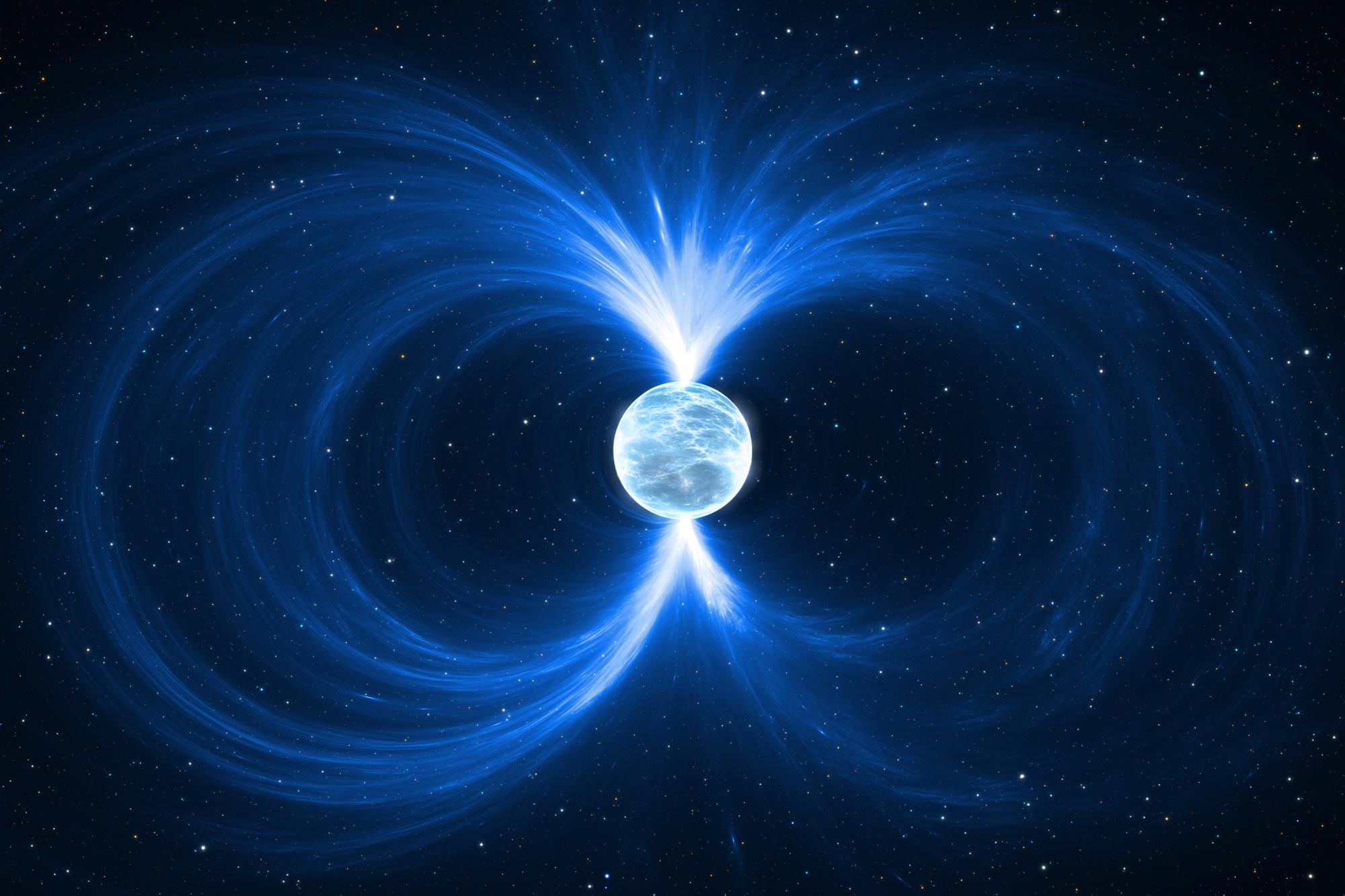
A black hole isn’t the only possible outcome when neutron stars collide: simulations suggest some mergers can create the extreme magnetic fields of magnetars in milliseconds.
When two neutron stars collide, the result is often a black hole. But some mergers leave behind a massive neutron star with an extraordinarily powerful magnetic field. New supercomputer simulations suggest that these collisions can produce magnetar-strength magnetic fields in just milliseconds, offering a possible explanation for how some of the universe’s most magnetic objects form.
Magnetars are a rare class of neutron stars, distinguished by magnetic fields that can be roughly 1,000 times stronger than those of ordinary neutron stars. They are associated with intense bursts of radiation, including soft gamma-ray repeaters, and may also produce some fast radio bursts.
Simulating a Neutron Star Collision in Extraordinary Detail
Using Japan’s FUGAKU supercomputer, researchers simulated the collision of two neutron stars, each with 1.35 times the Sun’s mass. The calculation achieved a spatial resolution of 6.25 meters (20.5 feet), allowing the team to track small-scale turbulence and its effects on magnetic fields throughout the merger.
The stars initially had magnetic fields of approximately 3.16 trillion gauss, consistent with the upper range observed in binary pulsars. The collision generated fields reaching around 10 quadrillion gauss across parts of the remnant, with localized regions reaching even greater strengths.
The researchers say the simulation demonstrates that “the Kelvin-Helmholtz instability that emerges when the two neutron stars touch amplifies the magnetic field to an expected electromagnetic saturation energy of ∼ 10⁵⁰ erg within 3 ms after the merger.”
How Turbulence Amplifies Magnetic Fields
The Kelvin-Helmholtz instability develops when neighboring layers of fluid move at different velocities. During a neutron star merger, enormous differences in fluid motion generate turbulence that stretches and strengthens magnetic fields.
Initially, the strongest amplification occurs on very small scales. The turbulent magnetic field subsequently influences progressively larger regions of the merged star, allowing magnetic amplification to reach stellar scales.
The researchers say the instability “induces stellar-scale magnetic field amplification by at least a factor of 316.”
Within approximately five milliseconds, the simulated stellar-scale magnetic field had increased from 3.16 trillion gauss to around one quadrillion gauss, reaching magnetar strength. As the researchers put it, “Namely, a magnetar is born.”
Could These Newborn Magnetars Survive?
Although the simulation produced magnetar-strength fields, the researchers caution that uncertainties in how turbulence and magnetic dissipation operate at extremely small scales could affect the estimated amplification.
In one extrapolation to more realistic conditions, the simulated stellar-scale field could be overestimated by a factor of 10. Even under that assumption, the resulting magnetic field would still reach approximately 100 trillion gauss.
The magnetic structure also remained concentrated near the remnant’s equatorial plane rather than forming the organized polar field associated with launching relativistic jets. Additional magnetic processes, particularly the magnetorotational instability, may be needed to develop that configuration.
The researchers say their “result suggests that a magnetar formation could be inevitable in binary neutron star mergers at least temporarily following the mergers, unless it promptly collapses to a black hole.”
The simulations cover only the earliest moments after the collision. Longer calculations will be needed to determine how these magnetic fields evolve, whether they help power energetic outbursts, and how long the resulting neutron star can survive before potentially collapsing into a black hole.
Reference: “A magnetar formation in binary neutron star merger” by Kenta Kiuchi, Alexis Reboul-Salze, Yuichiro Sekiguchi and Masaru Shibata, June 9, 2026, arXiv.
DOI: 2606.11299
Never miss a breakthrough: Join the SciTechDaily newsletter.
Follow us on Google and Google News.