
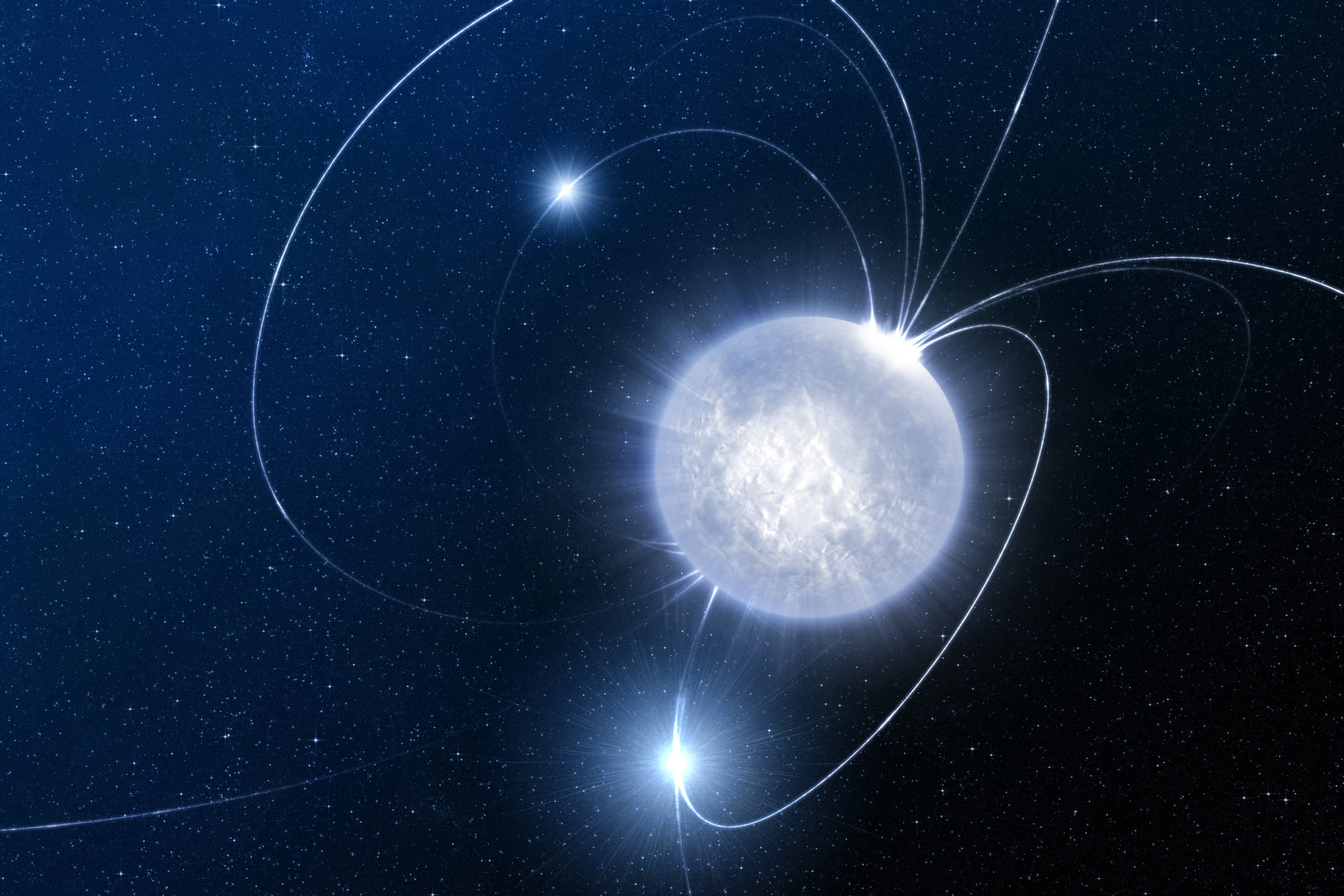
A newly published study sheds new light on star death, finding that the brightest supernovae are the result of a type of explosion within the star’s core which creates a smaller but extremely dense and rapidly spinning magnetic star.
Astronomers at Queen’s University have shed new light on the rarest and brightest exploding stars ever discovered in the universe.
The research is published on Thursday (17 October) in Nature Magazine – one of the world’s most prestigious science publications. It proposes that the most luminous supernovae – exploding stars – are powered by small and incredibly dense neutron stars, with gigantic magnetic fields that spin hundreds of times a second.
Scientists at Queen’s Astrophysics Research Center observed two super-luminous supernovae – two of the Universe’s brightest exploding stars – for more than a year. Contrary to existing theories, which suggested that the brightest supernovae are caused by super-massive stars exploding, their findings suggest that their origins may be better explained by a type of explosion within the star’s core which creates a smaller but extremely dense and rapidly spinning magnetic star.
Matt Nicholl, a research student at the Astrophysics Research Center at Queen’s School of Mathematics and Physics, is the lead author of the study. He said: “Supernovae are several billions of times brighter than the Sun, and in fact are so bright that amateur astronomers regularly search for new ones in nearby galaxies. It has been known for decades that the heat and light from these supernovae come from powerful blast-waves and radioactive material.
“But recently some very unusual supernovae have been found, which are too bright to be explained in this way. They are hundreds of times brighter than those found over the last fifty years and the origin of their extreme properties is quite mysterious.
“Some theoretical physicists predicted these types of explosions came from the biggest stars in the universe destroying themselves in a manner quite like a giant thermonuclear bomb. But our data doesn’t match up with this theory.
“In a supernova explosion, the star’s outer layers are violently ejected, while its core collapses to form an extremely dense neutron star – weighing as much as the Sun but only tens of kilometers across. We think that, in a small number of cases, the neutron star has a very strong magnetic field, and spins incredibly quickly – about 300 times a second. As it slows down, it could transmit the spin energy into the supernova, via magnetism, making it much brighter than normal. The data we have seems to match that prediction almost exactly.”
Queen’s astronomers led an international team of scientists on the study, using some of the world’s most powerful telescopes. Much of the data was collected using Pan-STARRS – the Panoramic Survey Telescope and Rapid Response System. Based on Mount Haleakala in Hawaii, Pan-STARRS boasts the world’s largest digital camera, and can cover an area 40 times the size of the full moon in one shot.
The study is one of the projects funded by a prestigious € 2.3 million grant from the European Research Council. The grant was awarded to Professor Stephen Smartt, Director of Queen’s Astrophysics Research Center, in 2012 to lead an international study to hunt for the Universe’s earliest supernovae.
Professor Smartt said: “These are really special supernovae. Because they are so bright, we can use them as torches in the very distant Universe. Light travels through space at a fixed speed, as we look further away, we see snapshots of the increasingly distant past. By understanding the processes that result in these dazzling explosions, we can probe the Universe as it was shortly after its birth. Our goal is to find these supernovae in the early Universe, detecting some of the first stars ever to form and watch them produce the first chemical elements created in the Universe.”
Reference: “Slowly fading super-luminous supernovae that are not pair-instability explosions” by M. Nicholl, S. J. Smartt, A. Jerkstrand, C. Inserra, M. McCrum, R. Kotak, M. Fraser, D. Wright, T.-W. Chen, K. Smith, D. R. Young, S. A. Sim, S. Valenti, D. A. Howell, F. Bresolin, R. P. Kudritzki, J. L. Tonry, M. E. Huber, A. Rest, A. Pastorello, L. Tomasella, E. Cappellaro, S. Benetti, S. Mattila, E. Kankare, T. Kangas, G. Leloudas, J. Sollerman, F. Taddia, E. Berger, R. Chornock, G. Narayan, C. W. Stubbs, R. J. Foley, R. Lunnan, A. Soderberg, N. Sanders, D. Milisavljevic, R. Margutti, R. P. Kirshner, N. Elias-Rosa, A. Morales-Garoffolo, S. Taubenberger, M. T. Botticella, S. Gezari, Y. Urata, S. Rodney, A. G. Riess, D. Scolnic, W. M. Wood-Vasey, W. S. Burgett, K. Chambers, H. A. Flewelling, E. A. Magnier, N. Kaiser, N. Metcalfe, J. Morgan, P. A. Price, W. Sweeney and C. Waters, 16 October 2013, Nature.
DOI: 10.1038/nature12569
arXiv:1310.4446
Never miss a breakthrough: Join the SciTechDaily newsletter.
Follow us on Google and Google News.
1 Comment
In as much as Sol is in the 90th percentile these superluminous objects are in the over 90th percentile pre implosion. R Duncan informs as to magnetars on the net. Perhaps these large objects all implode to form compact, perfectly spherical (objects like Sol) suns under the intense pressure of an imploded magnetic field. The discarded material (dirty gas) forms the rocky planets in the former space of the immense star (Beetle Sun on Google Drive)
Could Sol and its rocky planets be truly rare? The product of an imploded sun of the over 90th percentile?