
Close Menu
    Facebook X (Twitter) Instagram
    SciTechDaily
    • Biology
    • Chemistry
    • Earth
    • Health
    • Physics
    • Science
    • Space
    • Technology
    Facebook X (Twitter) Pinterest YouTube RSS
    SciTechDaily
    Home»Space»Astronomers Reveal Superluminous Supernova Gaia16apd is Powered by a Magnetar
    Space

    Astronomers Reveal Superluminous Supernova Gaia16apd is Powered by a Magnetar

    By Harvard-Smithsonian Center for AstrophysicsMarch 13, 2017No Comments3 Mins Read
    Facebook Twitter Pinterest Telegram LinkedIn WhatsApp Email Reddit
    Share
    Facebook Twitter LinkedIn Pinterest Telegram Email Reddit
    An Ultraviolet Excess in the Superluminous Supernova Gaia16apd Reveals a Powerful Central Engine
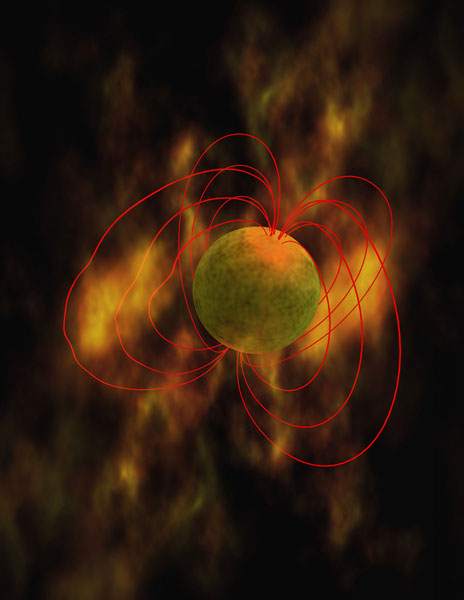
    An artist’s conception of a magnetar, with its magnetic field lines.

    A team of astronomers studying the superluminous supernova Gaia6apd has concluded in part from the behavior of its extraordinary ultraviolet emission that it is powered by an internal magnetar.

    Supernovae, the explosive deaths of massive stars, are among the most momentous events in the cosmos because they disburse into space all of the chemical elements that were produced inside their progenitor stars, including the elements essential for making planets and life. Their bright emission also enables them to be used as probes of the very distant universe. Not least, supernovae are astrophysical laboratories for the study of very energetic phenomena. One class of supernovae consists of single stars whose mass is at least eight solar masses as they finish their lives.

    A typical supernova shines about as brightly as ten billion Suns at its peak. In the last decade, a new type of supernova was discovered that is ten to one hundred times more luminous than a normal massive stellar collapse supernova, and today over a dozen of these superluminous supernovae (SLSN) have been seen. Astronomers are in agreement that these objects come from the collapse of massive stars, but their tremendous luminosities cannot be explained by the usual physical mechanisms invoked. Instead, the debate has centered on whether the excess emission results from an external source, for example the interaction of material ejected from the explosion with a circumstellar shell, or instead by some kind of powerful internal engine such as a highly magnetized, spinning neutron star.

    The SLSN “Gaia6apd” was discovered by the European Gaia satellite, and at a distance of about one and one-half billion light-years it is the second-closest SLSN discovered to date. It is also special in another way: it is extraordinarily bright in the ultraviolet, nearly four times brighter than the next nearest known SLSN despite the fact that in the optical both have comparable luminosities. CfA astronomers Matthew Nicholl, Edo Berger, Peter Blanchard, Dan Milisavljevic, and Peter Challis and their colleagues used facilities at the CfA’s MMT and Fred Lawrence Whipple Observatory to track the changing emission of this source from immediately after its discovery and continuing for one hundred and fifty days. The long time coverage revealed that the UV emission eventually faded to a level typical for normal supernovae, providing some clues to the mechanisms responsible. The scientists review all the known data and conclude that the most likely source is an internal central engine like a rapidly spinning neutron star. They also emphasize the key role that UV wavelengths played in diagnosing the mechanisms and urge that future studies of SLSN include UV coverage.

    Reference: An Ultraviolet Excess in the Superluminous Supernova Gaia16apd Reveals a Powerful Central Engine” by M. Nicholl, E. Berger, R. Margutti, P. K. Blanchard, D. Milisavljevic, P. Challis, B. D. Metzger and R. Chornock, 17 January 2017, The Astrophysical Journal Letters.
    DOI: 10.3847/2041-8213/aa56c5
    arXiv:1611.06993

    Never miss a breakthrough: Join the SciTechDaily newsletter.
    Follow us on Google and Google News.

    Astronomy Astrophysics Cosmology Harvard-Smithsonian Center for Astrophysics Magnetar Neutron Star Supernova
    Share. Facebook Twitter Pinterest LinkedIn Email Reddit

    Related Articles

    Chandra Studies Extraordinary Magnetar: Fastest Spinning and Possibly the Youngest Magnetar Known

    Spitzer Observations of Binary Neutron Star Merger GW170817

    New Model Supports Connection Between Gamma Ray Bursts and Supernovae

    “Heavy Metal” Supernova Discovery Challenges Current Ideas of How Supernovas Occur

    Astronomers Search for Trigger of Nearby Supernova

    Astronomers Shed New Light on the Rarest and Brightest Exploding Stars

    Supernova Shock Wave Breaks Through a Cocoon of Gas

    Origins of Type Ia Supernovae

    Links Between Core Collapse Supernovae and Star Formation Established

    Leave A Reply Cancel Reply

    • Facebook
    • Twitter
    • Pinterest
    • YouTube

    Don't Miss a Discovery

    Subscribe for the Latest in Science & Tech!

    Trending News

    One of the Universe’s Largest Stars May Be Getting Ready To Explode

    Scientists Discover Enzyme That Could Supercharge Ozempic-Like Weight Loss Drugs

    Popular Sweetener Linked to DNA Damage – “It’s Something You Should Not Be Eating”

    Ancient “Rock” Microbes May Reveal How Complex Life Began

    Researchers Capture Quantum Interference in One of Nature’s Rarest Atoms

    “A Plague Is Upon Us”: The Mass Death That Changed an Ancient City Forever

    Scientists Discover Game-Changing New Way To Treat High Cholesterol

    This Small Change to Your Exercise Routine Could Be the Secret to Living Longer

    Follow SciTechDaily
    • Facebook
    • Twitter
    • YouTube
    • Pinterest
    • Newsletter
    • RSS
    SciTech News
    • Biology News
    • Chemistry News
    • Earth News
    • Health News
    • Physics News
    • Science News
    • Space News
    • Technology News
    Recent Posts
    • New Study Challenges 40-Year Puzzle About Childhood Body Fat
    • 20-Year Study Finds Daily Multivitamins Don’t Extend Lifespan
    • Landmark Study Links Never Marrying to Significantly Higher Cancer Risk
    • Revolutionary Imaging Technique Unlocks Secrets of Matter at Extreme Speeds
    • Where Does Mass Come From? Scientists Find Evidence of a New Exotic Nuclear State
    Copyright © 1998 - 2026 SciTechDaily. All Rights Reserved.
    • Science News
    • About
    • Contact
    • Editorial Board
    • Privacy Policy
    • Terms of Use

    Type above and press Enter to search. Press Esc to cancel.