
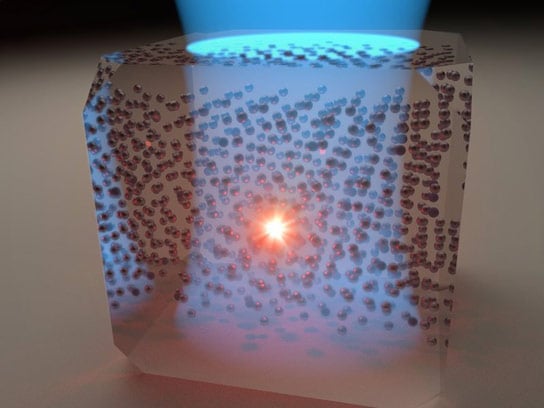
Scientists from the Max Planck Institute have succeeded in performing high-resolution spectroscopy and microscopy on individual rare earth ions in a crystal, opening the door to future possibilities for storing and processing quantum information.
A promising material is lining itself up as a candidate for a quantum memory. A team at the Max Planck Institute for the Science of Light in Erlangen is the first to succeed in performing high-resolution spectroscopy and microscopy on individual rare earth ions in a crystal. With the aid of ingenious laser and microscopy technology, they determined the position of triply charged positive praseodymium atoms (Pr3+) in a yttrium orthosilicate to within a few nanometers and investigated their weak interaction with light. In addition to its impact on fundamental studies, the work may make an important contribution to the quantum computers of the future because the ions investigated are suitable for storing and processing quantum information.
Around the globe, numerous researchers are working on components for the quantum computers of the future, which will be able to process information significantly faster than today. The key elements of these super-computers include quantum systems with optical properties similar to those of an atom. This is why many researchers are currently focusing their attention on different systems such as light-emitting crystal defects (“color centers”) in diamond or on semiconductor quantum dots. However, so far there has been no ideal solution. “Some of the light sources lose their brightness or flicker in an uncontrollable way,” explains Vahid Sandoghdar, who heads the Nano-Optics Department at the Max Planck Institute for the Science of Light in Erlangen. “Others are greatly affected by the environment into which they are embedded.”
Researchers observe the signals of an individual ion
It has long been known that the rare earth ions such as neodymium or erbium do not suffer from these problems – which is also why they play a key role in lasers or laser amplifiers. They emit only weakly, however, and are therefore difficult to detect. This is precisely what Tobias Utikal, Emanuel Eichhammer, and Stephan Götzinger from Sandoghdar’s Group in Erlangen have succeeded in doing: after more than six years of intensive research they were able to detect individual praseodymium ions, pinpoint them with an accuracy of a few nanometers, and measure their optical properties with an accuracy never achieved before.
The triply charged, positive ions were embedded in tiny microcrystals and nanocrystals of yttrium orthosilicate (YSO). Their energies varied only slightly depending on their position in the crystal. In other words, they reacted to slightly different frequencies. The scientists used this to excite individual ions in the crystals with a laser and to observe how they emit the energy after some time in the form of light. “Because rare earth ions are not strongly affected by the thermal and acoustic oscillations of the crystal, some of their energy states are unusually stable,” says Sandoghdar. “It takes more than a minute before they make the transition into the ground state again – a million times longer than for most of the other quantum systems that have been investigated so far.”
The aim is for the signals of the ions to be even easier to observe in the future. Since an individual ion responds with less than 100 photons per second at the moment, the Erlangen-based scientists want to employ nano-antennas and microcavities to amplify the praseodymium signal by a hundred or a thousand times.
Reference: “Spectroscopic detection and state preparation of a single praseodymium ion in a crystal” by Tobias Utikal, Emanuel Eichhammer, Lutz Petersen, Alois Renn, Stephan Götzinger and Vahid Sandoghdar, 11 April 2014, Nature Communications.
DOI: 10.1038/ncomms4627
arXiv: 1310.8180
Never miss a breakthrough: Join the SciTechDaily newsletter.
Follow us on Google and Google News.