
Scientists have created new superconducting compounds of hydrogen and praseodymium, a rare-earth metal, one substance being quite a surprise from the perspective of classical chemistry. The study helped find the optimal metals for room-temperature superconductors. The results were published in Science Advances.
A theory that has evolved in the past fifteen years assumes that hydrogen compounds (hydrides) can make excellent superconductors; that is, substances that have zero electrical resistance when cooled down to a certain temperature and are capable of carrying electricity without any losses, which is particularly valuable for power networks. However, the sticking point that scientists are still striving to work out is the temperature at which a substance achieves superconductivity. For most compounds it is very low, so superconductors used in real life are typically cooled with liquid helium using complex and costly equipment. Physicists are busy searching for a substance that achieves superconductivity at room temperature. One of the likely candidates is metallic hydrogen, but the pressure required to produce it exceeds 4 million atmospheres!
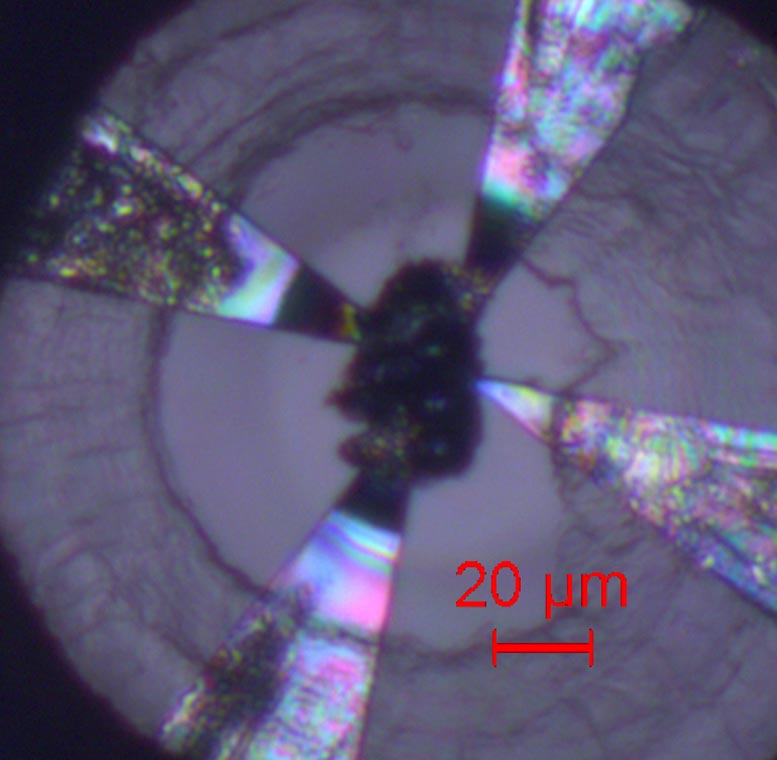
A group of Russian scientists from Skoltech and Chinese researchers from Jilin University published a paper, with Dmitry Semenok and Di Zhou as the first authors, featuring their research results. Their team created compounds of hydrogen and praseodymium, a metal from the lanthanide series, and studied their physical properties. The authors synthesized several compounds with different ratios of atoms for each element. To do this, they placed praseodymium and hydrogen samples in a special chamber where they were pressed between two cone-shaped diamonds so that pressure increased to 40 GPa, and were laser-heated. The elements got compressed and reacted to form the compound PrH3. The downside is that diamonds tend to become too fragile and break up when coming into contact with hydrogen.
The scientists then replaced pure hydrogen with ammonium borane, a compound containing a large amount of hydrogen readily released when heated and reacting with praseodymium. The researchers found this method to be more effective and continued to use it in further experiments. By increasing the pressure, they obtained PrH9. Earlier, they had synthesized compounds of hydrogen and lanthanum, another metal from the same series, using the same technique. The molecules they obtained are special in that they are an “outlaw” in classical chemistry, as they do not obey by its rules. Even though, formally, the praseodymium atom’s electronic structure is such that it does not allow it to bond with so many other atoms, the existence of such “improper” compounds can be predicted by complex quantum calculations and proved by experiments.
Also, the scientists investigated the superconductivity of the new substances by measuring electrical resistance at different temperatures and pressures and found that praseodymium hydride becomes superconducting at -264 °C, which is much lower compared to LaH10, although the two compounds are similar both chemically and structurally. The authors looked into the reasons for the difference in the characteristics by comparing their results to other studies and found that the metal’s position in the periodic table and its properties play a pivotal role. It transpired that praseodymium atoms act as donors for electrons: unlike their neighbors, lanthanum, and cerium, they carry small magnetic moments that suppress superconductivity which can still occur, although at lower temperatures.
“We applied the method used previously to synthesize lanthanum hydrides and succeeded in creating new superconducting metallic praseodymium hydrides. We made two main conclusions. First, you can get abnormal compounds with compositions having nothing to do with valence; that is, the number of bonds an atom can have with other atoms. Second, we validated the new principle for creating superconductors. We found that the metals from the “lability zone” located between groups II and III of the periodic table are the best candidates. The elements nearest to the “lability zone” are lanthanum and cerium. Going forward, we will proceed from this finding to obtain new high-temperature superconductors,” said Skoltech and MIPT professor, Artem Oganov.
Reference: “Superconducting praseodymium superhydrides” by Di Zhou, Dmitrii V. Semenok, Defang Duan, Hui Xie, Wuhao Chen, Xiaoli Huang, Xin Li, Bingbing Liu, Artem R. Oganov and Tian Cui, 28 February 2020, Science Advances.
DOI: 10.1126/sciadv.aax6849
The project was supported by a grant from the Presidential Program for the development of the Russian Science Foundation’s (RSF) world-class lab research projects.
Never miss a breakthrough: Join the SciTechDaily newsletter.
Follow us on Google and Google News.