
Close Menu
    Facebook X (Twitter) Instagram
    SciTechDaily
    • Biology
    • Chemistry
    • Earth
    • Health
    • Physics
    • Science
    • Space
    • Technology
    Facebook X (Twitter) Pinterest YouTube RSS
    SciTechDaily
    Home»Space»Hubble Image of the Week – Spiral Galaxy NGC 1448
    Space

    Hubble Image of the Week – Spiral Galaxy NGC 1448

    By SciTechDailyMarch 13, 2017No Comments2 Mins Read
    Facebook Twitter Pinterest Telegram LinkedIn WhatsApp Email Reddit
    Share
    Facebook Twitter LinkedIn Pinterest Telegram Email Reddit
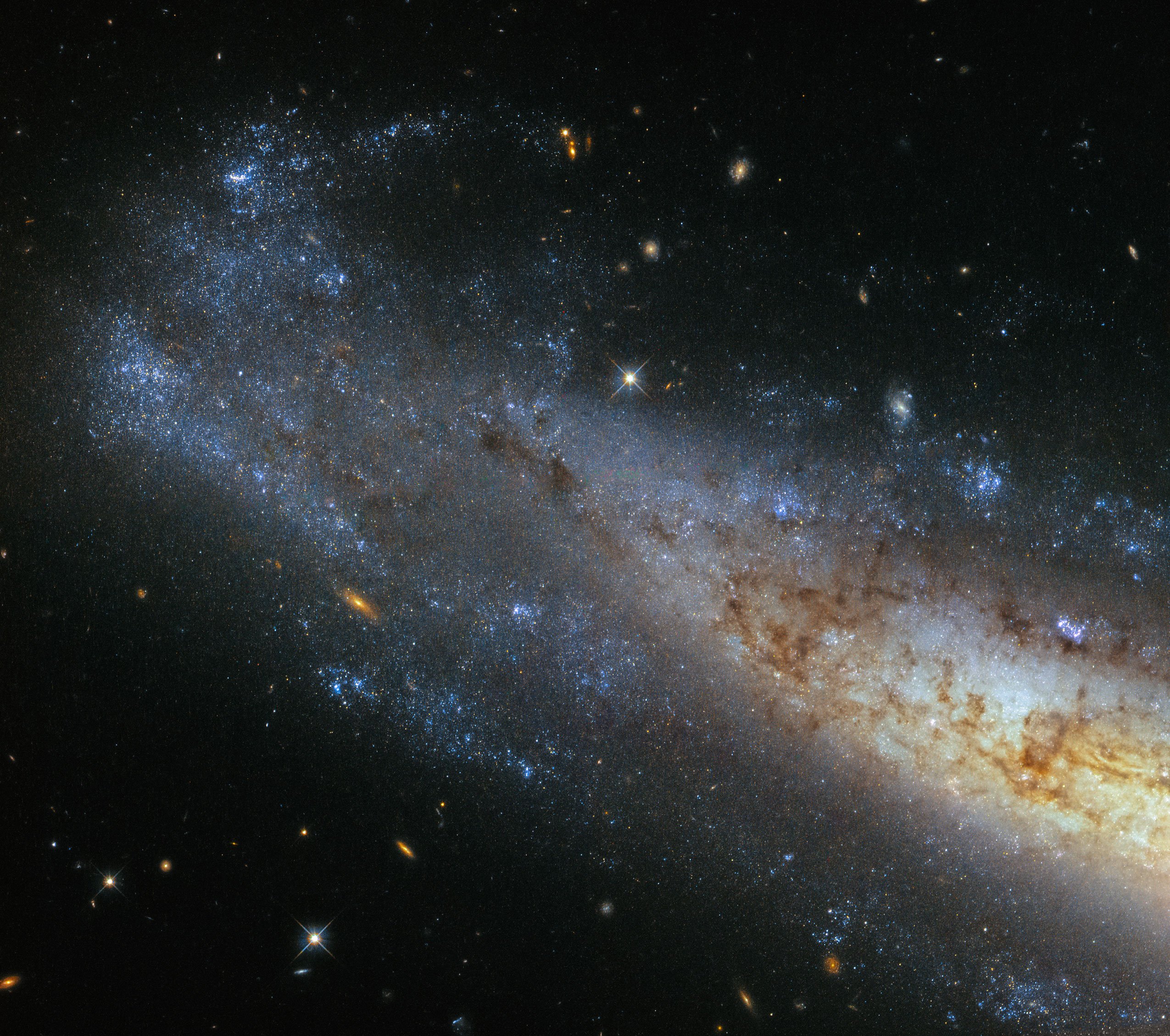
    Hubble Views Spiral Galaxy NGC 1448
    Spiral galaxy NGC 1448 is located about 50 million light-years from Earth in the little-known constellation of Horologium (The Pendulum Clock). Credit: ESA/Hubble & NASA

    This Hubble image of the week shows spiral galaxy NGC 1448, which is located roughly 50 million light-years away.

    This image from Hubble’s Wide Field Camera 3 (WFC3) shows NGC 1448, a spiral galaxy located about 50 million light-years from Earth in the little-known constellation of Horologium (The Pendulum Clock). We tend to think of spiral galaxies as massive and roughly circular celestial bodies, so this glittering oval does not immediately appear to fit the visual bill. What’s going on?

    Imagine a spiral galaxy as a circular frisbee spinning gently in space. When we see it face on, our observations reveal a spectacular amount of detail and structure — a great example from Hubble is the telescope’s view of Messier 51, otherwise known as the Whirlpool Galaxy. However, the NGC 1448 frisbee is very nearly edge-on with respect to Earth, giving it an appearance that is more oval than circular. The spiral arms, which curve out from NGC 1448’s dense core, can just about be seen.

    Although spiral galaxies might appear static with their picturesque shapes frozen in space, this is very far from the truth. The stars in these dramatic spiral configurations are constantly moving and spinning around the galaxy’s core, with those on the inside whirling around faster than those sitting further out. This makes the formation and continued existence of a spiral galaxy’s arms something of a cosmic puzzle, because the arms wrapped around the spinning core should become wound tighter and tighter as time goes on — but this is not what we see. This is known as the winding problem.


    Never miss a breakthrough: Join the SciTechDaily newsletter.
    Follow us on Google and Google News.

    Astronomy Cosmology Hubble Space Telescope
    Share. Facebook Twitter Pinterest LinkedIn Email Reddit

    Related Articles

    Hubble Image of the Week: Starburst Galaxy Messier 94

    ESO and Hubble Reveal Fast-Moving, Wave-Like Features in the Debris Disk Around AU Microscopii

    New Phoenix Cluster Observations Provide A Fresh Perspective

    Hubble Image of Arp 194 – Cosmic Optical Illusions in Ursa Major

    Hubble Image of the Week – Evolution in Slow Motion

    Hubble Explores the Wings of the Twin Jet Nebula

    Astronomers Discover Supernovae in ‘Wrong Place at Wrong Time’

    Hubble Reveals Diffusion of Stars Through the Core of the Globular Cluster 47 Tucanae

    Study Suggest Spiral Galaxies Are Larger Than Previously Thought

    Leave A Reply Cancel Reply

    • Facebook
    • Twitter
    • Pinterest
    • YouTube

    Don't Miss a Discovery

    Subscribe for the Latest in Science & Tech!

    Trending News

    Millions of People Have Osteopenia Without Realizing It – Here’s What You Need To Know

    Researchers Discover Boosting a Single Protein Helps the Brain Fight Alzheimer’s

    World-First Study Reveals Human Hearts Can Regenerate After a Heart Attack

    Why Your Dreams Feel So Real Sometimes and So Strange Other Times

    This Simple Home Device May Boost Brain Power in Adults Over 40

    Enormous Prehistoric Insects Puzzle Scientists

    Scientists Develop Bioengineered Chewing Gum That Could Help Fight Oral Cancer

    After 37 Years, the World’s Longest-Running Soil Warming Experiment Uncovers a Startling Climate Secret

    Follow SciTechDaily
    • Facebook
    • Twitter
    • YouTube
    • Pinterest
    • Newsletter
    • RSS
    SciTech News
    • Biology News
    • Chemistry News
    • Earth News
    • Health News
    • Physics News
    • Science News
    • Space News
    • Technology News
    Recent Posts
    • Researchers Identify the Most Common Recessive Neurodevelopmental Disorder Ever Discovered
    • This Is What Makes You Irresistible to Mosquitoes
    • Shockingly Powerful Giant Octopuses Ruled the Seas 100 Million Years Ago
    • After 100 Years, Scientists Uncover Hidden Rule Governing Cosmic Rays
    • The Milky Way Has a Hidden Edge and Scientists Finally Mapped It
    Copyright © 1998 - 2026 SciTechDaily. All Rights Reserved.
    • Science News
    • About
    • Contact
    • Editorial Board
    • Privacy Policy
    • Terms of Use

    Type above and press Enter to search. Press Esc to cancel.