
Close Menu
    Facebook X (Twitter) Instagram
    SciTechDaily
    • Biology
    • Chemistry
    • Earth
    • Health
    • Physics
    • Science
    • Space
    • Technology
    Facebook X (Twitter) Pinterest YouTube RSS
    SciTechDaily
    Home»Space»Hubble Image of Arp 194 – Cosmic Optical Illusions in Ursa Major
    Space

    Hubble Image of Arp 194 – Cosmic Optical Illusions in Ursa Major

    By NASA, ESA and the Hubble Heritage Team (STScI/AURA)September 21, 2015No Comments2 Mins Read
    Facebook Twitter Pinterest Telegram LinkedIn WhatsApp Email Reddit
    Share
    Facebook Twitter LinkedIn Pinterest Telegram Email Reddit
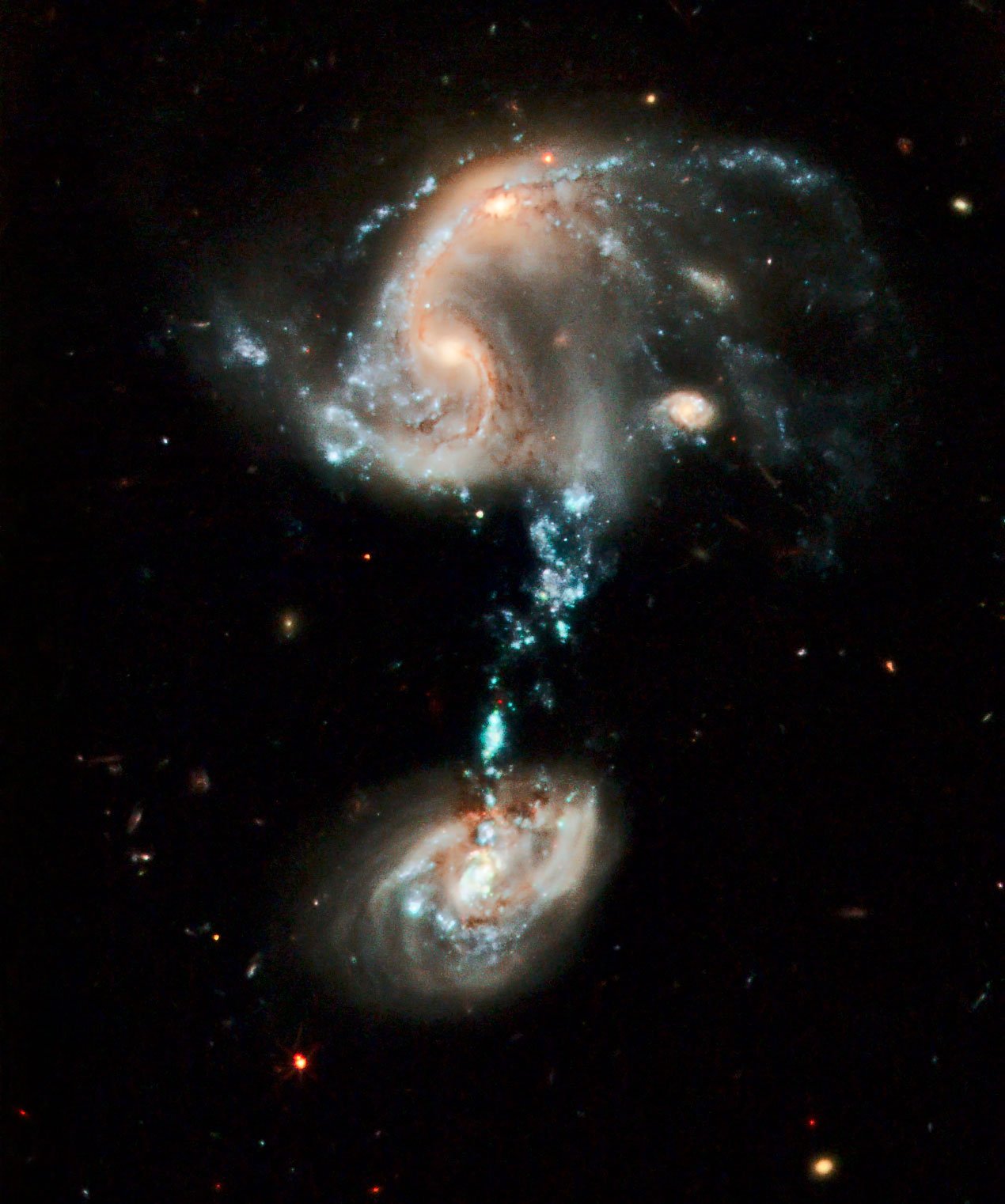
    Hubble Image Cosmic Optical Illusions in Ursa Major
    Arp 194 is a galaxy group just under 600 million light-years away from Earth in the constellation of Cepheus.

    Released in 2009 to commemorate the Hubble’s 19th year in space, this image of Arp 194 shows several galaxies, along with a “cosmic fountain” of stars, gas, and dust that stretches over 100,000 light-years.

    Some of the stunning views we have of the cosmos owe their beauty to a trick of perspective, as captured in this NASA/ESA Hubble Space Telescope image.

    The galaxies at the top and bottom of the frame are named PGC 37639 and PGC 101374 respectively. Although it may look as if the two are in the middle of a galactic tug-of-war, connected by the prominent stream of blue through the center of the image, PGC 37639 lies somewhat closer to Earth than its companion, and the two are not physically connected.

    In another optical trick, this image does not contain two galaxies, but at least four. The upper left patch actually hosts two galaxies in the early stages of merging. Their bright centers can still be seen separately, glowing amid a maelstrom of gas and dust.

    A smaller and relatively intact spiral galaxy, known as SDSSCGB 19.4, can be seen to the right of the merging duo. This trio of galaxies comprises Arp 194, a galaxy group just under 600 million light-years away from Earth in the constellation of Cepheus.

    The blue stream is thought to have formed through the turbulent gravitational interactions occurring at the top of the frame — the uppermost galaxy clump is a whirl of flailing once-spiral arms. The stream is some 100,000 light-years long, and made up of gas, dust, and many millions of newborn stars. These stars, which are clumped together to form star clusters, which in turn later accumulate as superclusters, are responsible for the striking blue hue visible here. They are mostly young, hot, and massive, a combination that causes them to emit blue light.

    Never miss a breakthrough: Join the SciTechDaily newsletter.
    Follow us on Google and Google News.

    Astronomy Cosmology Hubble Space Telescope
    Share. Facebook Twitter Pinterest LinkedIn Email Reddit

    Related Articles

    Theoretical Study Suggests Most Earth-Like Worlds Have Yet to Be Born

    Hubble Image of the Week: Starburst Galaxy Messier 94

    ESO and Hubble Reveal Fast-Moving, Wave-Like Features in the Debris Disk Around AU Microscopii

    New Phoenix Cluster Observations Provide A Fresh Perspective

    Hubble Image of the Week – Evolution in Slow Motion

    Hubble Explores the Wings of the Twin Jet Nebula

    Astronomers Discover Supernovae in ‘Wrong Place at Wrong Time’

    Hubble Reveals Diffusion of Stars Through the Core of the Globular Cluster 47 Tucanae

    Study Suggest Spiral Galaxies Are Larger Than Previously Thought

    Leave A Reply Cancel Reply

    • Facebook
    • Twitter
    • Pinterest
    • YouTube

    Don't Miss a Discovery

    Subscribe for the Latest in Science & Tech!

    Trending News

    New Pill Lowers Stubborn Blood Pressure and Protects the Kidneys

    Humans May Have Hidden Regenerative Powers, New Study Suggests

    Scientists Just Solved the Mystery of Why Crabs Walk Sideways

    Doctors Are Surprised by What This Vaccine Is Doing to the Heart

    This Popular Supplement May Boost Your Brain, Not Just Your Muscles

    Scientists Say This Simple Supplement May Actually Reverse Heart Disease

    Warming Oceans Could Trigger a Dangerous Methane Surge

    This Simple Movement Could Be Secretly Cleaning Your Brain

    Follow SciTechDaily
    • Facebook
    • Twitter
    • YouTube
    • Pinterest
    • Newsletter
    • RSS
    SciTech News
    • Biology News
    • Chemistry News
    • Earth News
    • Health News
    • Physics News
    • Science News
    • Space News
    • Technology News
    Recent Posts
    • Researchers Discover Efficient New Way To Split Hydrogen From Water for Energy
    • This Korean Skincare Ingredient Could Help Fight Deadly Superbugs
    • Giant Squid Detected off Western Australia in Stunning Deep-Sea Discovery
    • Popular Sugar-Free Sweetener Linked to Liver Disease, Study Warns
    • Why Weight Loss Isn’t Enough for Everyone at Risk of Diabetes
    Copyright © 1998 - 2026 SciTechDaily. All Rights Reserved.
    • Science News
    • About
    • Contact
    • Editorial Board
    • Privacy Policy
    • Terms of Use

    Type above and press Enter to search. Press Esc to cancel.