
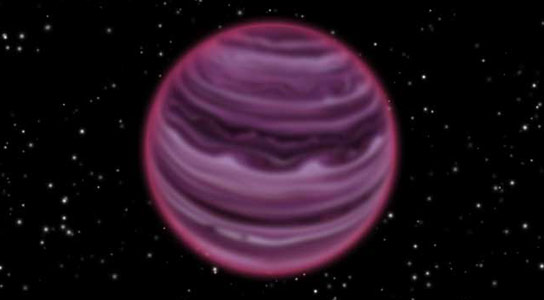
Using the Pan-STARRS 1 wide-field survey telescope, a team of astronomers has discovered a free-floating planet that is 80 light-years away from Earth.
An international team of astronomers has discovered an exotic young planet that is not orbiting a star. This free-floating planet, dubbed PSO J318.5-22, is just 80 light-years away from Earth and has a mass only six times that of Jupiter. The planet formed a mere 12 million years ago—a newborn in planet’s lifetimes.
It was identified from its faint and unique heat signature by the Pan-STARRS 1 (PS1) wide-field survey telescope on Haleakala, Maui. Follow-up observations using other telescopes in Hawaii show that it has properties similar to those of gas-giant planets found orbiting around young stars. And yet PSO J318.5-22 is all by itself, without a host star.
“We have never before seen an object free-floating in space that looks like this. It has all the characteristics of young planets found around other stars, but it is drifting out there all alone,” explained team leader Dr. Michael Liu of the Institute for Astronomy at the University of Hawaii at Manoa. “I had often wondered if such solitary objects exist, and now we know they do.”
During the past decade, extrasolar planets have been discovered at an incredible pace, with about a thousand found by indirect methods such as wobbling or dimming of their host stars induced by the planet. However, only a handful of planets have been directly imaged, all of which are around young stars (less than 200 million years old). PSO J318.5-22 is one of the lowest-mass free-floating objects known, perhaps the very lowest. But its most unique aspect is its similar mass, color, and energy output to directly imaged planets.
“Planets found by direct imaging are incredibly hard to study, since they are right next to their much brighter host stars. PSO J318.5-22 is not orbiting a star so it will be much easier for us to study. It is going to provide a wonderful view into the inner workings of gas-giant planets like Jupiter shortly after their birth,” said Dr. Niall Deacon of the Max Planck Institute for Astronomy in Germany and a co-author of the study.
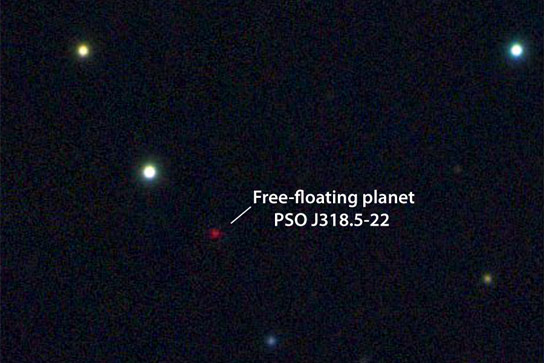
PSO J318.5-22 was discovered during a search for the failed stars known as brown dwarfs. Due to their relatively cool temperatures, brown dwarfs are very faint and have very red colors. To circumvent these difficulties, Liu and his colleagues have been mining the data from the PS1 telescope. PS1 is scanning the sky every night with a camera sensitive enough to detect the faint heat signatures of brown dwarfs. PSO J318.5-22 stood out as an oddball, redder than even the reddest known brown dwarfs.
“We often describe looking for rare celestial objects as akin to searching for a needle in a haystack. So we decided to search the biggest haystack that exists in astronomy, the dataset from PS1,” said Dr. Eugene Magnier of the Institute for Astronomy at the University of Hawaii at Manoa and a co-author of the study. Dr. Magnier leads the data processing team for PS1, which produces the equivalent of 60,000 iPhone photos every night. The total dataset to date is about 4,000 Terabytes, bigger than the sum of the digital version of all the movies ever made, all books ever published, and all the music albums ever released.
The team followed up the PS1 discovery with multiple telescopes on the summit of Mauna Kea on the island of Hawaii. Infrared spectra taken with the NASA Infrared Telescope Facility and the Gemini North Telescope showed that PSO J318.5-22 was not a brown dwarf, based on signatures in its infrared light that are best explained by it being young and low-mass.
By regularly monitoring the position of PSO J318.5-22 over two years with the Canada-France-Hawaii Telescope, the team directly measured its distance from Earth. Based on this distance, about 80 light-years, and its motion through space, the team concluded that PSO J318.5-22 belongs to a collection of young stars called the Beta Pictoris moving group that formed about 12 million years ago. In fact, the eponymous star of the group, Beta Pictoris, has a young gas-giant planet in orbit around it. PSO J318.5-22 is even lower in mass than the Beta Pictoris planet and probably formed in a different fashion.
The other key authors of the paper are Katelyn Allers (Bucknell University), Trent Dupuy (Harvard-Smithsonian Center for Astrophysics), and Michael Kotson and Kimberly Aller (University of Hawaii at Manoa).
Reference: “The Extremely Red, Young L Dwarf PSO J318-22: A Free-Floating Planetary-Mass Analog to Directly Imaged Young Gas-Giant Planets” by Michael C. Liu, Eugene A. Magnier, Niall R. Deacon, Katelyn N. Allers, Trent J. Dupuy, Michael C. Kotson, Kimberly M. Aller, W. S. Burgett, K. C. Chambers, P. W. Draper, K. W. Hodapp, R. Jedicke, N. Kaiser, R.-P. Kudritzki, N. Metcalfe, J. S. Morgan, P. A. Price, J. L. Tonry and R. J. Wainscoat, 22 October 2013, The Astrophysical Journal Letters.
DOI: 10.1088/2041-8205/777/2/L20
arXiv:1310.0457
Never miss a breakthrough: Join the SciTechDaily newsletter.
Follow us on Google and Google News.
15 Comments
According to Neil Tyson, it should not be called a planet because it does not conform to his definition! Ha, ha, ha! Just kidding! It would be amazing to have an up close look at it!
Tha’s interesting, but I assume “Free Floating: mean free floating at all. Such planets. . maybe thet should be called “micro stars”. . . that they must be orbiting the Center of the Milky Way in an erratic path, being juggled to and from in all sorts of directions a bit by stars that are surrounding them just like any star is. . .A Multy Body Problem for calculating its path through the Galaxy.
Maybe THAT is one of the Wandering Stars the character Lee Marvin played, in Paint Your Wagon, was born under:-)
Free floating nomad planet could have escaped from the grip of a star or from its Kuiper Belt carrying debris of comets which are universal everywhere in the cosmos. Thank YOu.
How do they know it’s 12 million years old?
They found a free floating planet in The Fifth Element. Didn’t turn out too well for them…
Perhaps this planet like object is orbiting a black hole.
Very interesting article, but the title picture makes no sense. If the planet is not orbiting a star there is no significant heating mechanism to lead to that type of convective banding in the clouds
gas giants can generate radiation and energy of their own and it could be partially caused by rotation speed differentials.
Internal heat comes to mind. Compressed gas or some type of heavy core maybe.
A floating planet??? Watch-out earth. The Death Star is coming your way.
k if pluto can’t be a planet then why the heck is this “planet” allowed to be a planet. not cool.
That’s no moon…Its a space station…
If the orphan planet has moons, and no reason not to think so, would they be properly called “planets”?
Hello! PSOJ318.5-22 the orphaned planet is about 80 light years away n the constellation Capricornus and still measures 125 arcseconds in size. How can you deem it to be a space ship or ordinary asteroid of ordinary size, other than a gas giant like Jupiter of our Sun ? Please don’t ridicule the astronomers whose job is to find the exoplanets. Any space ship to travel 80 light years would take 80 billion years at least.Thank YOu.
it s obviously the Deatrh Star.