
Close Menu
    Facebook X (Twitter) Instagram
    SciTechDaily
    • Biology
    • Chemistry
    • Earth
    • Health
    • Physics
    • Science
    • Space
    • Technology
    Facebook X (Twitter) Pinterest YouTube RSS
    SciTechDaily
    Home»Space»Hubble Views Elliptical Galaxy PGC 6240
    Space

    Hubble Views Elliptical Galaxy PGC 6240

    By Hubble Space TelescopeOctober 10, 20131 Comment3 Mins Read
    Facebook Twitter Pinterest Telegram LinkedIn WhatsApp Email Reddit
    Share
    Facebook Twitter LinkedIn Pinterest Telegram Email Reddit
    Hubble Views Elliptical Galaxy PGC 6240
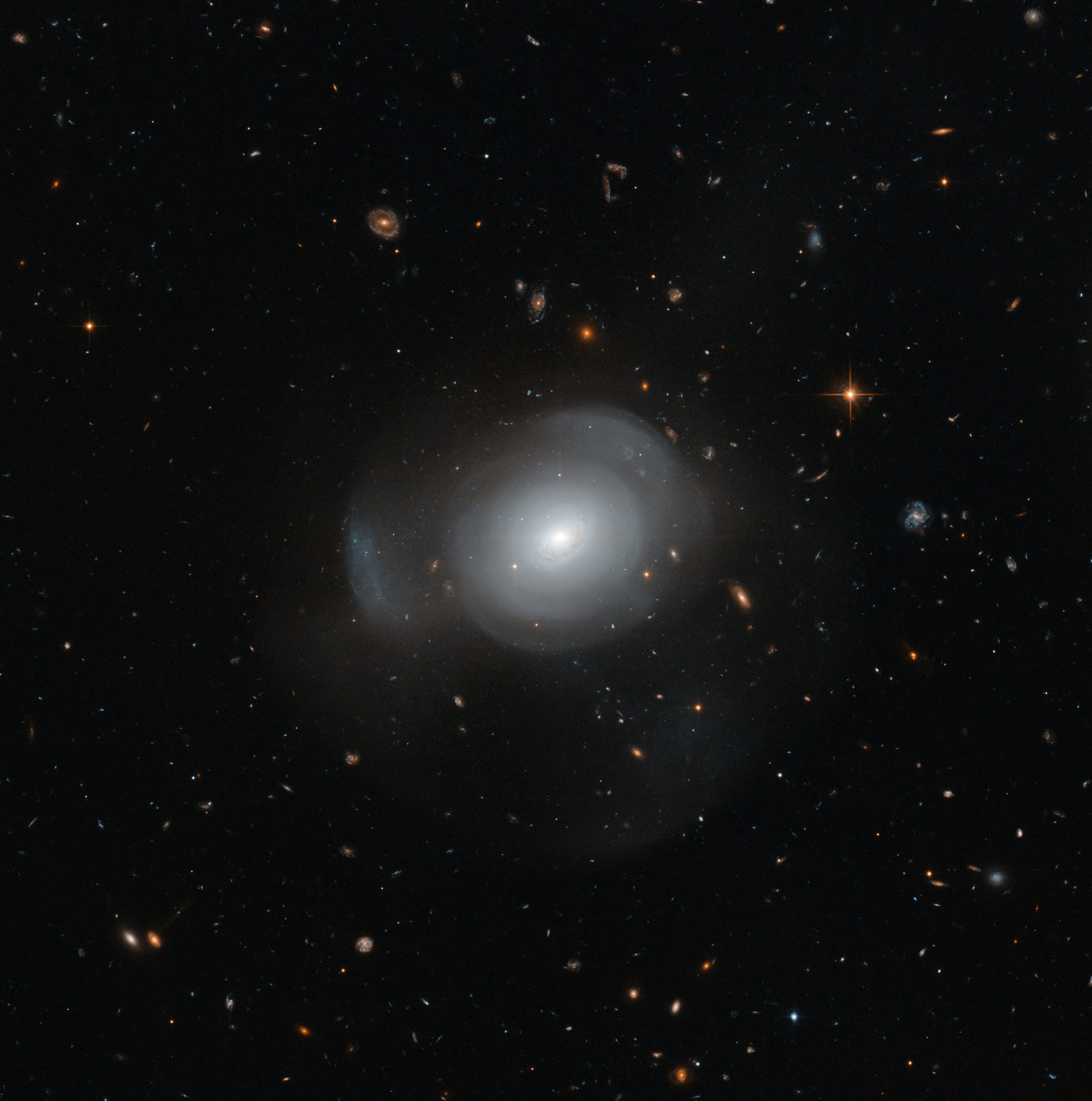
    PGC 6240 is an elliptical galaxy approximately 350,000,000 light-years away in the southern constellation of Hydrus (The Water Snake). It is orbited by a number of globular clusters that contain both young and old stars — thought to be a result of a galactic merger in the recent past. Credit: ESA/Hubble & NASA, Acknowledgment: Judy Schmidt

    This Hubble Space Telescope image shows elliptical galaxy PGC 6240, which is located in the southern constellation of Hydrus.

    The beautiful, petal-like shells of galaxy PGC 6240 are captured here in intricate detail by the NASA/ESA Hubble Space Telescope, set against a sky full of distant background galaxies. This cosmic bloom is of great interest to astronomers due to both its uneven structure, and the unusual clusters of stars that orbit around it — two strong indications of a galactic merger in the recent past.

    PGC 6240 is an elliptical galaxy that resembles a pale rose in the sky, with hazy shells of stars encircling a very bright center. Some of these shells are packed close to the center of the galaxy, while others are flung further out into space. Several wisps of material have been thrown so far that they appear to be almost detached from the galaxy altogether.

    Astronomers have studied PGC 6240 in detail due to this structure, and also because of its surrounding globular clusters — dense, tightly packed groups of gravitationally bound stars that orbit galaxies. Over 150 of these clusters orbit our own galaxy, the Milky Way, all composed of old stars.


    This video pans across Hubble observations of PGC 6240. The shells that make up the galaxy were caused by a galactic merger some time in the recent past, an event that disrupted and shaped the material in the galaxy. Credit: NASA & ESA. Music: movetwo. Acknowledgment: Judy Schmidt

    All the globular clusters around a certain galaxy form at approximately the same time, giving them all the same age. This is echoed within the clusters — all the stars within a single cluster form at around the same time, too. Because of this, most galaxies have cluster populations of pretty similar ages, both in terms of overall cluster, and individual stars. However, PGC 6240 is unusual in that its clusters are varied — while some do contain old stars, as expected, others contain younger stars which formed more recently.

    The most likely explanation for both the galaxy’s stacked shell structure and the unexpectedly young star clusters is that PGC 6240 merged with another galaxy at some point in the recent past. Such a merger would send ripples through the galaxy and disrupt its structure, forming the concentric shells of material seen here. It would also ignite a strong burst of star formation in the galaxy, which would then trigger similar activity in nearby space — leading to the creation of new, younger globular clusters around PGC 6240.

    PGC 6240 is an elliptical galaxy in the southern constellation of Hydrus (The Water Snake). Also visible in this region are numerous background galaxies, speckled across the sky behind PGC 6240. Even though these bodies are at such vast distances from us, it is possible to make out the structure of many of the galaxies, especially the small spirals that stand out colorfully against the dark sky.

    A version of this image was entered into the Hubble’s Hidden Treasures image processing competition by contestant Judy Schmidt.

    Never miss a breakthrough: Join the SciTechDaily newsletter.
    Follow us on Google and Google News.

    Astronomy Hubble Space Telescope
    Share. Facebook Twitter Pinterest LinkedIn Email Reddit

    Related Articles

    A Morphing Spiral Galaxy Amongst Friends

    Hubble Views Magnificent Lopsided Galaxy NGC 2276

    Hubble Captures Fantastic Detail of Eponymous Spiral Galaxy NGC 691

    Spectacular Image Captured by Hubble Shows a Strangely Contorted Spiral Galaxy

    A Distant Spiral in Virgo: Extraordinary Detail Seen in a Galaxy 150 Million Light-Years Away From Earth

    Magnetic Monsters: Hubble Tracks Down Location of Mysterious Radio Signals From Intergalactic Space

    A Menagerie of Galaxies: Hubble Captures a Cluster With Galaxies of All Shapes and Sizes

    How Habitable Are Planets That Orbit Red Dwarfs – The Most Common Type of Stars in the Galaxy?

    Cosmic Silver Lining: Hubble Spots V565 Surrounded by Four Prominent Diffraction Spikes

    1 Comment

    1. Andrew on October 11, 2013 4:03 am

      think that such kind of a galaxy connected with gravitational lensinggravitational, when on a straight line the centre spiral a galaxy and a black hole

      Reply
    Leave A Reply Cancel Reply

    • Facebook
    • Twitter
    • Pinterest
    • YouTube

    Don't Miss a Discovery

    Subscribe for the Latest in Science & Tech!

    Trending News

    Black Hole Collisions May Follow a Surprisingly Simple Rule

    The Eye Has a Hidden Cleanup System and Scientists Just Discovered It

    The Truth About Vikings Is More Complicated Than Museums Admit

    New Catalyst Turns Stubborn Plant Waste Into Valuable Chemicals

    Quantum Gravity May Be Far Less Quantum Than Physicists Expected

    New Tool Supercharges Immunotherapy Against Prostate Cancer

    The Hidden Cancer Risk of Ketogenic Diets

    One Asteroid Collision May Have Rocked Earth, Mars, and the Moon

    Follow SciTechDaily
    • Facebook
    • Twitter
    • YouTube
    • Pinterest
    • Newsletter
    • RSS
    SciTech News
    • Biology News
    • Chemistry News
    • Earth News
    • Health News
    • Physics News
    • Science News
    • Space News
    • Technology News
    Recent Posts
    • World’s First Room-Temperature Quantum Material Sorts Light in an Unprecedented Way
    • Mathematician Offers New Solution to a Fundamental Cosmic Paradox
    • Scientists Turn Plastic Waste Into Clean Hydrogen Fuel
    • Scientists Reveal How Exercise May Protect the Aging Brain
    • Long COVID Brain Scans Reveal Damage to Dopamine Neurons
    Copyright © 1998 - 2026 SciTechDaily. All Rights Reserved.
    • Science News
    • About
    • Contact
    • Editorial Board
    • Privacy Policy
    • Terms of Use

    Type above and press Enter to search. Press Esc to cancel.